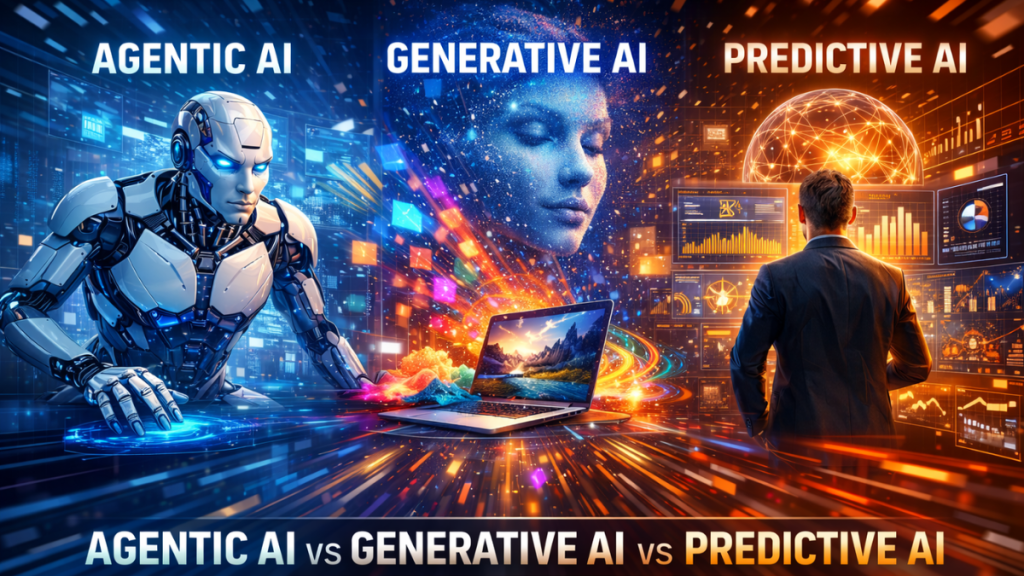
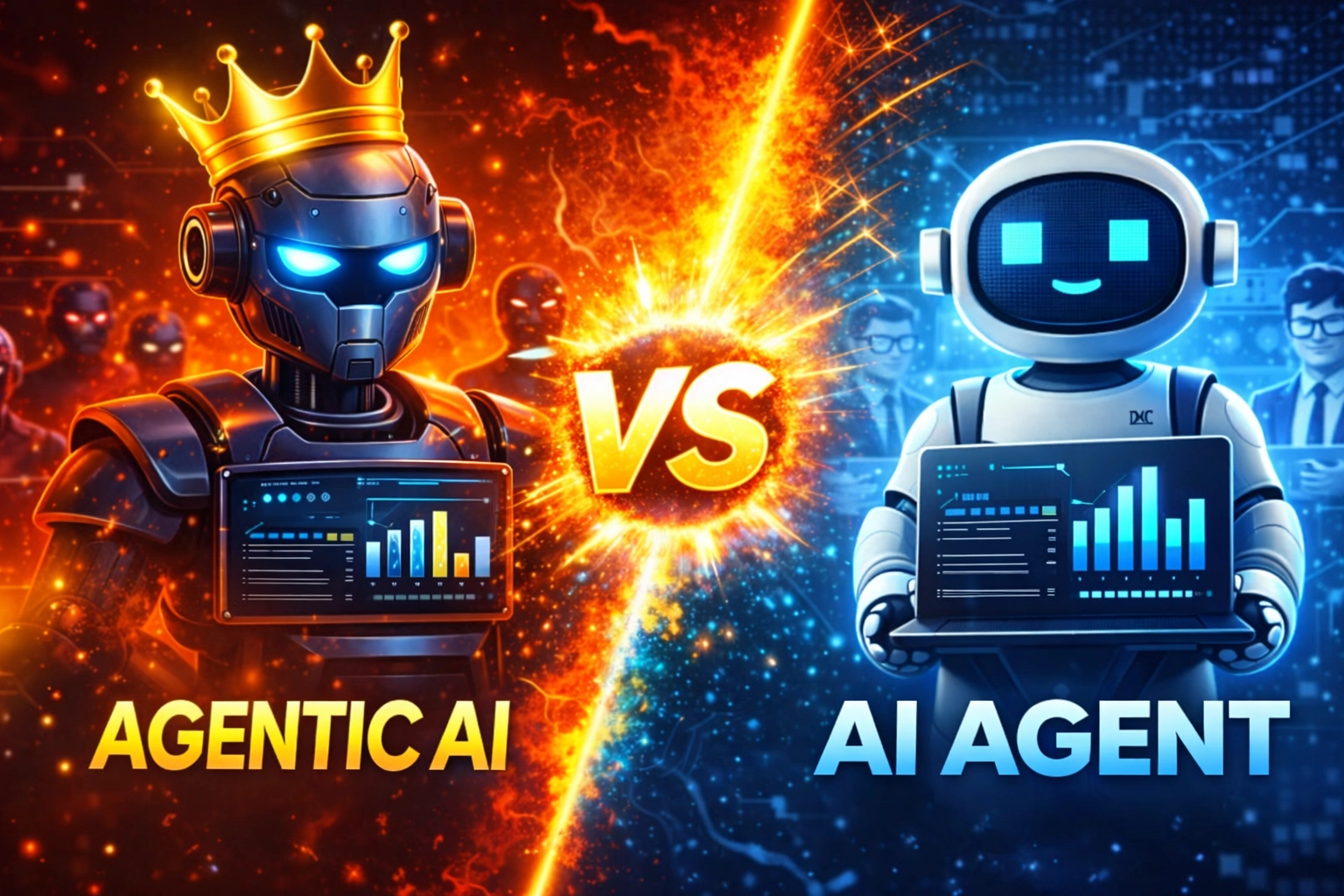
Artificial Intelligence is no longer one “thing,” but today businesses across the US, UK, Canada, Australia, and the EU are investing in the AI fields to reduce the employee and workers costs, improve decisions, and automate operations but not all AI works the same way. The biggest confusion comes from three powerful categories of Artificial Intelligence isagentic AI vs generative AI vs predictive AI
So what is the real difference between these terminologies in the AI environment and which one should you use for your product, business, or career strategy? The most ambiguous question is present in the mind people.
This guide break down the complete explanation about the ambiguous part of AI which is agentic AI vs generative AI vs predictive AI in step by step with real-world examples, key benefits, and how these systems are being adopted now globally in the high-value AI industries like enterprise software, cloud computing, fintech, and healthcare.
Table of Contents
Agentic AI vs Generative AI vs Predictive AI (Quick Comparison)
Before we go deeper into the main topics, which are based on Agentic AI vs Generative AI vs Predictive AI, so before going into the details here is a simplest way to understand all of them:
Predictive AI which forecasts that what will happen next (based on past data)
Generative AI which creates the new content (text, images, code, audio)
Agentic AI which takes action to achieve a goal (plans + executes tasks)
Simple Table for Agentic AI vs Generative AI vs Predictive AI
This simple table demonstrates the short form of the understanding about Agentic AI, Generative AI, and Predictive AI, which is given below:
AI Type
What it does
Best for
Typical Output
Predictive AI
Predicts outcomes
forecasting, risk scoring
probabilities, trends
Generative AI
Generates content
writing, coding, design
text, images, code
Agentic AI
Executes multi-step goals
automation, operations
completed tasks, workflows
What Is Predictive AI?
A type of artificial intelligence which uses historical and real-time data to forecast the future outcomes is known as Predictive AI.
Explanation:
By analysing patterns and trends in past and current data, it enables the organizations to anticipate events before they occur. Predictive AI systems are commonly implemented and built using machine learning (ML) models such as regression, decision trees, gradient boosting, and deep learning.
Why Predictive AI Matters
The real value and importance of the predictive AI is present in its ability to turn data into actionable insight. All digital businesses are now using predictive models to answer critical questions such as:
Which customers are likely to cancel in the next month?
Which transactions show signs of fraud?
How many units should be stocked for the next quarter?
By providing the reliable forecasts, then the predictive AI will help organizations to reduce risk, to optimize resources, and to improve strategic planning.
Example of Predictive AI
Thus, for example, a financial technology company based in the UK may employ a predictive AI to create a risk scores for loan applicants based on their income patterns, repayment patterns, and macroeconomic indicators, thereby providing valuable insights which is useful and help lenders to make more informed credit decisions while managing risk effectively.
Strengths and Limitations
The biggest strength which is associated with predictive Artificial Intelligence is it has a high level of accuracy and strong decision-support capabilities. However, it is important to note that the predictive AI does not generate content or act autonomously, but it provides the information through different insights which inform humans or decision makers to take actions before the problem occurs.
What Is Generative AI?
A type of an artificial intelligence which is specifically designed to create new content rather than to predict numerical outcomes is known as Generative AI.
Generative AI gives and generates original outputs such as text, images, code, and designs based on learned patterns from large datasets.
Most of the modern generative AI systems are powered by large language models (LLMs) or diffusion models, which enable them to create and produce human-like text, images that are realistic, and among other creative assets.
Common Applications of Generative AI
Used for Marketing like Blog posts, ad copy, and email sequences
Used for Engineering like Code generation, debugging, and technical documentation
Used for Customer Support, like AI chatbots and self-service help systems
Used for Design like Image generation, creative assets, and early-stage prototypes
Why Generative AI Is Booming?
Generative AI is popular now because it boosts the productivity quickly and generates the result according to the human needs. Many teams and groupmates use it to significantly reduce the time spent on:
Writing reports and content
Drafting sales and marketing materials
Coding repetitive features
Summarizing meetings and documentation
This allows professionals to be more productive by focusing their attention to more valuable work.
Example of Generative AI
A software-as-a-service company based in Canada may utilize a generative artificial intelligence for the development of its onboarding messages, writing its articles for customer support, and creating its product release notes, which would ultimately help the company develop its scale content with the least addition to its headcount.
Strengths and Limitations
The primary and core strength of the generative AI model is its capacity for generation and enhancing creativity at a large scale. In addition to that, generative AI may occasionally produce a response that may sound correct but is subsequently incorrect and inaccurate without appropriate guidelines from a human.
What Is Agentic AI?
A new type of an artificial intelligence which is designed to plan, decide, and take action on its own to achieve a goal, is known as Agentic AI.
While instead of just answering the questions or generating text, agentic AI systems can actually run tasks and complete workflows end-to-end.
This shift is one of the biggest trends in AI adoption in today era, especially in the enterprise automation, operations, and high-scale businesses.
How Agentic AI Is Different from Generative AI
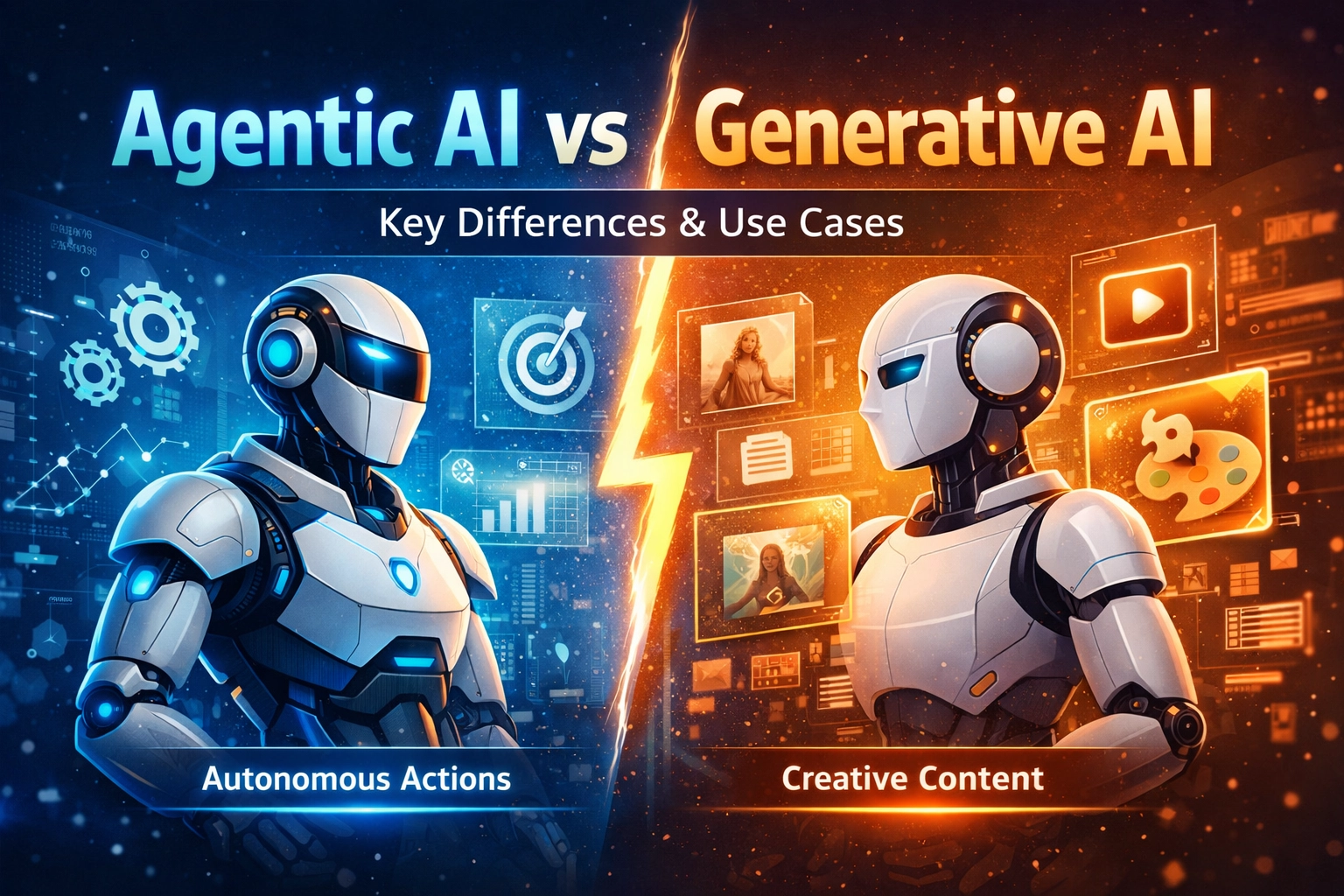
Generative AI responds to prompts while Agentic AI goes further.
Think of generative AI as a smart assistant that give you suggestions while Agentic AI acts more like a digital operator that gets things done.
An agentic AI system can:
Break a big goal into smaller tasks
Gather and analyze information
Use tools like APIs, browsers, and internal systems
Retry steps if something fails
Complete full workflows without constant human input
That is why the agentic AI is often described as autonomous AI agents rather than a simple chatbots.
Common Agentic AI Use Cases
Agentic AI is already being used in industries where speed, accuracy, and automation matter most:
In IT Enterprise used for incident resolution and access provisioning
In Fintech operations used to check compliance and fraud investigations
In Cybersecurity used to alert, triage and automated response
In Sales operations used for outbound sequencing and CRM updates
In Cloud operations used to auto-scaling recommendations and execution
These use cases show how the agentic AI moves beyond content generation into real operational work.
Example of Agentic AI in Action
Here is a practical example of the Agentic AI is given below:
An Australian enterprise might deploy an agentic AI system to handle customer support operations. The AI agent could perform these:
Monitor incoming support tickets
Detect urgent or high-priority issues
Pull relevant customer and account data
Draft a response for the customer
Escalate issues to engineering when needed
Automatically create a Jira ticket
This is not just AI generating text but it is AI executing business processes across multiple systems.
Benefits and Limitations of Agentic AI
The biggest advantage of the agentic AI is the automation at large scale. By handling entire workflows, these systems significantly boost productivity and reduce the manual effort of humans in an industry.
So the agentic AI requires strong controls, including proper permissions, security policies, and audit trails. Because these systems can take real actions, governance and oversight are critical.
Why Agentic AI Matters
Agentic AI represents the next evolution of artificial intelligence which is moving from the “assistive AI” to autonomous, action-driven systems. For enterprises looking to scale operations and to reduce friction, the agentic AI is quickly becoming a competitive advantage.
The main point is to note that not all AI is built for the same job. Every job has a different nature of workflow, so to decide or give an outcome according to the nature of the job, then one must first learn which type of AI is required for that job. For all businesses, the real value comes from understanding that what each type of AI actually does and when to use it.
Here is a brief overview of all three categories of Artificial Intelligence which matter most for today’s modern age and era.
1) Predictive AI: Probability-Based Decision Making
The Predictive AI entirely focused on forecasting “what will likely to happen next” based on the past data and patterns.
Predictive AI works best when your core question is based on: “What is likely to happen next?”
Common examples which are including credit risk scoring, demand forecasting, churn prediction, and fraud detection.
2) Generative AI: Content Creation and Communication
The Generative AI is all about creating and transforming content. It does not make decisions or take action but it helps humans to communicate faster and more clearly.
Generative AI can produce:
Text, code, and images
Summaries, explanations, and rewrites
This type of AI shines when your question is: “Can you create or rewrite this for me?”
Commonly use cases include marketing content, customer support responses, documentation, and software development assistance.
3) Agentic AI: Autonomous Workflow Execution
The Agentic AI goes a step further by taking action on your behalf. Instead of just giving insights or generating content, it executes the full workflows using tools and systems.
Agentic AI systems can deliver:
Completed tasks
Automated workflows across multiple tools
That’s just the right way to ask a question like “Can you do this entire process for me?”
Common examples it may include handling support tickets, automating IT operations, Sales Management, or other complex business process management flows.
Why This Difference Matters
This Difference Matters is significant for most businesses because the significant returns can be derived by integrating and combining all three types of AI, like using predictive AI to forecast outcomes, generative AI to communicate, and agentic AI to act and execute.
When seeking to understand these key differences, it helps teams to invest in the right tools, also set realistic expectations, and unlock the real and actual operational impact.
Which AI Should You Use? (Practical Guide)
The AI is not one single tool anymore in this advanced and modern era. It is a growing toolbox, and choosing the right type of AI depends less on the famous and trends but more on the outcome you want for your business or for boosting your organization.
If you are wondering about that from where to start (or what to add next), well, here is a simple way to think about it.
Using Predictive AI when You need clarity for the future outcomes
Predictive Artificial Intelligence is really just about patterns and probabilities, and smart business decisions based on historical patterns or your past data, and tells you what is likely to happen next, so you can act before problems get expensive and occur.
Use Predictive AI if your goals include the following:
Forecasting and planning such as (sales, demand, capacity)
Reducing risk factors like these fraud, customer turnover, and non-compliance.
Decision intelligence dashboards which guide leadership with data-backed insights
If your business needs to ask a lot of questions like this form of “What’s coming next?” questions, this is your foundation.
Use Generative AI when speed and scale matter
Generative AI is the creator. It writes, designs, summarizes, and builds fast. This is the AI most people recognize, but its real value shows up when volume and consistency are critical.
Use Generative AI if you need:
Content at scale (blogs, ads, emails, scripts, documentation)
Knowledge base and support automation for employees or customers
If your team spends too much time producing, rewriting, or explaining, Generative AI gives that time back.
Use Agentic AI when work needs to actually get done
Agentic AI does not just suggest but it also acts. It connects tools, follows steps, and executes workflows with minimal human intervention.
Use Agentic AI if you want:
Operational automation tools like (CRM, ERP, email, analytics)
Multi-step process execution without manual handoffs
AI copilots that take real action, not just give advice
If your main issue is getting things done rather than generating ideas, this is where automation can lead to real change or transform everything according to your expectations.
What leading enterprises are doing right now
Many High-performing teams are not choosing just one type of AI but they are layering them or combining them for best result and accuracy.
A common real-world strategy looks like this:
Predictive AI identifies the risk or opportunity
Generative AI creates the message, report, or response
Agentic AI executes the workflow across systems
This layering and combining approach is increasingly being adopted in different regions of the US and EU, particularly in industries which have maximum and high ROI on automation, like finance, healthcare, logistics, retailers, and SaaS.
The takeaway
The question isn’t “Which AI is best?” but it is about “What outcome do we want?”
When used together, AI stops being a tool but starts acting as a system.
Adoption Trends and Business Value
AI investments are continuing and gradually increasing globally because the ROI is measurable in the following:
productivity
cost reduction
faster decision cycles
better customer experience
For example:
Predictive AI which can reduce fraud losses and improve underwriting accuracy in the fintech.
Generative AI which can shorten content and software cycles dramatically.
Agentic AI which can automate repetitive operational work and reduce ticket backlogs.
In enterprise environments, the biggest focus areas are now:
security and governance
accuracy and monitoring
compliance and audit logging
privacy and data residency (especially relevant in the EU)
Conclusion:
Understanding the best one, agentic AI vs generative AI vs predictive AI helps you to choose the right technology and to avoid the most expensive mismatches.
If your priority is specifically on forecasting and risk scoring, then start with predictive AI.
If your priority is completely on content creation and productivity, adopt generative AI.
If your priority is completely based on end-to-end automation, then invest in agentic AI with strong governance.
The highest value propositions for most businesses and organizations in the US, UK, Canada, Australia, and the EU, is from combining them: predictive insights + generative output + agentic execution. That is where modern enterprise AI is heading and where high-impact careers and products are being created now.
FAQ (Featured Snippet + Voice Search Ready)
1) How is agentic AI different from generative AI?
Agentic AI takes actions to complete tasks (plans + executes) at the other end generative AI creates content like text, images, or code. Agentic AI = execution Generative AI = creation
2) Which one is better or best between predictive AI and generative AI?
No one is universally “better AI” but it depends on your goal, which one is useful for you: Choose predictive AI for forecasting and risk scoring Choose generative AI for content creation and productivity
3) Should I use agentic AI in my business today?
You should consider and have priority for agentic AI if you have: repetitive operational workflows, clear task boundaries and permissions, and strong compliance requirements Agentic AI works best when paired with logging, approvals, and human oversight.
4) Which AI is best for fintech and financial services?
Most fintech teams use a combination of: Predictive AI for fraud detection and credit risk Generative AI for reporting and customer support Agentic AI for compliance workflows and case investigation automation
5) How do AI agents work in enterprise software?
AI agents typically perform the following: interpret a goal, break it into steps, call tools (APIs, CRMs, ticketing systems), verify progress, and complete the workflow automatically