The AI, which stands for Artificial Intelligence, it is no longer bounded only to large corporations with huge budgets, but a small business can use AI tools to automate those tasks which are repetitive, also improve customer experience, and monitor and scale all operations within or outside the organization without hiring large teams.
The best AI tools for small businesses are helping in Automation like to automate marketing through AI, customer support, content creation, and even data analysis, which allows business owners to focus on the best strategy and choose growth instead of manual work.
2) What AI Tools Mean for Small Businesses
AI tools are the software platforms which use machine learning models, automation, and data analysis to perform tasks which were previously required human effort in early times.
Now, for small businesses, these tools typically help with:
content creation and marketing
customer support automation
workflow productivity
sales optimization
data insights and forecasting
Instead of replacing employees, guide them or train them about the AI tools because these AI tools usually act as productivity multipliers, which helping small teams to accomplish far more with limited resources.
3) How to Choose the Right AI Tool
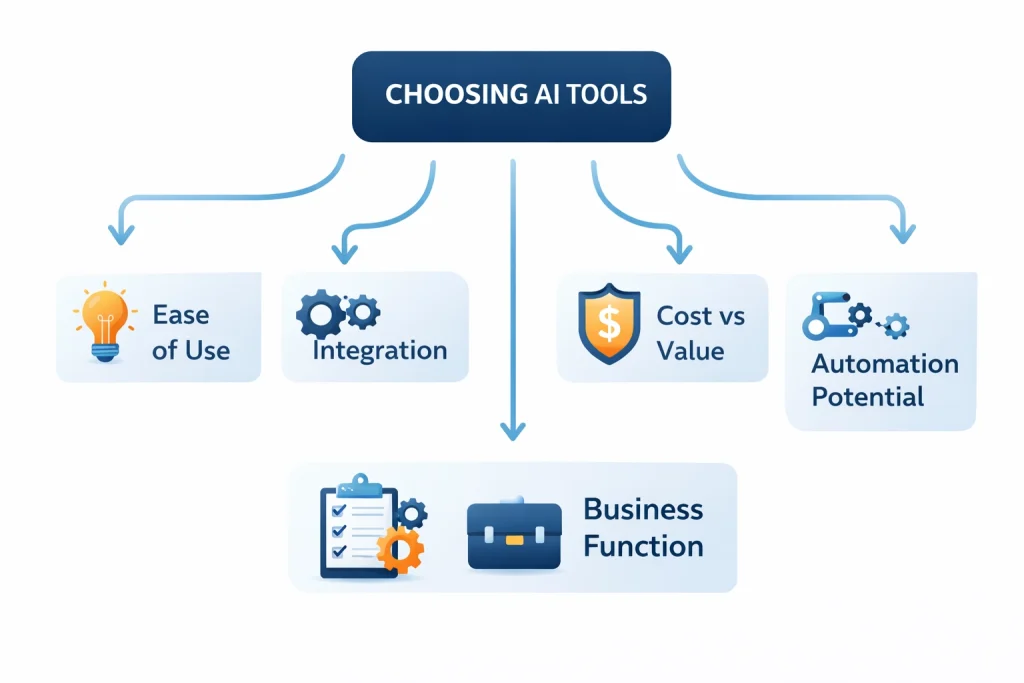
When you want to boost up your small business, then a very complicated question arises: “Which is the right AI tool?” to boost my business, because not all AI tools are useful for every business. The right choice depends on the nature of your business, workflow, budget, and growth goals.
When evaluating tools, consider these factors which are necessary for the best choice:
Business function: marketing, operations, analytics, or customer support
Ease of use: whether non-technical teams can operate it
Integration: compatibility with existing software
Cost vs value: pricing relative to productivity gains
Automation potential: how much time it can save
Many businesses fail with AI adoption because they choose tools based on the hype rather than specific operational needs, which leads them to failure.
4) Best AI Tools for Small Business (Top Picks)
Here are some of the most practical, widely adopted, and usable AI tools across key business functions are given below:
ChatGPT is one of the most versatile AI tools for small businesses, which may help with common uses include:
writing blog posts
generating marketing copy
drafting emails
brainstorming ideas
and many more things
It significantly reduces the content creation time and helps small teams to maintain consistent marketing output in less time with minimum human effort.
Jasper is designed specifically for marketing teams and content creators, which is very valuable for them. The following characteristics of Jasper AI are given.
Key features include:
AI marketing copy generation
blog writing assistance
brand voice customization
SEO content workflows
This tool is ideal for businesses to produce large volumes of marketing content based on the needs.
4.2) AI Customer Support Tools
4.2.1) Intercom AI
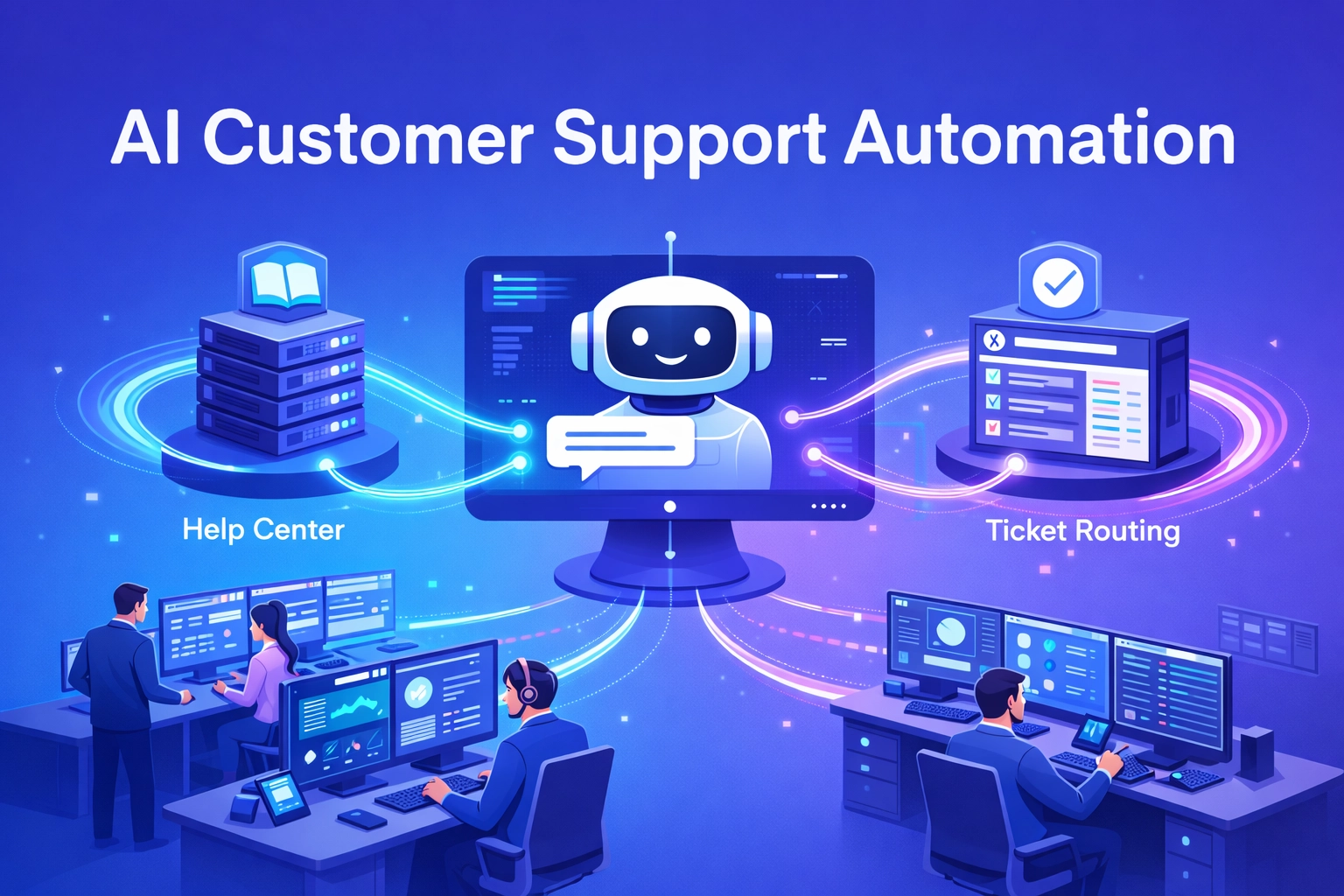
Intercom is an AI Customer Support tool which combines customer messaging with AI automation to automate easily and provide convenience to the customers.
The capabilities of Intercom AI include:
AI chatbots
automated support responses
customer conversation analysis
help center automation
Small businesses can use Intercom AI to reduce support workload while maintaining fast response times to customers without delaying them.
4.2.2) Tidio AI Chatbot
Tidio provides and is responsible for AI-powered live chat for websites and e-commerce stores.
Key benefits are given below:
automated customer responses
lead generation
product recommendation bots
integration with ecommerce platforms
It is particularly useful for those stores which are online and online service websites.
4.3) AI Marketing Automation Tools
4.3.1) HubSpot AI
HubSpot is the best AI marketing tool, which integrates the AI into its marketing and CRM platform.
It helps businesses to:
automate email marketing
generate content ideas
analyze customer data
personalize marketing campaigns
The platform is especially powerful for growing businesses managing multiple marketing channels.
4.4) AI Productivity Tools
4.4.1) Notion AI
Notion AI is a productivity tool that enhances the popular productivity workspace.
Features include:
AI writing assistance
meeting summaries
task automation
knowledge management
It helps to small teams which can centralize documentation, planning, and collaboration.
4.5) AI Data & Analytics Tools
4.5.1) Pecan AI
Pecan AI is a data analysis tool which completely focuses on the predictive analytics for businesses without data science teams.
It allows companies to:
predict customer churn
forecast sales
analyze marketing performance
identify growth opportunities
For data-driven businesses, this type of AI can unlock valuable strategic insights for the upcoming future.
5) Comparison Table of the Best AI Tools
Tool
Best For
Key Strength
Typical Pricing
ChatGPT
Content & research
versatile AI assistant
Freemium
Jasper AI
Marketing content
brand-focused AI writing
$49+/month
Intercom AI
Customer support
automated conversations
$39+/month
Tidio
Website chatbots
ecommerce support automation
$29+/month
HubSpot AI
Marketing automation
integrated CRM platform
Free + paid tiers
Notion AI
Productivity
workspace automation
$10+/month
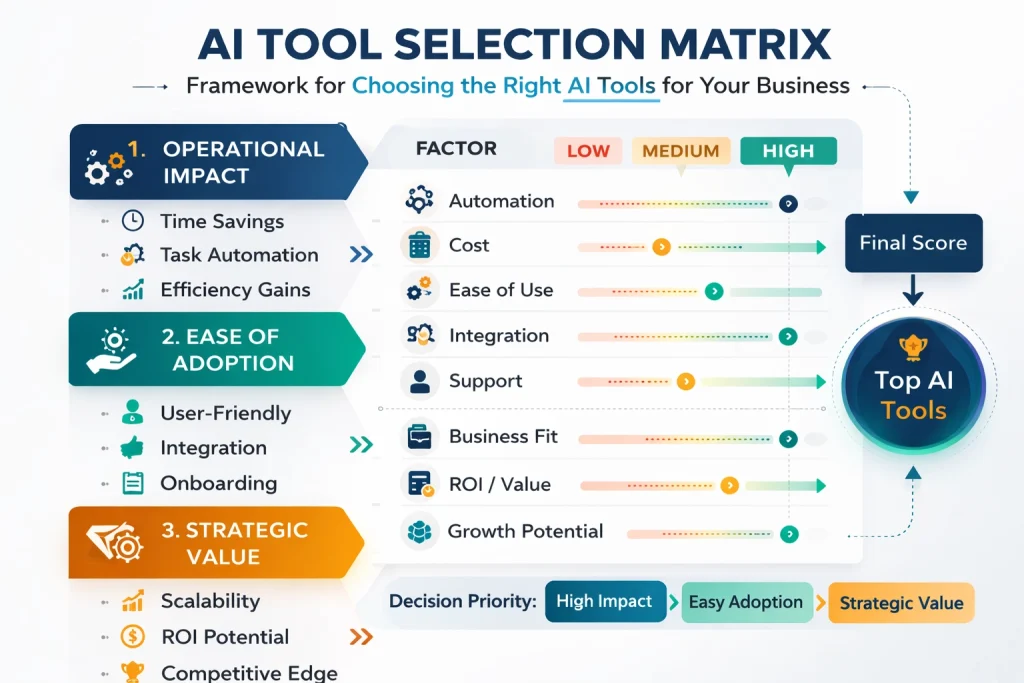
6) The Small Business AI Tool Selection Matrix (Original Framework)
Choosing the best AI tools becomes easier when your businesses evaluate them across three decision layers. The three decision layers are the following:
6.1) Layer 1 — Operational Impact
How much time does the tool save for the business and also for the customer?
Low impact: minor productivity gains
Medium impact: workflow automation
High impact: major operational transformation
6.2)Layer 2 — Ease of Adoption
How quickly can the team start using it to grow easily?
plug-and-play tools
tools requiring training
tools requiring technical integration
6.3)Layer 3 — Strategic Value
Does the tool create long-term competitive advantage?
Examples include:
data insights
marketing personalization
predictive analytics
Those Tools which scoring highest across all these three layers usually deliver the strongest ROI for small businesses.
7) How Small Businesses Should Implement AI Tools
Many companies struggle with AI adoption because they try to automate everything at once. To implement AI Tools smartly, there is a need for the best approach to avoid any mistakes for the growth of the business.
A smarter approach involves the gradual implementation instead of direct or fast implementation without knowing the nature of the tool or business.
7.1) Phase 1 — Start With One Business Function
Focus on one high-impact area such as:
marketing
customer service
content creation
7.2)Phase 2 — Measure Results
Track the required aspects for the business, like:
Once the team becomes comfortable with the AI tools and understand tools deeply for their needs, so expand to other departments.
This step-by-step and incremental approach reduces risk and improves adoption success even for small businesses.
8) Quick Summary: Best AI Tools for Small Businesses
AI tools help small teams to scale productivity without hiring a large staff
The most useful categories include content, marketing, support, and analytics
Businesses should evaluate tools using impact, ease of adoption, and strategic value
Start with one automation area, then expand gradually
AI works best when integrated into existing workflows
9) Frequently Asked Questions
9.1) What are the best AI tools for small businesses?
The best AI tools for small businesses depend on the business function and its nature. ChatGPT and Jasper help with content creation, HubSpot supports marketing automation, and Intercom or Tidio improve customer support through AI chatbots.
9.2) Are AI tools affordable for small businesses?
Yes. Many AI platforms offer premium or low-cost plans which is specifically designed for startups and small businesses. The small and low-budget companies can start with free versions and upgrade as their needs grow.
9.3) How can small businesses start using AI?
Small businesses can start using AI by identifying their repetitive tasks such as writing emails, answering customer questions, or analysing marketing data. Then implement a simple AI tool which automates that specific workflow.
9.4) Do AI tools replace employees?
The most debated question in 2026 or in the future is “will AI replace humans or employees?” in most cases, the AI tools augment employees rather than replace them. They handle repetitive work while humans focus on strategic decisions, creativity, and customer relationships, so this combination will give better results.
9.5) Is AI difficult to implement in a small business?
No, AI is not difficult to implement in a small business because most modern AI tools are designed in such a way that non-technical users can use them easily. Many platforms require little setup and integrate easily with common business tools such as CRMs, email platforms, and productivity apps.
10) Conclusion
Artificial intelligence has become one of the most powerful and growth tools available to small businesses to grow easily. Instead of requiring large technical teams, all modern AI tools and platforms allow users and companies to automate marketing, streamline customer support, and improve productivity with minimal setup.
The key to success in this modern and digital era is not adopting as many AI tools as possible but choosing the right one tool among the other tools which solve real operational problems. By using and evaluating tools through the Small Business AI Tool Selection Matrix the impact, ease of adoption, and strategic value, business owners can identify solutions that deliver meaningful results for their businesses.
Firstly, start with one high-impact area, measure the benefits, and gradually expand AI adoption across your business for easy growth in this modern era. Over time, these tools can significantly increase efficiency and help small businesses to compete with much larger organizations.