
Table of Contents
Introduction
In today’s modern era, the Customer support has become one of the most compulsory and complex operational challenges for growing companies.
As businesses grow from a normal state, alternatively, the number of customer support requests increases quickly. This makes it hard and difficult for the company teams to keep response times fast and maintain good service quality based on the customer expectations.
This is where the technology of AI customer support automation is transforming modern customer service into the real world needs to cover the sophisticated situations when needed to support a customer quickly.
Those companies that completely rely on modern technology are now using AI chatbots, intelligent ticket routing, and automated workflows to manage and easily handle thousands of support conversations with in less time without expanding their support teams.
After the implementation, the AI automation can improve:
- response speed
- operational efficiency
- customer satisfaction
But the implementation of AI successfully requires a structured strategy not just installing a chatbot.
Quick Answer
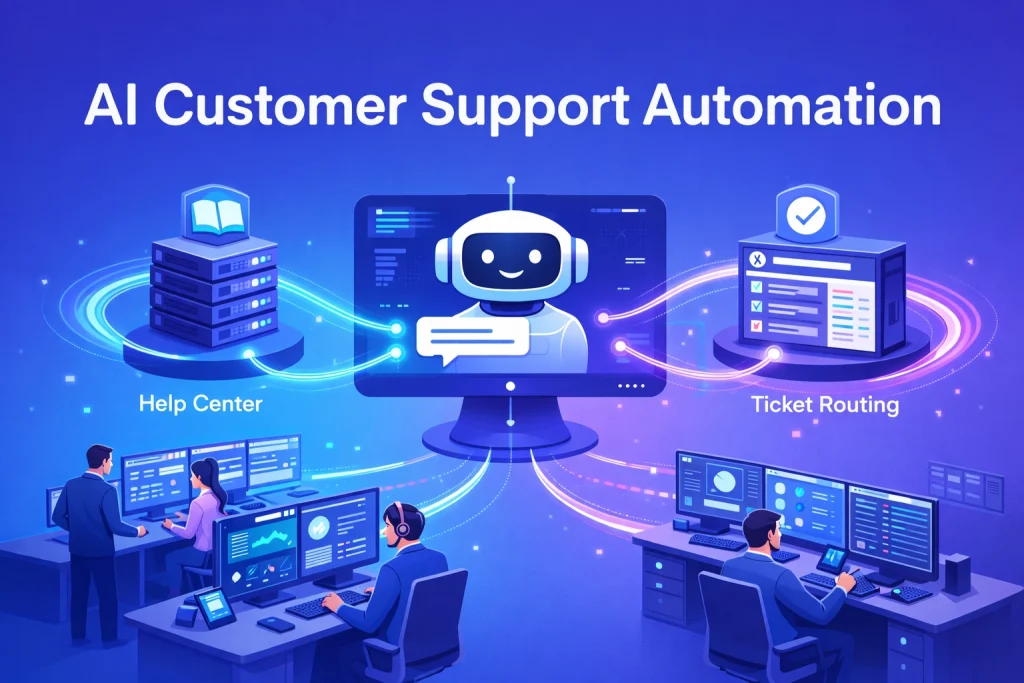
AI customer support automation use different technologies such as chatbots, natural language processing (NLP), and machine learning to automatically handle all about customer queries, route support tickets, and assist humans in a manner that feels like handled by a human. Basically, modern businesses use it to reduce response times, to handle support operations, and automate repetitive customer service tasks while keeping human agents engaged and solve complex issues.
What Is AI Customer Support Automation?
To use an artificial intelligence system to automatically handle customer service interactions and support workflows of the system is known as AI Customer Support Automation.
These systems can perform the following tasks:
- answer frequently asked questions
- route tickets to the correct team
- provide instant responses via chatbots
- recommend knowledge base articles
- assist agents with response suggestions
AI helps the agents to support those tasks which are repetitive and make the agent fast instead of replacing them. It does not replace them, but it makes their work more efficient and more valuable.
Why Businesses Are Adopting AI Support Automation
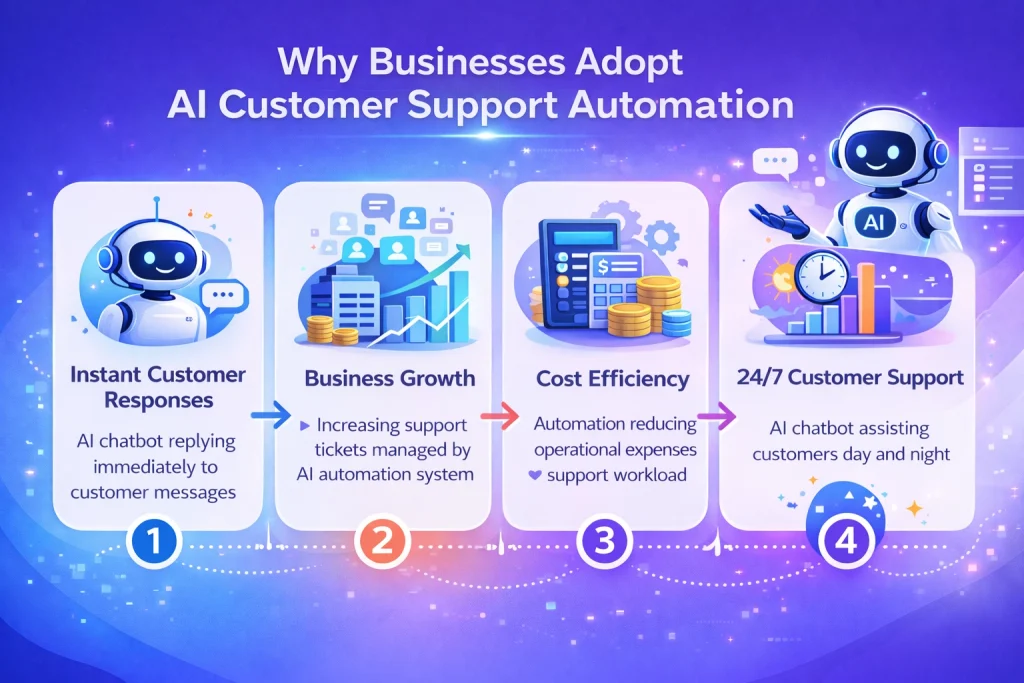
There are many reasons that Businesses Are Adopting AI Support Automation, but a few of them are mentioned below:
1. Customer Expectations for Instant Responses
In this busy and advanced era, all customers need and expect quick responses or answers from any service providers. To wait multiple hours for support responses is increasingly unacceptable, and the customer will go for other service providers. That is why quick response is now a days mandatory in this competitive environment.
2. Rapid Business Growth
The growth of business in vast areas ultimately turns into the support tickets growing exponentially. Here AI helps to the business teams to scale up without dramatically increasing hiring costs.
3. Cost Efficiency
The unexpected growth in business also needs a huge number of operational devices, which need operators, to manage properly, so here AI Automation reduces operational costs by itself, handling repetitive inquiries automatically.
4. 24/7 Customer Support
When the businesses are offline, there should be an alternative way for the users to deal with them during offline hours. All these hurdles is deals by AI chatbots to provide continuous assistance even outside working hours.
Famous Industry Insight about The Business Impact of AI Support
According to the McKinsey, AI technologies can automate up to 60–70% of routine customer service tasks in many industries, whether it is related to small or large enterprises, but AI can automate in these areas wisely.
Now the question arises that “Is AI replace human in businesses?” So, the answer is simply no; this does not eliminate human roles, but it dramatically improves productivity and scalability for an enterprise in a short time.
Those companies which successfully deploy and implement AI support automation they are often have the following benefits which are:
- lower support costs
- faster response times
- improved customer satisfaction
The AI Customer Support Efficiency Model
To implement the AI automation effectively and efficiently, businesses can follow a structured approach, which is known as The AI Customer Support Efficiency Model.
This framework divides support automation into four operational layers which are:
| Layer | Function | Example |
| Self-Service | Prevent support tickets | Help center, FAQ |
| Conversational AI | Handle simple conversations | AI chatbot |
| Smart Ticket Management | Automate internal workflows | ticket routing |
| Human Collaboration | Escalate complex issues | live agents |
These four layered models completely ensure AI automation and improve the efficiency of the services without harming the customer experience.
Step-by-Step Guide to Implement AI Customer Support Automation
We are going to discuss in details that “how to implement AI Customer support Automation?”. These are the main steps which are necessary for the implementation, which are given below.
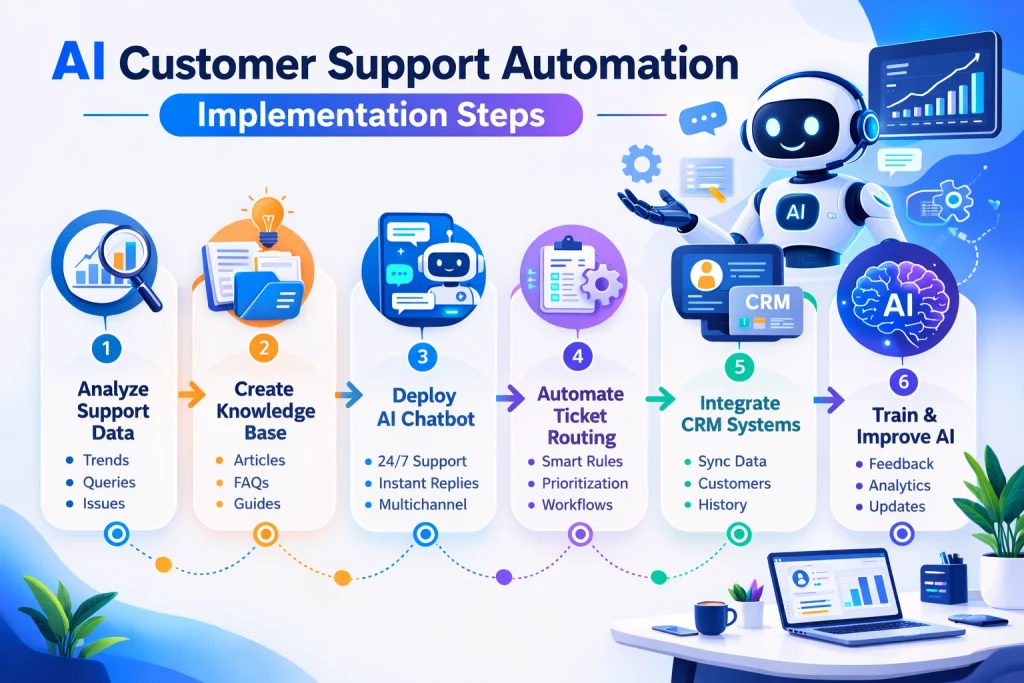
Step 1: Analyze Your Support Requests
In the first phase, start by reviewing your support data to identify the most common support requests, such as:
- order tracking
- account access issues
- billing questions
- password resets
These repetitive requests are ideal candidates for AI model or automation.
Step 2: Build a Self-Service Knowledge Base
A collection of self-service data based on your domain is the foundation for your AI automation.
Create articles that explain:
- common problems
- troubleshooting steps
- product usage instructions
When customers can solve their own problems, the number of support tickets decreases a lot.
Step 3: Deploy an AI Chatbot
AI chatbots are often the first visible automation layer for your automation using AI.
A good and well-suited support chatbot should:
- answer FAQs
- recommend help articles
- collect customer information
- escalate to human agents when needed
Popular chatbot platforms include:
- Intercom
- Zendesk AI
- Freshdesk AI
- Tidio
Step 4: Automate Ticket Routing
There are many companies that waste their time manually while sorting support tickets.
An AI model can automatically categorize incoming requests based on these:
- topic
- urgency
- customer type
- sentiment analysis
This ensures that the customer’s tickets exactly reach to the right team immediately.
Step 5: Integrate AI With Your CRM
An AI automated system can work best when connected to your existing tools.
Typical integrations include:
- CRM systems
- helpdesk platforms
- e-commerce platforms
- analytics systems
Integration enables the personalized support responses based on customer history, which acts as a backbone for this model.
Step 6: Train and improve the AI System
Gradually, AI support systems improve when there is data gathering using these systems.
Regularly review:
- chatbot conversations
- failed responses
- unresolved tickets
This feedback helps to improve training data and automation rules for easy updates in the services.
AI Customer Support Tools Comparison
Below is a comparison of popular AI support platforms.
| Platform | Key Features | Best For |
| Zendesk AI | advanced automation, analytics | enterprise teams |
| Intercom | conversational AI, messaging | SaaS companies |
| Freshdesk | AI helpdesk automation | SMBs |
| Tidio | easy chatbot builder | small businesses |
| Drift | conversational marketing and support | sales-focused teams |
Why Many Companies Fail with AI Support
Many Companies Fail with AI Support because they are assuming that installing a chatbot will automatically solve customer support problems. But in reality, the poor implementations often create worse customer experiences.
Common failures include:
- Over-automation
- Sometimes customers get trapped in chatbot loops without reaching a human.
- Poor chatbot training
- Without proper training data, AI provides incorrect answers.
- No escalation path
- Customers must always be able to reach a human agent.
The conclusion is that, in short, a successful automation combines AI efficiency with human support.
Key Benefits of AI Customer Support Automation
Those businesses which are implementing AI automation typically achieve the following benefits over traditional business methods:
- faster response times
- lower operational costs
- scalable support systems
- improved agent productivity
- better customer experience
When properly implemented, AI automation becomes a competitive advantage instead of just a cost-saving tool.
FAQ
How does AI automate customer support?
AI automates customer support using different technologies such as chatbots, natural language processing (NLP), and machine learning to automatically handle all about customer queries, route support tickets, and assist humans in a manner that feels like handled by a human.
What is the best AI tool for customer support automation?
The best AI tool depends on your business size and support needs, not a specific industry, but platforms like Zendesk AI, Intercom, and Freshdesk offer strong automation capabilities and cover the needs, which include chatbots, ticket routing, and helpdesk analytics.
Can small businesses use AI customer support tools?
Yes, small businesses can use AI customer support tools because many AI support platforms offer affordable plans which is specifically designed for startups and small businesses. Tools like Tidio and Freshdesk allow small companies to automate basic support interactions instead of without needing advanced technical resources.
Does AI replace human support, agents?
AI does not fully replace humans, but up to some limits, it may be possible if the human has no knowledge or is not ready to evolve according to the needs. AI automates the repetitive tasks while human agents focus on complex customer issues that require empathy, judgment, and deeper problem-solving techniques, which are not included in the AI sense.
Is AI customer support automation expensive?
AI customer support automation costs vary, depending on the platform and scale, or the limit of your use. Such as small business plans often start around $20–$50 per month, while large enterprise solutions can cost significantly more, depending on features and automation volume.
Conclusion
AI customer support automation is quickly becoming an essential capability and the core part for all modern businesses. By automating repetitive support tasks, companies can improve response times, which allows many users to be assisted in small time efficiently, also reduce operational costs, and deliver better customer experiences.
However, successful automation requires more knowledge and experience than simply installing a chatbot. Businesses must design a proper, structured support system that combines self-service tools, conversational AI, intelligent ticket management, and human collaboration.
Organizations which adopt this layered strategy can scale their support operations without sacrificing or losing the service quality.
For growing companies, AI-powered support is no longer just a technical upgrade, but it is a strategic advantage over traditional ones.