
Table of Contents
Overview of AI Automation for Startups:
Every startup and even all of them operate under the constant pressure of limited runways, small teams, and aggressive growth targets to scale quickly. So, traditional hiring of more people is not always workable for small businesses because manual processes can slow you down, and encounter inefficiencies quickly. That is where AI automation for startups becomes a strategic tool, but not a trend.
Modern AI tools allow startups and small businesses to automate repetitive tasks, improve decision-making, and scale operations without proportional increases in economy.
However, many founders and beginners are struggling with a key question, which is: “Where should AI automation actually start?”
This guide provides a complete and practical implementation path, including cost considerations, tool selection criteria, and a structured decision model to help founders to deploy AI automation responsibly and profitably to cover the desired results.
Whether you are building or starting a business in SaaS, fintech, e-commerce, or B2B services, this article focuses completely on execution, not on theory.

Why AI Automation Matters for Startups
Best Startups win when you have a good plan to cover all the desired steps easily, which are necessary for success with the best speed and capital efficiency. AI Automation enables small teams to operate like much larger organizations with AI.
AI automation helps in the following:
- Reduce operational overhead
- Scale workflows without increasing payroll
- Helps to improve customer response time
- Used to minimize human error in files
- Also used to unlock data-driven decision
Startups have an advantage over the larger companies, which is that they have fewer old systems in place. This makes it easier and quicker for them to implement changes, as long as the approach is well thought out.
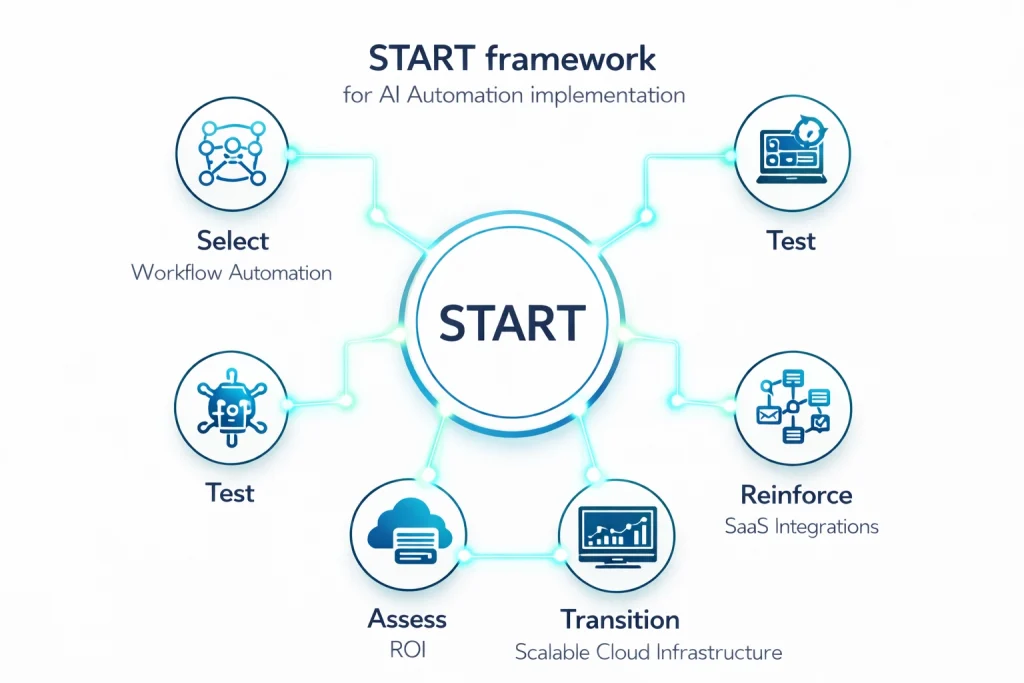
The Startup Automation Readiness Model (SARM Framework™)
Everyone should use this 4-stage framework to avoid random tool adoption, which is very necessary for scaling and growth through AI:
1) Identify High-Friction Processes
First, look for the needs:
- Repetitive tasks
- Manual Data entry
- For slow approval cycles
- For supporting a large volume of tickets
Common startup automation candidates:
- Customer onboarding
- Lead qualification
- Marketing email sequences
- Financial adjustment
- Support routing
2) Quantify Impact Before Automating
Ask:
- How many hours per week does this process consume to complete a task?
- What is the punishment in terms of cost for an error or delay?
- Does this bottleneck affect revenue?
If the automation saves less than 5 to 10 hours per week, it may not completely justify early-stage complexity.
3) Select Automation Layer
The automation layer will help you easily when there is complexity, so there are three automation layers:
| Layer | Example Use Case | Complexity | Cost |
| Task-Level | Email replies, data tagging | Low | Low |
| Workflow-Level | Lead → CRM → Email → Follow-up | Medium | Medium |
| Decision-Level | Predict churn, dynamic pricing | High | High |
Every and all early-stage startups should begin at the task or workflow level before moving to the predictive systems because when you understand the basic level, then you can achieve easily the higher level easily of the Automation.
4) Pilot Before Scaling
Before scaling so at least run a 30–60-day pilot to ensure your framework is workable or not:
- Measure the time which is saved
- Track and find out the cost reduction
- Monitor and point out error rates
- In last gather team feedback about the process
Only scale after measurable When ROI is confirmed.
Where Startups Should Apply AI First: Use cases of AI automation
Basically, startups focus on automation of high-frequency, repeatable workflows. That is why here we are going to discuss how Common Startup Functions That Benefit From AI Automation.
1. Customer Support Automation
AI chatbots and automated ticket systems can resolve many customer issues quickly at the same time mean at the instant. AI-powered chat systems can do these:
- Answer FAQs
- Route tickets
- Provide 24/7 responses
- Order tracking
This completely reduces the support headcount pressure from them while improving response times.
2. Sales & Lead Qualification
AI-driven marketing automation tools which help to startups to manage campaigns more efficiently. Automated scoring systems can do these:
- Prioritize high-intent leads
- Reduce manual screening
- Increase the transition and conversion efficiency
SaaS startups for B2B often produce the fastest ROI.
Automation for Sales Pipeline:
CRM platforms are now integrated with AI to automate and follow up, lead qualification, and pipeline forecasting, which allows the sales teams to focus on closing deals rather than administrative tasks.

3. Marketing Workflow using Automation
Automation in marketing can be done like:
- Email sequences
- Ad specification and optimization
- Content repurposing
- Performance reporting
Marketing automation improves scalability without adding marketing staff which is very beneficial for small startups.
4. Internal workflow
Automation tools can also handle internal workflows to optimize, such as the following activities:
- Hiring screening
- Expense categorization
- Document handling and processing
- Financial prediction and forecasting
Operational automation increases the investor confidence for small startups because it demonstrates scalability and discipline.
Cost Considerations: What Startups Must Budget For
AI automation is not “free efficiency,” but costs are included such as:
- SaaS subscription fees
- API charges
- Costs of cloud computation
- Time of Integration and development
- Support and Maintenance
Early-stage startup automation stacks typically range:
- Lean setup: $200–$800/month
- Growth-stage setup: $1,000–$5,000/month
- Advanced AI modelling: significantly higher depending on data volume
Always compare automation cost against:
- Equivalent salary expense
- Delay in Opportunity cost
- Revenue acceleration potential
Common Mistakes in AI Automation
1) Automating Broken Processes
If your workflow is poorly designed, manually it will be completely inefficient, and automation will amplify the inefficiency.
Fix the process first means startups should first optimize processes before automating them
2) Over-Automation in Early satge
In the early stage, using too many automation tools can make things complicated for your startup. If you are still figuring out if your product fits the market, basically, you should focus on learning instead of optimizing. Choose platforms that can do multiple tasks and work well with each other.
3) Ignoring Data Quality
AI-driven systems completely rely on clean data not on messy data which can lead to poor consequences if the data is messy. Critical areas such as customer relationships and strategic decisions still require human involvement. Poor CRM hygiene can destroy automation accuracy.
Beginner vs Advanced AI Implementation Path
| Early-Stage Startups (Pre-Series A) 1) Should focus on workflow automation 2) Use no-code tools 3) Avoid building custom AI models 4) Target operational efficiency | Growth-Stage Startups (Series A+) 1) Implement and unite predictive analytics 2) Should automate churn prediction 3) Use AI for pricing optimization 4) Connect multiple SaaS systems |
Enterprise vs Startup Perspective
Enterprises automate for cost reduction. While Startups automate for scalability, which is a critical difference. Your goal isn’t replacing employees, but it is extending team capacity without burning runway.
Measuring ROI of AI Automation
Track:
- Time saved per week
- Revenue per employee
- Response time of the Customer
- Percentage of an error reduction
- Per customer operational cost
If automation doesn’t improve at least one of these metrics within 60–90 days, reassess.
Conclusion
AI automation can help to startups to grow by making their process more effective and efficient. It is not about chasing and following trends, but it is important to build a system that can grow effectively at the initial stage.
By automating those tasks which are repetitive, startups can save resources and make better decisions, which help them to grow faster.
However, to implement AI successfully, it requires strategic planning instead of using or adopting new tools.
Startups should focus on identifying key tasks like high-impact workflows, try out small automation projects, and measure results carefully before applying automation across the organization in large scale.
It is also important not to complicate things with other tools. Focus on processes that boost revenue, improve customer experience, or enhance efficiency.
In the next decades, the most successful startups will not be those that have the biggest teams, but those that know smart automation.
Start small. Measure carefully. Scale deliberately
FAQ Section
1. How should a startup begin to implement AI automation?
Start firstly to find the repetitive tasks which consume enough time of the team. And quantify their cost and impact also for understanding, then first implement automation at the workflow level, run a 30–60 day as a test, and measure ROI before scaling.
2. Is AI automation in early-stage for startups can be expensive?
It depends on the scope of the startups; basic workflow automation may cost $200–$800 per month, approximately, not exactly. The advanced predictive analysis systems cost significantly more than the normal ones. The key is to compare automation costs to salary savings or revenue acceleration, which is a great choice to clarify everything easily.
3. Which areas and use cases can deliver the fastest ROI from automation?
The areas and use cases which can deliver the fastest ROI from automation are these: Customer support, lead qualification, and marketing workflows often generate the fastest returns. This use cases make directly impact on revenue and operational scalability, and make ROI measurable within 60–90 days, possibly.
4. Should startups develop their own custom AI models or not?
According to the experts, the early-stage startups typically should not develop their own custom AI models because the custom models require clean data, data engineering resources, and ongoing maintenance and support are also necessary. Also, use proven and best SaaS automation tools first before in investing in the advanced AI development.
5. What is the biggest mistake that startups make with the AI automation?
The biggest mistake that startups make with the AI automation is automating inefficient processes. The AI Automation should improve a well-designed workflow when you use it properly. If the system has flaws or a lack of proper planning or well structure, AI will make the problem worse instead of fixing it.