Quick Answer:
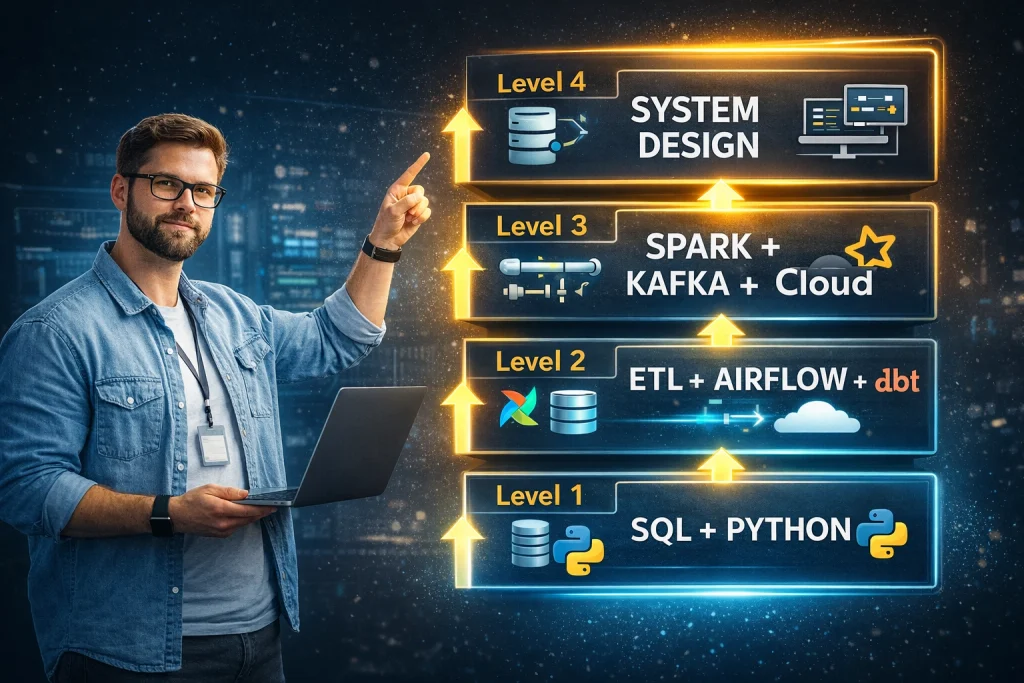
The data engineer roadmap in 2026 starts with fundamental skills, which are SQL and Python, and then proceeds into the ETL pipelines, data warehousing, and cloud platforms. To become job-ready, you should build real-world projects, learn big data tools like Spark, and focus on system design.
Table of Contents
Data Engineer Roadmap Summary (2026)
| Stage | Focus | Tools |
| Beginner | SQL, Python | PostgreSQL, Pandas |
| Intermediate | ETL, Warehousing | Airflow, dbt |
| Advanced | Big Data, Cloud | Spark, Kafka |
| Expert | System Design | Distributed systems |

What Does a Data Engineer Actually Do in the Real world of data?
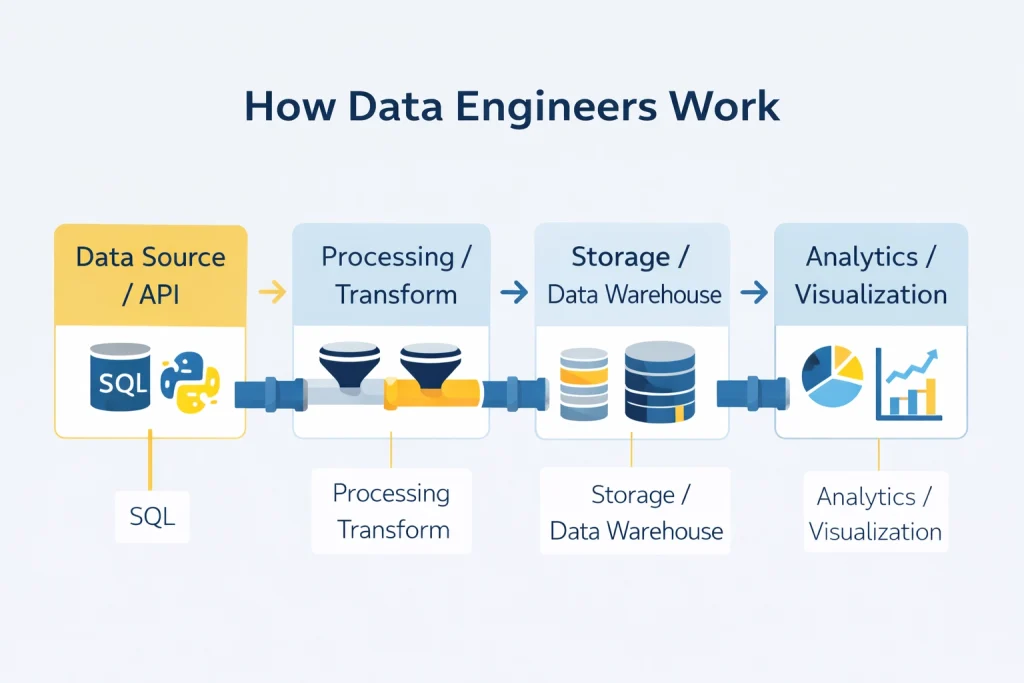
Data engineers build and maintain the pipeline systems, which can easily perform data movement, clean it, and store data for the purpose of analysts and scientists so that they can use it based on their needs.
Think of it this way: “If data is water, a data engineer builds the pipeline systems, in which data moves and filters easily.”
In the real world, as a data engineer, each day:
- Debugging a broken Airflow DAG,
- Optimizing and improving a slow SQL query in Redshift, or
- Designing a new pipeline from a third-party API.
My main focus is not about analysing trends but about making sure data arrives on time, in the right format, and without breaking.
The job sits at the intersection between software engineering and infrastructure, and that is what makes it interesting.
How Is Data Engineering Different from Data Analysis and Data Science?
The following discussed questions will clarify everything in detail, so let’s try to start one by one
Data Engineering Different from Data Analysis and Data Science due to the following reasons:
- Data analysts ask, “What happened?” Also, analysts use tools like Tableau and Excel
- Data scientists ask, “What will happen?” Also, scientists use Python notebooks and ML models.
- Data engineers ask, “How do we get the data there in the first place?” and Engineers write production pipelines that feed both of them. It is a builder type and more of a plumbing role instead of making a dashboard.
If you enjoy building systems more than creating dashboards, data engineering is a better fit and a well-suited job for you.
How do Data Engineers work daily?
Data Engineers Solve Daily different types of problems like:
- Missing data records,
- pipeline failures,
- schema drift, and
- Slow queries are eating up cloud costs
That is basically the main job of a data engineer in a nutshell.
For example, a common headache is when an upstream API changes its response format, and your pipeline silently starts dropping fields. Engineers fix that by adding validation layers and alerts. The work is reactive and proactive:
- You are patching problems today while designing better architecture for tomorrow.
Why Should You Choose Data Engineering as a Career in 2026?
Choosing Data Engineering as a Career in 2026 or beyond, so there are two main reasons which are:
- “Demand”
- “Salary”
Is Data Engineering Still in Demand?
Yes, Data Engineering is still in demand, and it is not going to slow down, but it is growing faster than normal.
Every digital company depends on data; there are needs of someone to move and manage it reliably. Roles in data engineering have expanded well beyond big tech, such as healthcare, finance, logistics, and e-commerce; they all need pipeline engineers.
The more companies adopt real-time analytics and AI, the more the underlying data infrastructure matters.
Engineers who understand both the code and the systems behind it are especially hard to find, and that is why they are valuable due to their insufficient presence.
What Is the Average Salary and Growth Path?
The Average Salary and Growth Path are different in data engineering careers, like:
- Entry-level data engineers earn the reward of their jobs between $80K–$100K in the US, with senior roles reaching $140K–$180K.
Beyond salary, the career path is genuinely wide. You can grow into:
- Data architecture, ML engineering, platform engineering, or cloud consulting.
Companies pay a premium package for engineers who can own a full pipeline end-to-end, not just write scripts. The more you understand the system design, the faster you move up, and promotion will be easy.
What Skills Are Needed to Become a Data Engineer?
Skills that are needed for you to become a Data Engineer are the:
- technical skills and
- supporting skills
Also, read about data engineering skills that AI won’t replace.
What Are the Core Technical Skills Required?
The Core Technical Skills are required for data engineers, which are non-skippable:
- SQL (Most important skill)
- Python (for scripts and pipelines)
- A solid understanding of how databases work.
- After that, you will need to learn:
- ETL concepts,
- cloud platforms, and
- at least one orchestration tool.
Do not try to learn everything at all; learn and practice these. I would focus the first three months entirely on SQL and Python before touching anything else.
Why SQL is the Most Important Skill for Data Engineers?
SQL is the most Important Skill for data engineers because it is used everywhere and in any industry, now.
When you are querying a Postgres database, writing transformations in dbt, or building a view in BigQuery, SQL is the language on which the data world runs. Most job postings list it in first for a reason.
Practice by working with real datasets, such as Kaggle or public government datasets are great for this.
How Much Python Do You Need?
You do not need to write Django apps. You need to write clean scripts that read from APIs, transform data, and load it into databases that sit. Specifically focus on pandas, requests, and basic file handling.
A good benchmark: Can you have the ability to build a script which can pull data from a REST API and load it into a CSV or database table? If yes, you are ready to move on.
What Are the Supporting Skills (Non-Coding)?
The Supporting Skills, which are known by the term “non-coding”, include:
- Data modelling,
- Version control with Git, and
- Basic Linux command-line skills.
Understanding how data flows through a business, not just in a database, will make you far more effective.
Communication matters too because data engineers often act as translators between technical teams and business stakeholders.
What Is the Step-by-Step Data Engineer Roadmap in 2026?
The Step-by-Step Data Engineer Roadmap is discussed in detail from beginner to advanced level:
Step 1: How Do You Start as a Beginner?
This section covers all the needs for beginners, so let’s start:
What Basics Should You Learn First?
Basically, learn and start with the fundamentals:
- Learn SQL, specifically make these more perfect SELECT, JOINs, GROUP BY, subqueries, and window functions than the normal.
- Then move to Python basics such as data types, loops, functions, and working with files.
Once both feel comfortable, then learn how relational databases work and their fundamentals like primary keys, indexes, and normalization. This foundation takes 4–8 weeks with consistent daily practice, suppose an hour a day is enough.
Which Resources Are Best for Beginners?
Resources which are best for beginners, like SQL, Mode Analytics SQL Tutorial, and SQLZoo, are free and practical. For Python, I would recommend the CS50P (Harvard’s free course) or “Automate the Boring Stuff.”
Don’t buy any courses; finish one before moving to the next. The habit of finishing matters more than finding the “perfect” resource.
Step 2: How Do You Build Intermediate Skills?
This topic deals with the intermediate-level skills for data engineers:
What Are ETL Pipelines and How Do You Practice Them?
ETL stands for Extract, Transform, Load.
It is the main point for the workflow of data engineering, which pulls data from a source, cleans or reshapes it, and then stores it in a useful place.
Practice makes you perfect, so by building a simple pipeline:
- That can fetch weather data from a free API,
- Clean it with pandas, and
- Load it into a local SQLite or Postgres database.
Once that works, try scheduling it with Apache Airflow.
How Do You Learn Data Warehousing?
A data warehouse stores structured, historical data optimized for analysis, such as Snowflake, BigQuery, or Redshift.
Start by understanding star schema design (fact tables + dimension tables). Then spin up a free BigQuery account and load some public datasets.
The key concept is thinking about how data will be queried, not just how it is stored.
Step 3 – How Do You Reach an Advanced Level?
This is where you handle large-scale systems, which is why advanced-level skills for data engineering include:
How Do Big Data Tools Like Spark Fit In?
Big Data Tools Like Spark Fit In because Apache Spark handles datasets too large for a single machine. You would not need it on day one, but as pipelines grow, it becomes necessary too.
I would suggest learning PySpark after you’re comfortable with Python and SQL.
Start with the Spark documentation and practice on Databricks Community Edition, which is free. Focus on understanding why Spark is faster for large data, not just how to write Spark jobs.
What Is Stream Processing and When It is Used?
Stream processing handles data as it arrives to the system, in real-time, continuously, and event-driven. Tools like Apache Kafka and Flink are built for this.
If a company needs fraud detection or live dashboard updates in milliseconds, they are using streaming.
Most early-career engineers work with batch pipelines first; streaming becomes relevant at Stage 3 or when joining a company with real-time requirements.
Step 4: How Do You Become Job-Ready?
What Projects Should You Build?
To become a job-ready data professional in the field of data engineering, you should build these three:
- A batch ETL pipeline using Python + Airflow + a cloud database,
- A data warehouse project with dbt transformations on a public dataset, and
- A streaming mini-project using Kafka and a simple consumer.
Host everything on GitHub with clean READMEs. Recruiters do read them.
How Do You Prepare for Interviews?
To prepare for data engineering interviews:
- Practice SQL on LeetCode (medium-level problems) and be ready to explain your pipeline architecture decisions out loud.
- Companies typically test SQL, Python scripting, system design (design a pipeline to ingest 10M records/day), and debugging scenarios.
- Know your projects cold, expect questions like “what would break if the source schema changed?”
Which Tools and Technologies Should You Learn at Each Stage?
Tools and Technologies that you should learn at Each Stage of the Data Engineering roadmap are the following:
1) Beginner:
- SQL like (PostgreSQL),
- Python, Excel for quick exploration, and
- Git for version control. Don’t skip Git.
You cannot ignore or skip these in every job.
2) Intermediate:
- Apache Airflow for orchestration,
- dbt for transformations, and
- one cloud platform (AWS S3 + Glue, GCP BigQuery, or Azure Data Factory).
- Pick one cloud and go deep rather than sampling all three.
3) Advanced:
- Apache Spark (PySpark),
- Kafka for streaming,
- Terraform for infrastructure-as-code and
- distributed system design concepts.
- These are the tools you’ll see in job descriptions for senior roles.
Also, read the top 10 project ideas for data engineering
What Is the “Data Engineer Career Growth Matrix”?
The “Data Engineer Career Growth Matrix” refers to a framework I use to explain where someone stands and what to work on next.
| Stage | Skill Depth | System Complexity |
| 1) Foundation Builder | SQL, Python basics | Local scripts, small datasets |
| 2) Pipeline Developer | ETL, scheduling | Automated workflows, structured pipelines |
| 3) Data System Engineer | Cloud, warehousing | Scalable systems, architecture decisions |
| 4) Platform Architect | Spark, streaming | Distributed platforms, end-to-end ownership |
Most people get their first job at Stage 2. Senior roles start at Stage 3. Staff or architect roles require Stage 4 depth.
Use this to identify your gaps, not as a checklist to rush through.
How Long Does It Take to Become a Data Engineer?
To become the best Data Engineer, with consistent effort of 1 to 2 hours daily, most people become job-ready in 6 to 12 months. Let’s see in detail below:
What Is a Realistic Timeline for Beginners?
With consistent effort (1–2 hours daily), most people reach job-ready Stage 2 in 6–12 months. The biggest variable is whether you’re building real projects or just following tutorials. Tutorials give you syntax; projects give you judgment. Don’t confuse watching with learning.
Can You Transition from Another Career?
From Another Career Transition to data engineering is absolutely possible, especially from data analysis, software development, or database administration.
- Analysts already know SQL; they need to add Python and pipeline tooling. The transition typically takes 3–6 months if you’re focused.
Many of the best data engineers I have seen came from analyst backgrounds because they already understood the business context, which engineers who came straight from software often lack.
Common Mistakes Beginners Make
- Learning too many tools at once
- Avoiding SQL practice
- Watching tutorials without building projects
- Jumping into Spark too early
Frequently Asked Questions About Data Engineering
What is the best roadmap to become a data engineer?
The best roadmap to become a data engineer is SQL and Python first, then ETL pipelines, cloud platforms, and big data tools, while building real projects throughout.
Do I need a degree?
No, there is no need for a degree to become a data engineer; instead, skills and a portfolio of projects matter more. Many hiring managers care about what you’ve built, not where you studied.
Is Python necessary?
Yes, Python is mandatory because it’s the primary language for writing pipelines, automating workflows, and scripting transformations.
Which cloud platform should I start with?
Pick one: AWS, GCP, or Azure. GCP’s BigQuery has the most generous free tier, which makes it great for learning.
Can a data analyst become a data engineer?
A data analyst can easily become a data engineer, and it’s one of the most natural transitions. Start by adding Python and Airflow to your existing SQL skills, then take on a pipeline project.
Final Thoughts
Becoming a data engineer in 2026 requires a mixture of technical skills, real-world projects, and system design knowledge. So start with the basics, build projects consistently, and gradually move into advanced tools and cloud systems.
- The fastest way to succeed:
Learn → Build → Optimize → Scale
Next Step: Don’t start by installing Spark. Open a free BigQuery account today, load a public dataset (Google offers dozens), and write five SQL queries that answer a real question. That single action will teach you more than three hours of watching tutorials, and it’s the foundation on which everything else is built.
Quiz: test what you learned