
Note: This topic primarily reflects business owners seeking execution guidance and ROI validation before investing in AI tools; it simply focuses on AI Cost Reduction for Small Businesses
Table of Contents
Introduction
The operating costs are rising across the US, UK, Canada, Australia, and the EU in the digital companies, which are making them economically weak. Labor, compliance, customer acquisition, and inventory management are reducing profits, especially for small and medium-sized businesses (SMBs).
The opportunity? Artificial intelligence is no longer enterprise-only but also affordable SaaS platforms now allow small businesses to automate their tasks that once they required full-time staff to operate wisely.
This guide will explain how small businesses can use AI to reduce operating costs, where it actually works, where it does not work, and how to implement it strategically without overspending according to the industry’s or enterprise’s needs.

Where AI Actually Reduces Operating Costs
Artificial Intelligence reduces costs when it replaces repetitive, rule-based, or data-heavy tasks that are not based on strategic leadership.
1. Customer Support Automation
AI chatbots and virtual assistants can handle 60–80% of daily inquiries, such as order tracking, appointment booking, and FAQs, etc., which is very easy to handle for these chatbots.
Cost impact:
- Fewer support agents required
- Reduced after-hours staffing
- Faster response times (improves retention)
Tools in this space include conversational AI platforms, which are integrated into CRM systems or e-commerce platforms.
Mistake to avoid: Over-automating. Complex complaints still require human interaction because the nature of humans is too different from one another.
2. Marketing and Content Production
AI can assist with the following:
- Email campaigns
- Ad copy generation
- SEO optimization
- Social media scheduling
- Performance analytics
Instead of hiring a full marketing team, businesses can use AI-powered tools to streamline campaigns and reduce agency costs to make the company more beneficial using AI.
Cost impact:
- Lower outsourced marketing spends
- Faster campaign testing
- Improved targeting reduces wasted ad budget
Advanced strategy: However, human oversight remains essential for brand voice and compliance to strategically think and make necessary decisions on time.
3. Administrative & Back-Office Automation
Those tasks which are like the following:
- Invoice processing
- Payroll categorization
- Expense tracking
- Appointment scheduling
- Document summarization
AI-based automation software can reduce hours to spent on manual admin work, which is really helpful and impactful, resulting in a lot of time saved.
Real-world example:
In a firm, if there are 10 people when they are all using AI bookkeeping tools so they can reduce 10–20 hours per month of accounting labour.
ROI threshold: If the admin consumes more than 15% of payroll hours, AI automation usually delivers measurable savings.
4. Inventory and Demand Forecasting
The retailers and e-commerce businesses, as well as industries, are often overstocked or understocked due to inaccurate forecasting.
That’s why AI demand prediction tools analyze historical sales and seasonal patterns to improve purchasing decisions properly according to the market.
Cost impact:
- Reduced inventory waste
- Improved cash flow
- Lower storage costs
This is especially powerful in these sectors which depend on the daily inventories like retail, hospitality, and manufacturing.

The COST-AI Framework™ (Strategic Implementation Model)
The best framework and best strategic implementation model are used to avoid tool overload and wasted subscriptions. The structured approach is the following has discussed:
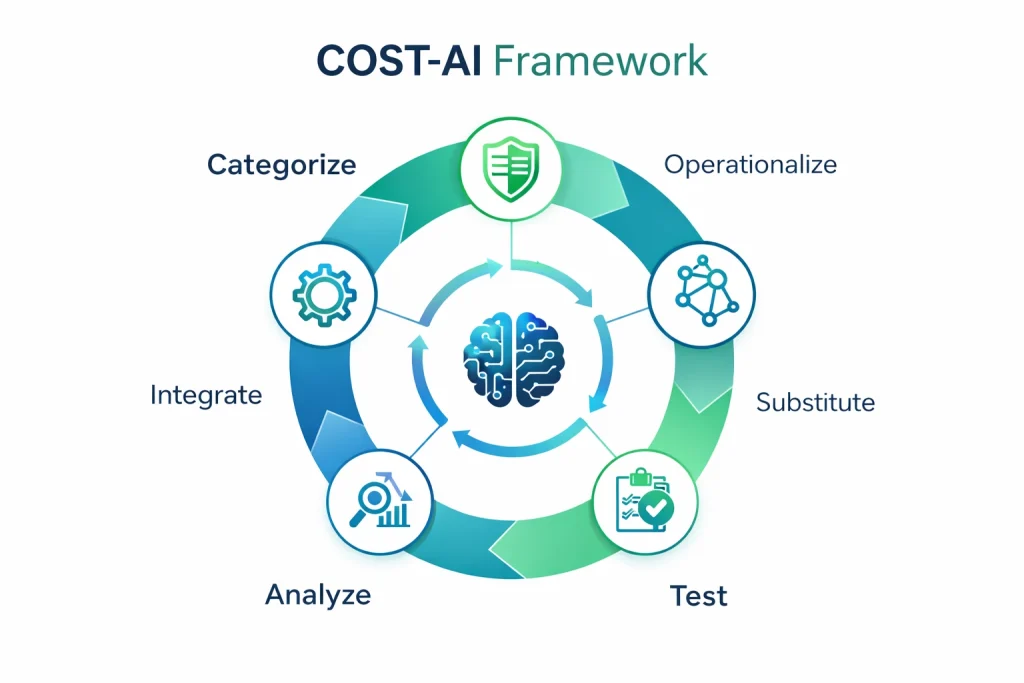
C: Categorize Expenses
- Make a list of the top 5 operating costs by percentage of revenue.
O: Operationalize Tasks
- Divide and break each cost into independent tasks. Identify the repetitive or heavy data workflows among them.
S: Substitute with Automation
- Assess those AI tools which can automate or assist in these tasks easily and efficiently.
T: Test on a Small Scale
- Conduct a pilot program lasting 30 to 60 days. Monitor the time saved and the reduction in direct costs.
A: Analyze ROI
- After the monitoring, analyze and compare the subscription cost vs the saved payroll or improved margin among the work which you have done by AI automation.
I: Integrate or Exit
- Before integrating and implementing tools, first scale the successful ones based on your desired results. Cancel underperforming tools quickly.
This framework ensures AI adoption remains financially disciplined rather than trend-driven.
Beginner vs Advanced AI Adoption
Beginner Path (Under 20 Employees)
- Start with AI-powered email marketing
- Implement chatbot for FAQs
- Use AI scheduling and document tools
- Focus on reducing contractor costs first
Advanced Path (Scaling or Multi-location)
- Predictive analytics for forecasting
- AI-based financial modelling
- Workflow automation across departments
- AI-powered CRM segmentation
The Advanced implementations are often integrated with ERP or enterprise SaaS systems.
Cost Considerations: What Small Businesses Must Know
For small businesses to implement AI, they should be aware of using AI correctly. The AI will reduce costs, but only if implemented correctly.
Direct Costs:
- SaaS subscriptions ($20–$300/month per tool, typical range)
- Integration or onboarding fees
- Staff training time
Hidden Costs:
- Tool overlap
- Poor data quality
- Over-customization
- Compliance risks (especially in EU regions)
Key principle:
If AI does not either reduce the payroll hours, or increase conversion rates, or reduce waste, it is not a cost-reduction tool, but it’s a novelty.
Common Mistakes to Avoid during AI Cost Reduction for Small Businesses
- Buying too many AI tools simultaneously
- Expecting AI to replace strategic decision-making
- Ignoring data privacy regulations
- Failing to train staff
- Measuring outputs instead of financial impact
The use of AI in small businesses should improve margins, not the complexity.
Long-Term Strategic Advantage
When Businesses adopt AI early and quickly instead of wasting time on 100 percent accurate use, they often gain:
- Lower fixed operating costs
- Faster response times
- Higher scalability
- Improved data-driven decisions
Over timing and reduced cost structures are create pricing flexibility and competitive advantage.
This is particularly relevant in the high-cost labour markets across North America and Western Europe, also globally.
Conclusion
AI is no longer only a future investment but it is a present-day cost control strategy too. For small businesses whose facing rising wages, tighter margins, and global competition, due to these reasons, the smartest move is not to “adopt AI everywhere,” but to implement it where it needs and measurably reduces repetitive labor, waste, or inefficiency.
Start from small one. Identify one high-cost workflow, Test one AI tool, Track real savings over 30–60 days. If it improves margins or frees meaningful staff time, scale it. If not, then replace it quickly so as not to waste the resources.
The businesses which win in the next decade won’t be the biggest, but they will be the most effective and operationally efficient. The AI tools, when applied strategically and effectively, they allows small companies in any country to compete with enterprise-level efficiency without enterprise-level overhead.
FAQ Section
1. How can small businesses start using AI without large upfront costs?
Start with subscription-based SaaS tools which automate one specific task, such as email marketing or scheduling etc. Avoid custom-built systems in the initial stage. Pilot for 30 days and track measurable savings before scaling and implementing.
2. Which AI tools reduce payroll expenses the most?
Those AI tools which reduce payroll expenses the most are Customer support chatbots, bookkeeping automation software, and marketing automation platforms, typically providing the fastest payroll savings because they reduce repetitive labour tasks.
3. Is AI worth for very small businesses?
Yes, especially for solo entrepreneurs or teams under 10 employees, the AI can act as a virtual assistant, reducing the need for part-time administrative or marketing support.
4. What operating costs can AI not reduce effectively?
The AI cannot reduce the operating costs of these strategic leadership, relationship management, creative branding, and complex negotiations because it still requires human expertise. The AI tools or systems work best on structured and repeatable tasks.
5. How long does it take to see ROI from AI adoption?
Most small businesses can measure impact within 30–90 days if they track time saved, reduced outsourcing costs, or improved conversion rates.
6. Should small businesses build custom AI systems?
In most cases, small businesses cannot build custom AI systems because Off-the-shelf AI SaaS tools are more cost-effective and lower risk unless the company has highly specialized workflows.