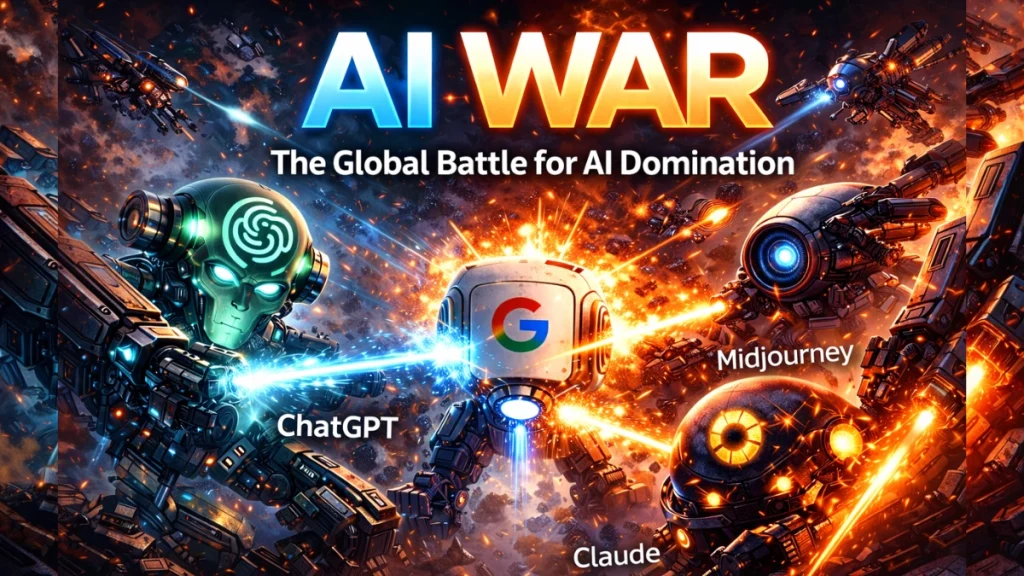
The AI War is no longer just a theoretical concept but now it is an active, accelerating global reality War which has already begun. Across the world, countries like the United States, Europe, the United Kingdom, Canada, Australia, and other countries are also introducing and launching the new artificial intelligence technologies almost daily, and rapidly transforming how people work, how businesses compete with one another, and how nations plan their futures using artificial Intelligence.
From Silicon Valley to London, Berlin, Toronto, and Sydney, AI is no longer experimental but also it is operational, commercial, and strategic, for those organizations that want to grow easily in this modern and digital era, and in short, it is necessary to compete with others in this modern era.
It is important to recognize that this is a different kind of conflict and war than the traditional wars, which were fought with weapons and soldiers in earlier times. But this conflict is fought with algorithms, data, computing power and resources, and skill or talent-based. You can describe it as a type of war which is based on technology of intelligence, speed, and the dominance or supremacy of automation.
Those companies and countries that are investing in AI will gain and achieve economic power, technological leadership or superiority, and strategic and global influence for many years. Those companies who are ignoring the AI implementation in industries then they will face severe risks and clashes and will be left behind in productivity, innovation, and global relevance. Understanding the AI War is no longer optional, but it is essential for all types of digital and technology-based businesses, professionals, and policymakers worldwide.
2. What Is the AI War?
The AI War refers and describe to the intensity of global competition to develop, control, and deploy advanced artificial intelligence technologies faster than other competitors. It involves:
Competing AI models and algorithms
Access to massive datasets
High-performance computing and AI chips
Skilled AI talent and research leadership
In contrast to previous technological revolutions, the AI war conflict affects all industries at once, and making this competition faster and more disruptive than ever before.
Leading technology firms and governments regard AI as a foundational technology, similar to electricity or the internet, but with significantly quicker adoption rates.
This competition in AI is not focused on destruction, but it is focused on economic strength, automation, and control over future innovation and advancements.
3. Why New AI Technologies Are Emerging So Fast
The speed of AI innovation is extraordinary due to these main factors:
3.1 Computing and Processing Power
Cloud computing and specialized dedicated AI hardware have significantly reduced the cost and expenses associated with training and implementing AI systems on a large scale.
3.2 Availability of Data
Digital platforms generate and produce vast amounts of data, which help in the rapid improvement of machine learning models.
3.3 Commercial and Market Pressure
Companies and businesses understand the importance of being first, which really matters in the surrounding. Early AI leaders and masters capture markets, talent, and investor confidence and trust, which are forcing the competitors to accelerate or disappear.
3.4 Explosive Investment
Global industry estimates indicate that the investment in Artificial Intelligence systems currently exceeds the value of hundreds of billions of dollars each year, covering sectors such as enterprise software, fintech, healthcare, and defense. Firms like NVIDIA are increasing the demand for AI chips, as cloud service platforms work to expand their infrastructure.
3.5 Breakthrough Models
Organizations like OpenAI and Google are continually releasing more advanced AI systems, which are compressing and shortening innovation timelines from years into months, which was very tough.
3.6 National Strategy
The US, EU, UK, and China have all declared and designated to AI as a strategic priority, directly linking it to the economic growth, defence readiness and preparedness, and global power.
Consequently, the AI system needs to be ready for implementation, which once took years in development but now takes months or even weeks.
4. The AI War Across Major Industries
The AI War is transforming and influencing almost every high-value industry, especially those with highly significant RPM advertising prospects.
4.1 Enterprise Software and Cloud Computing
AI is now integrating into:
Platforms for Business intelligence
Management of Customer Relationships
Commercial and business analytics
Cybersecurity systems
Automation for SaaS
Cloud providers capitalize on AI with premium enterprise service offerings, leading to significant revenue growth and expansion.
The adoption of Enterprise AI has become a significant competitive advantage for global companies.
4.2 Finance and Fintech
Financial institutions and technology companies like Banks and fintech firms use AI for:
Detection of Fraud
Credit scoring
Trading through algorithms
Risk management
This has transformed and redefined the worldwide financial services, particularly in the US, UK, EU, and Canada.
4.3 Healthcare and Life Sciences
AI speeds up the following in the medical field:
Analysis of Medical images
Identification of new medications
Predictive and forecasting of diagnostics
Personalized treatment planning
These applications demonstrate the significant real-world, transformative impact, which promotes AI’s ongoing integration and saves time, lowers expenses, and improves patient results.
4.4 Jobs and the Global Workforce
AI is transforming and changing the job structure and the importance of skills, such as which jobs are available and which skills are important.
Routine tasks are automated
The is a rising demand for AI professionals and specialists like AI engineers, data scientists, and AI-literate managers.
The continuous reskilling becomes mandatory
The future will belong to those people who understand, learn, and move forward with AI, rather than to those who plan how to fight AI.
5. Is the AI War a Threat or an Opportunity?
The answer is that “both words depend on preparation”.
Risks include for:
The Job displacement in routine roles
Widening skill and income gaps
Ethical and privacy concerns
Opportunities include for:
Massive productivity gains
Creation of high-paying tech jobs
Faster innovation across science, education, and healthcare
The outcome for individuals and businesses completely depends on how quickly they adapt.
6. Global Competition and Regulation in the AI War
Governments of different regions approach the AI War differently:
The US focuses on innovation and private-sector leadership
The EU emphasizes regulation, safety, and ethics
Other regions balance growth with control
How governments regulate AI will strongly influence who leads the next decade of global innovation and who falls behind in the AI War.
7. How Businesses and Individuals Can Prepare
To survive and succeed in the AI War, which is rapidly spending:
For businesses:
Integrate AI into core operations
Invest in AI talent and training
Focus on responsible and ethical use
For individuals:
Learn AI fundamentals
Build adaptable, analytical skills
Use AI tools to enhance productivity
Ignoring AI is no longer a safe option for all those people who want to survive in the autonomous technology era.
8. Conclusion: How to Position Yourself in the AI War
The AI War is not coming so far, but it is already here and making a revolution in the autonomous sectors and industries across the world. The AI War is a technology war that is happening in real time, but not a traditional war with weapons and soldiers. Daily, new AI tools and systems are launched which completely redefine industries, careers, and global power structures from the old version of itself. This competition is not slowing down but it’s going faster and speeding up daily.
The most successful players will not be those who fear and are scared of AI in this era, but those who learn, adapt, and integrate it responsibly. If you are an entrepreneur, employee, or policymaker, your future depends on how well you understand and respond to this global AI competition. Ultimately, you will be the winner of AI War.
Also the key question is not whether AI will change the world, but who will be ready for that change. Those who delay in adopting the AI tools may find themselves permanently behind in the most important technological shift of our lifetime. Take an action instead of regretting.
9. Frequently Asked Questions (FAQ)
What is meant by the AI War?
The AI War means the global race between international and national companies and countries to lead in artificial intelligence technology and innovation, and make a huge amount of growth.
How fast and quickly AI technology is changing?
AI technology is changing daily by daily and launching new tools and models to drive more competition.
Which industries are most affected by the AI War?
Those industries are most affected by the AI War are technology, finance, healthcare, manufacturing, and education are among the most affected.
Should I learn AI skills now?
Yes. AI literacy is becoming essential across nearly all careers.
Is AI replacing humans completely?
No. AI is replacing tasks, not people but only for those who adapt.
How does the AI War affect jobs?
The AI War affects jobs by automating repetitive work, creating new high-skill rolesand increasing demand for AI and data expertise
Which countries are leading the AI War?
The countries that are leading the AI War are the United States, China, and EU nations currently dominating, with strong competition from the UK and Canada.
Should businesses invest in AI now?
Yes every business should invest in AI because the early adoption improves productivity, competitiveness, and long-term survival in the advancement.
How can individuals prepare for the AI War?
An individual can be prepared for the AI War in terms of: Learn AI fundamentals, developing adaptable, analytical skills, and using AI tools in daily work