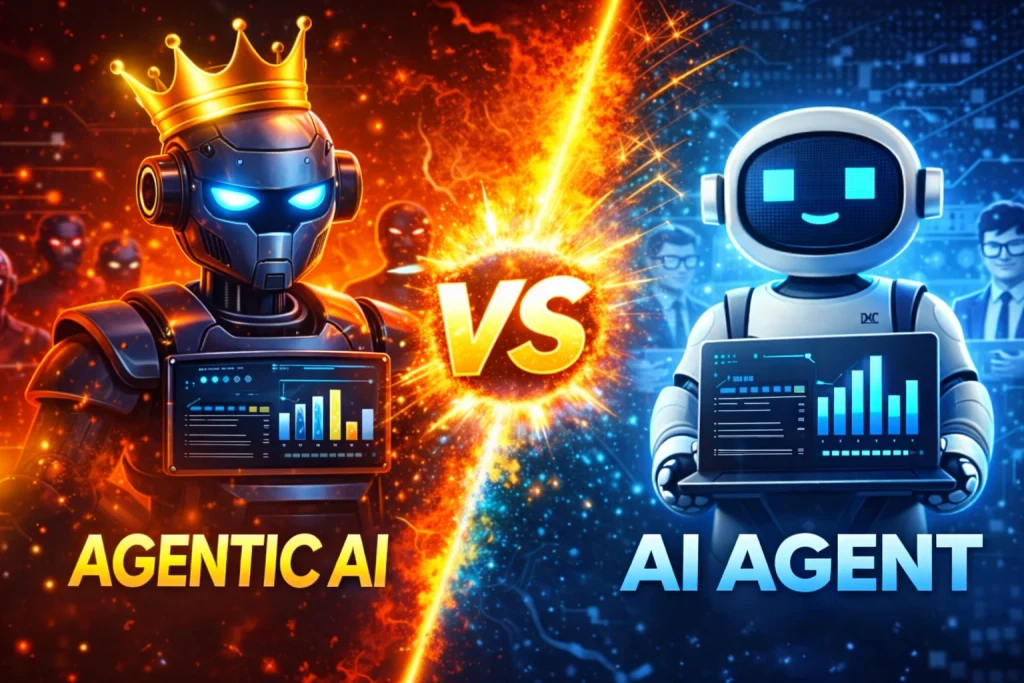
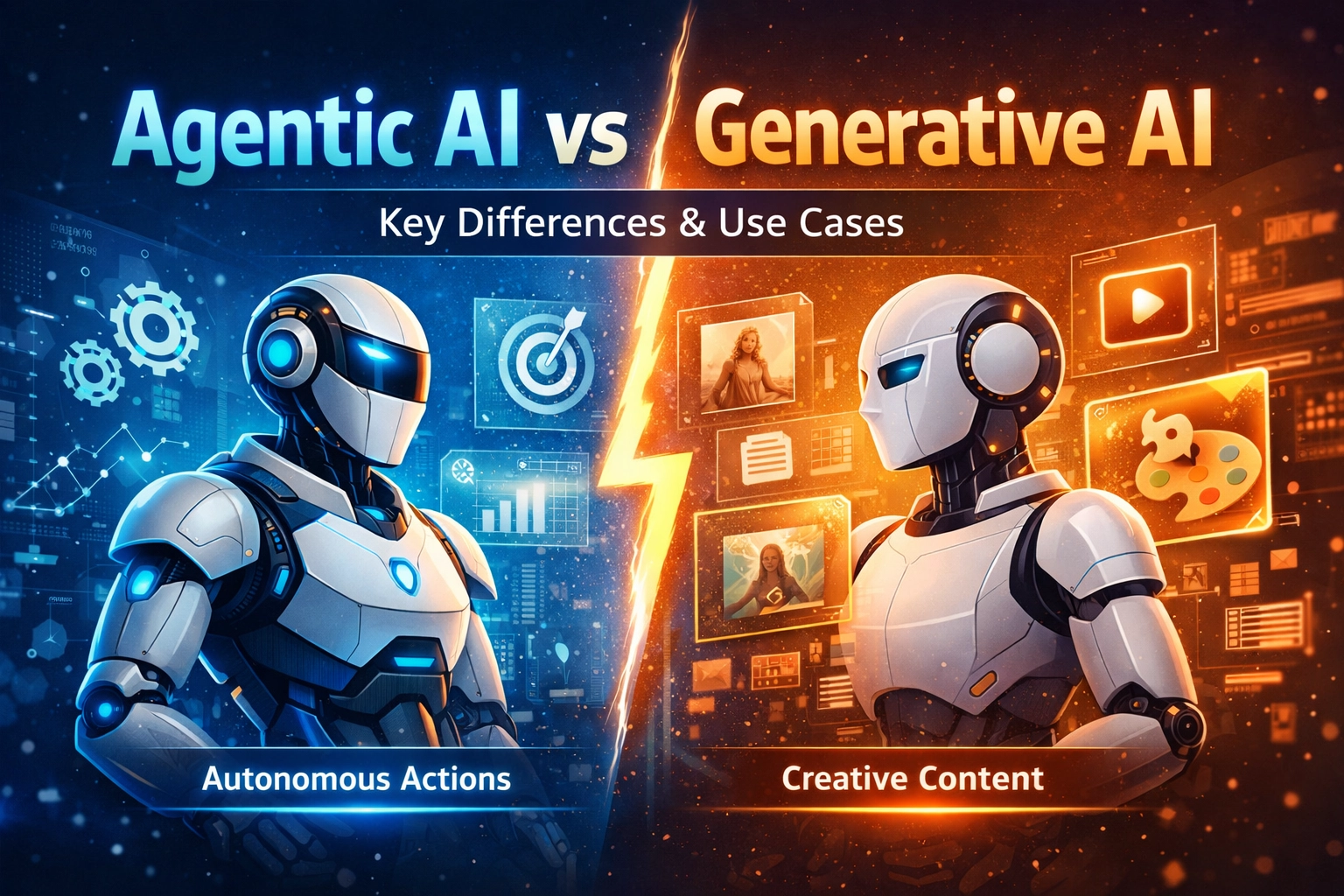
AI agent vs agentic AI are two terms that often get used interchangeably, but they describe meaningfully different approaches to building intelligent systems. The distinction matters when you are deciding which architecture fits a specific problem, and it matters even more as both technologies mature rapidly in 2026.
This guide explains what each term actually means, how they differ in autonomy and decision-making, where each one breaks down in practice, and how to choose between them based on your use case.
Table of Contents
AI Agent vs Agentic AI in 2026: Core Differences
The comparison below shows the main difference between agent vs agentic AI:
AI Agent vs Agentic AI
1) Autonomy Level
AI Agent: Executes tasks by specifying
Agentic AI: By itself decides which tasks to execute
2) Decision-Making
AI Agent: working Rule-based or prompt-based
Agentic AI: working Context-aware reasoning and planning
3) Scalability
AI Agent: It scales vertically (more tasks)
Agentic AI: It scales horizontally (more agents)
4) Risk & Governance
AI Agent: It is easier to audit
Agentic AI: It requires strong governance frameworks
AI Agent vs Agentic AI in 2026: ROI Comparison
Factor
AI Agents
Agentic AI
1. Setup Cost
Low
High
2. Monthly Pricing
$20–$200
$500–$10,000+
3. Autonomy
Limited
Advanced
4. ROI Timeline
Short-term
Long-term
5. Best Use Case
Automation
Decision intelligence
Organizations that have deployed autonomous AI systems consistently report meaningful reductions in operational costs within 12–18 months, particularly in complex, high-volume decision workflows.
Best Monetizable Use Cases by Industry
1) SaaS & Startups
AI agents for onboarding, support, CRM automation
Agentic AI for growth analytics and churn prediction
2) Fintech & Banking
AI agents for KYC and compliance
Agentic AI for fraud detection and portfolio optimization
3) E-Commerce
AI agents for chat and recommendations
Agentic AI for dynamic pricing and supply chain optimization
4) Cloud & DevOps (Very High RPM)
AI agents for monitoring
Agentic AI for infrastructure optimization
Real-World Adoption Across Industries
1) Enterprise & SaaS
AI agents dominate CRM, HR automation, and support systems.
Agentic AI is used for workflow orchestration and operational optimization.
2) Fintech & Banking
AI agents handle compliance checks.
Agentic AI manages risk modeling and fraud detection, especially in US and EU markets.
3) Healthcare
AI agents assist with diagnostics.
Agentic AI coordinates multi-step treatment planning.
Organizations running autonomous AI across complex workflows report consistent efficiency gains in decision-heavy processes, particularly in finance and healthcare operations.
Benefits and Challenges in Autonomous AI Systems
1) Benefits of AI Agents
Lower implementation cost
Predictable behavior
Easier compliance
2) Benefits of Agentic AI
Strategic decision-making
Higher long-term ROI
Adaptive intelligence
3) Challenges
AI agents: Limited intelligence growth
Agentic AI: Higher compute costs and ethical concerns
Which Should You Choose or Buy in 2026?
1) Choose AI Agents If:
You want fast results
You’re cost-sensitive
You need reliable automation
2) Choose Agentic AI If:
You want long-term competitive advantage
You manage complex workflows
You operate at scale
Note: Many organizations now adopt and use a hybrid model, combining both for best output because AI evolves daily in advance manners.
Agentic AI integrated into cloud platforms (AWS, Azure, GCP)
Increased demand for AI architects and agent engineers
FAQ: AI Agent vs Agentic AI (Featured Snippet Ready)
How does an AI agent differ from agentic AI?
AI agent differ from agentic AI because an AI agents perform assigned tasks or specific tasks while Agentic AI decides what tasks to perform and how.
Should businesses use agentic AI in 2026?
Absolutely they can use if they need advanced autonomy, planning, and optimization at scale or we can say that only they can use if they manage complex workflows and data pipelines.
Which industries benefit most from agentic AI?
These are those industries which are taking most benefits using agentic ai like Finance, healthcare, cybersecurity, logistics, and enterprise SaaS .
Is agentic AI more expensive than AI agents?
Yes, agentic AI more expensive than AI agents due to higher compute, orchestration, and governance needs.
Which is safer: AI agent or agentic AI?
AI agents are safer short-term while agentic AI requires strong oversight.
Which is better for ROI: AI agent or agentic AI?
Both are better for ROI but AI agents offer faster ROI while Agentic AI delivers higher long-term returns
Is agentic AI risky to deploy?
Yes, agentic AI risky to deploy because without governance.
Conclusion
The right choice depends on what your system actually needs to do, and understanding that distinction is the foundation for designing reliable AI architecture.
For a deeper look at how agent frameworks implement these approaches, see our comparison of LangGraph vs CrewAI vs AutoGen. For the broader infrastructure context, our guide to AI Agent Orchestration covers how these systems are coordinated at scale.