Imagine that there are five people and they are asking to build a house, but no one tells to them that who will handle the foundation, who will do the plumbing, and who will install the roof. The result will be only just confusion, and everything will be scattered. When people work on the wrong things, the same tasks get repeated again and again. Some things never get done at all.
The same problem shows up and occurs when you are trying to use multiple AI agents to handle a complex task. Each agent might be capable and designed for its own specific task, but without something coordinating them, they collide, duplicate effort, and fall apart. That is exactly what AI agent orchestration solves.
In this guide, you will get a clear and complete beginner-friendly explanation of “what AI agent orchestration” means, “why it matters, and how it works in the real world”. There is no need of technical background.
Quick Answer of AI Agent Orchestration:
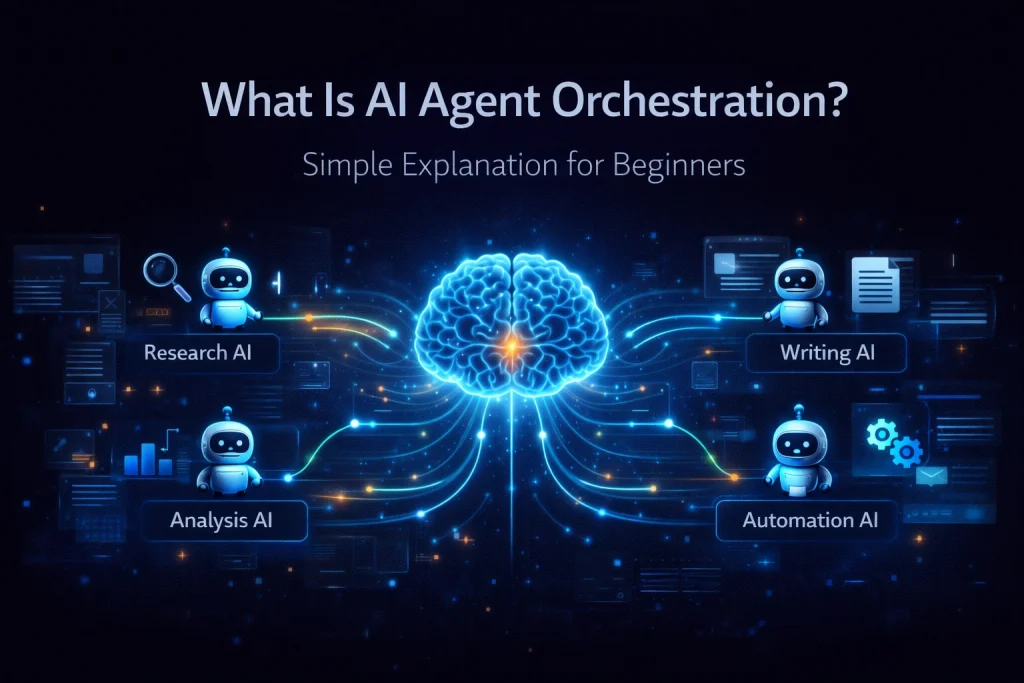
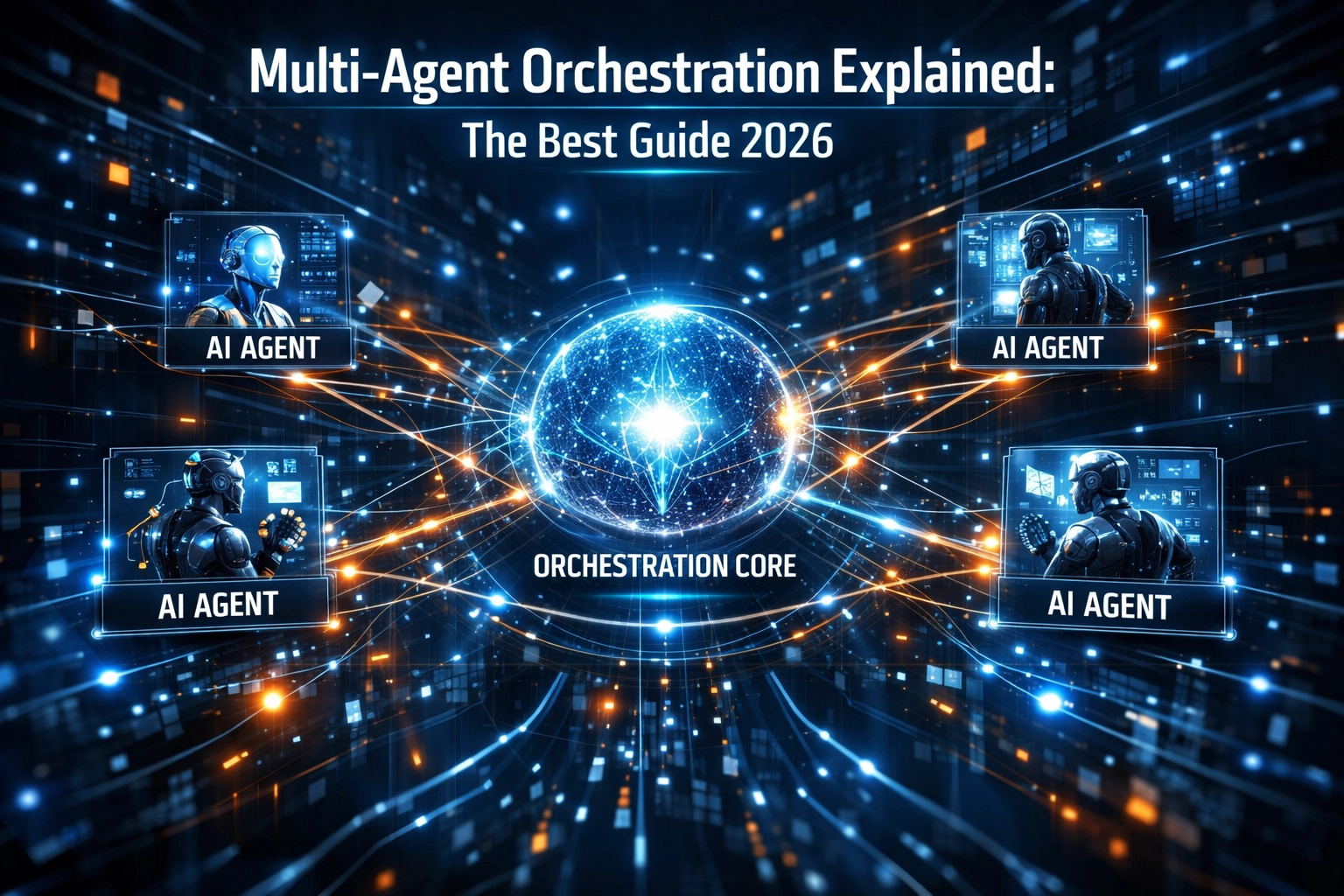
AI agent orchestration is the process of coordinating different types of multiple AI agents for the purpose so that they can work together effectively and efficiently to complete tasks and achieve a common goal. It acts like a manager which assigns different roles, manages communication, and ensures all the agents collaborate smoothly with each other.
The Core Idea Behind Orchestration
Why Coordination Is the Key Concept
To understand AI agent orchestration completely, then start with one word, which is “coordination”. That is actually a single concept on which the whole idea revolves.
“Think of an orchestra. It has dozens of musicians, violinists, drummers, flutists, and others also. Each one is talented in his profession. But without a conductor keeping everyone in the sync and rhythm, the performance would sound like noise and unpleasant and everyone get bored. The conductor does not play any an instrument. But their entire job is to ensure that every musician plays the right part at the right moment or not. That is exactly what orchestration does for AI agents or in the collaboration of AI agents’ systems in Orchestration.”
In an AI system, an agent is a program which has the ability that it can observe its environment, make decisions, and take actions to complete a goal based on the environmental situation. Probably you have one agent which searches the internet, another which summarizes the text, and another which writes emails. Each one is specialized in their domain.
Orchestration is the actually the layer which sits above all of them. It decides who does what, when, and in what order.Without it, all agents are just isolated tools. With this concept and methods in the Agentic Ecosystem, they become a coordinated system which can tackle complex, multi-step tasks, together.
Key idea: Orchestration does not replace agents, but it connects them with each other to complete a complex task in an effective manner and doesn’t confuse them. Think of it as the glue that turns individual capabilities into collective intelligence.
What Happens Without Orchestration?
Example of Uncoordinated AI Agents
Let’s say you’re building an AI system that handles customer complaints automatically. You have three agents:
Agent A reads and understands the complaint
Agent B checks the customer’s account history
Agent C drafts a response email
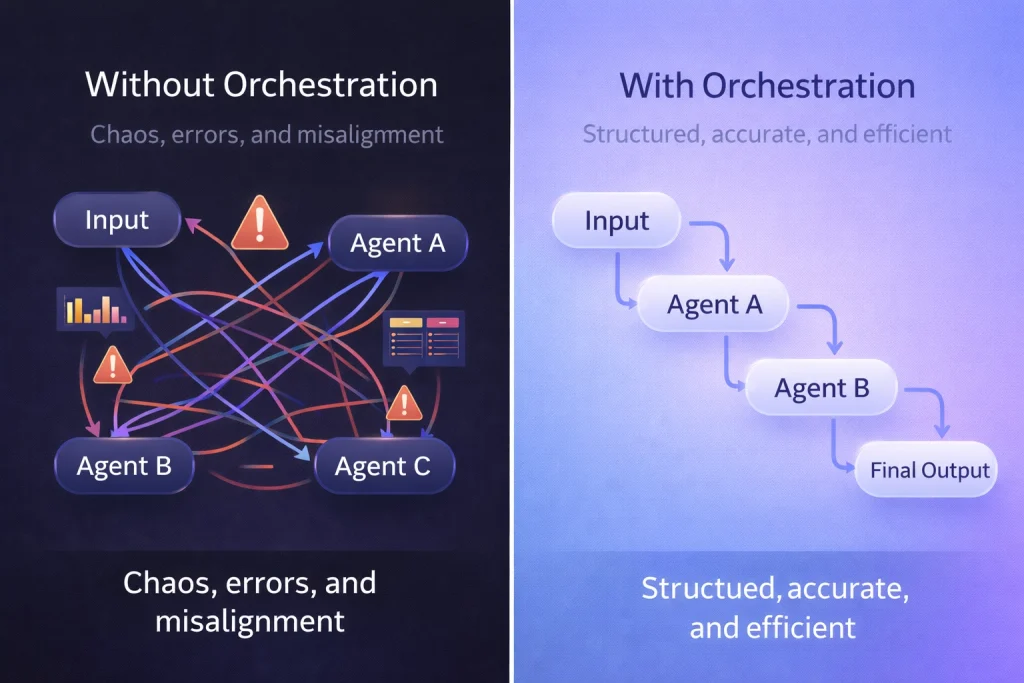
with vs without orchestration
❌ Without orchestration
✅ With orchestration
Without orchestration, here is what can go wrong: Agent C starts writing an email before Agent A finishes reading the complaint. Agent B looks up the wrong customer. No one is in charge, so errors pile up silently. The response sent to the customer is irrelevant or wrong.
With orchestration, the story changes completely: The orchestrator tells Agent A to go first. Once A finishes, B gets the green light. Only when both A and B complete their tasks does C start drafting using accurate, complete information. The response is relevant and correct.
The difference is clear. Without a coordinating layer, even best and capable agents can produce poor results and Timing issues, missing context, and conflicting actions all become serious problems. Orchestration eliminates these failure points by bringing the step by step procedure and structure to the process.
Funny Example:
“Capable agents working without coordination are like expert chefs cooking in the same kitchen with no communication; someone always burns the soup.”
How AI Orchestration Works:
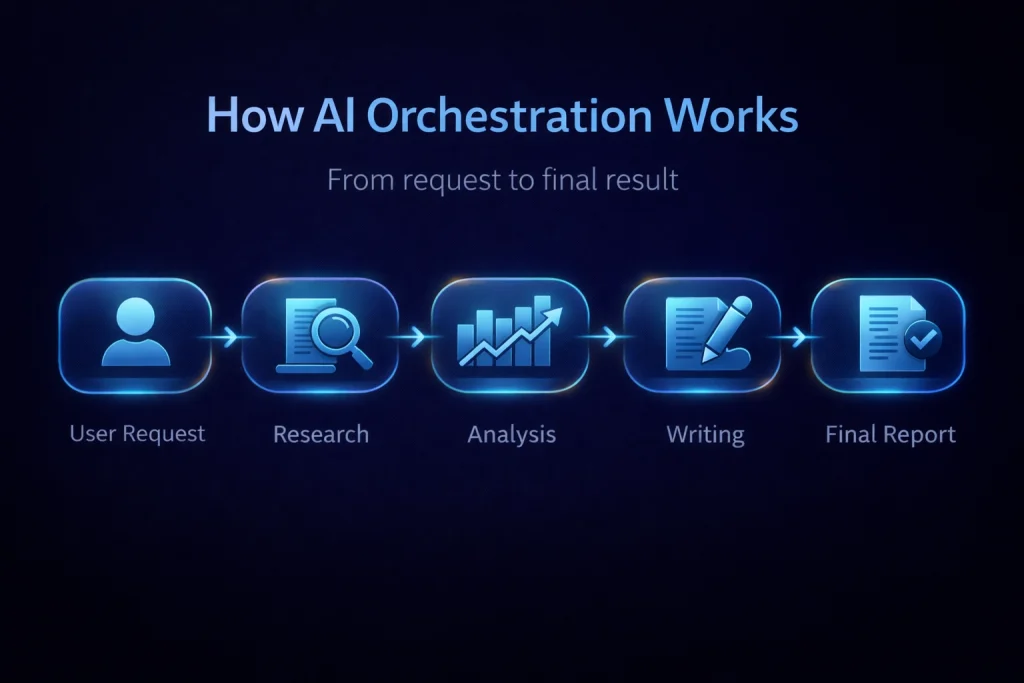
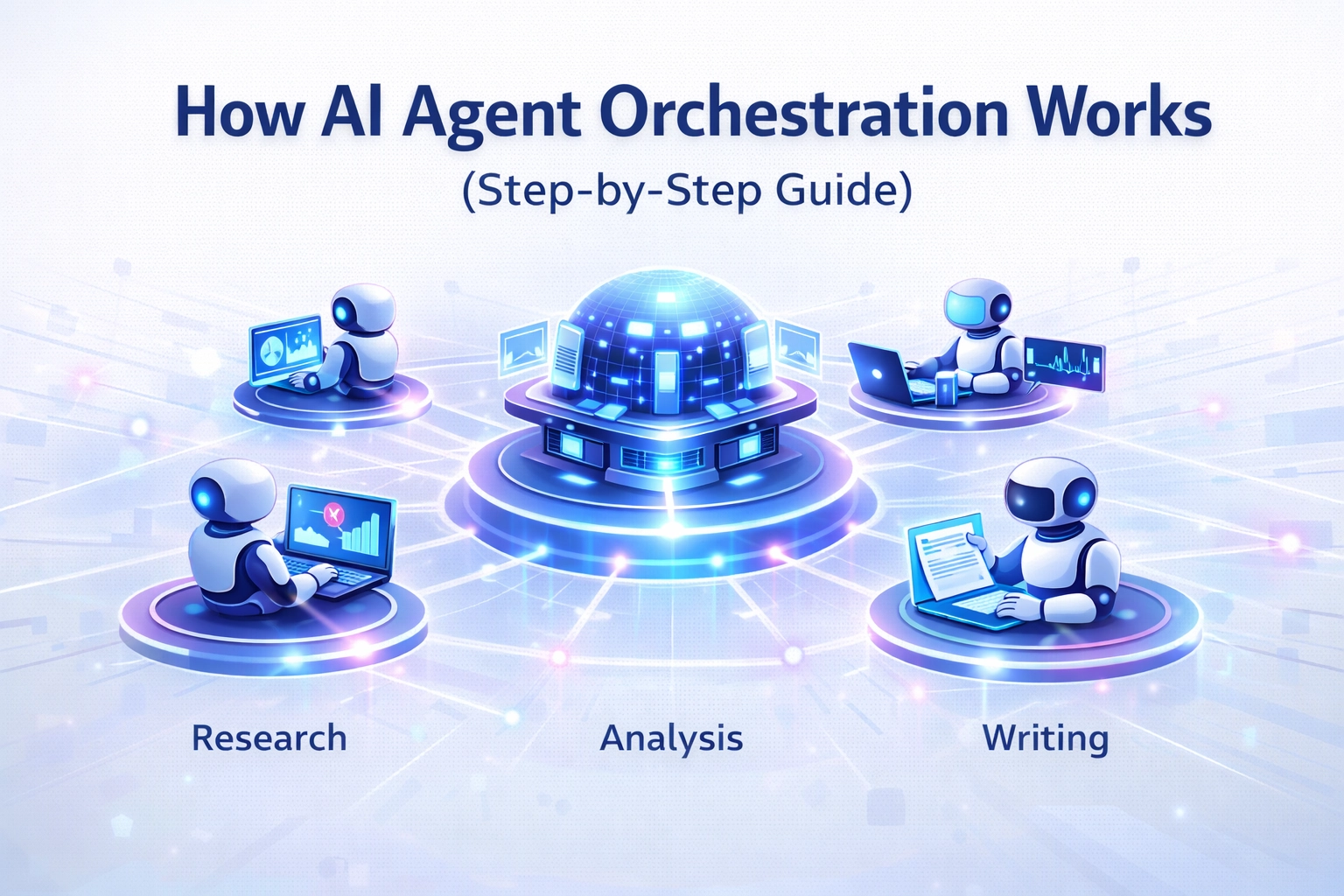
Here is a step-by-step, practical example that is easy. Suppose a company wants to use AI to automatically research a competitor and produce a summary report about the comeptitor. Here is how the orchestration manages the complete process:
AI Orchestration Works
Step 1: Task Received
The user types a query such as “Give me a competitor analysis report on Company X.” The orchestrator receives this query as instruction and breaks it into smaller, manageable subtasks which is called token.
Step 2: Research Agent Activated
The orchestrator assigns the first task to the Research Agent, it perform some operations on it like “go and search the web and gather information about Company X, everything about it like their products, pricing, and recent news etc”.
Step 3: Analysis Agent Steps In
Once the Research Agent completes its work, the orchestrator passes the control with the gather data to an Analysis Agent, from which the analysis agent identifies key trends, strengths, and weaknesses from the collected information.
Step 4: Writing Agent Takes Over
After the analysis, the orchestrator then activates a Writing Agent to handle the analyzed data and to generate a meaningful result in a simple and easily understandable format, which is in a clear, structured report in a professional tone.
Step 5: Report Delivered
The orchestrator collects the final output from the Writing Agent and presents the complete competitor analysis report to the user, which is all done automatically with the help of agentic System, in the right order.
Point to be noted:
You should notice that the user never managed in any task or step during the process. Basically, the orchestrator handled the entire sequence and procedures, which agent runs, when, and with what information. That is the actual nature and workflow of AI agent orchestration in use cases.
Core Elements of AI Agent Orchestration
Not all orchestration systems look exactly the same as one another, but they all rely and based on a few core elements to function properly in proper order and effectively. Understanding these elements or building blocks which makes the whole concept much easier to grab.
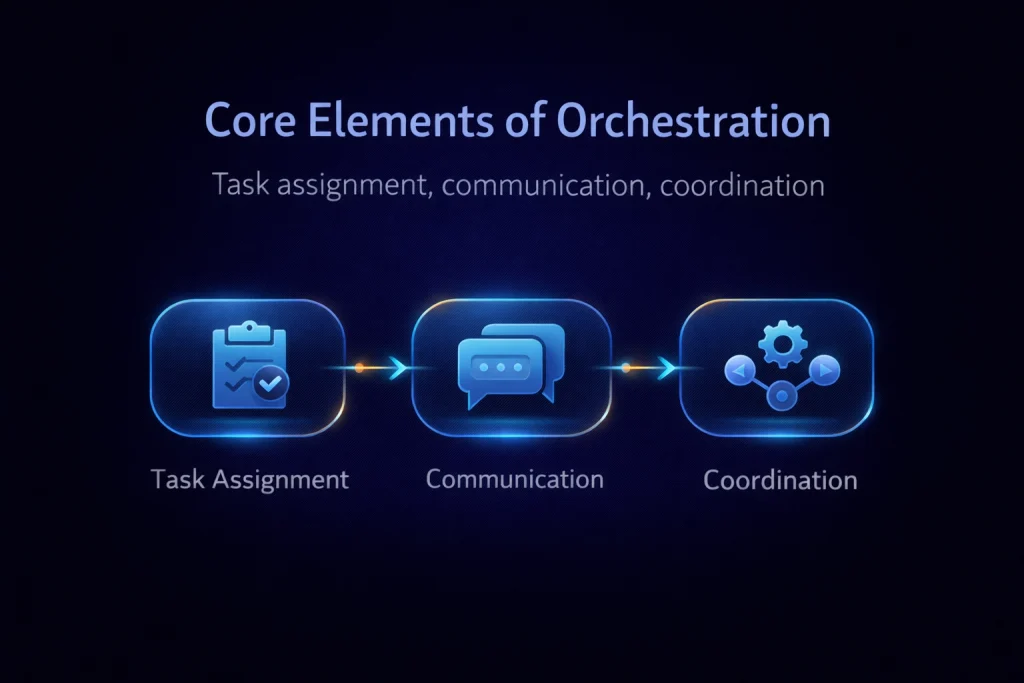
Core Elements of AI Agent Orchestration
Task Assignment
The first job of any orchestration system is knowing that which agent exactly to call upon, and when. Remember the basic point that every agent is not built for all jobs. For instance, “A summarization agent should not be tasked with retrieving data from a database, and a coding agent should not be writing marketing copy”.
Task assignment is about matching the capability of an agent with respect to the task needs. The orchestrator maintains about an understanding of what each agent does and delegates accordingly. Think of it as a manager who knows each team member skills and hands out work accordingly, there is no mismatches, no wasted effort.
Communication Between Agents
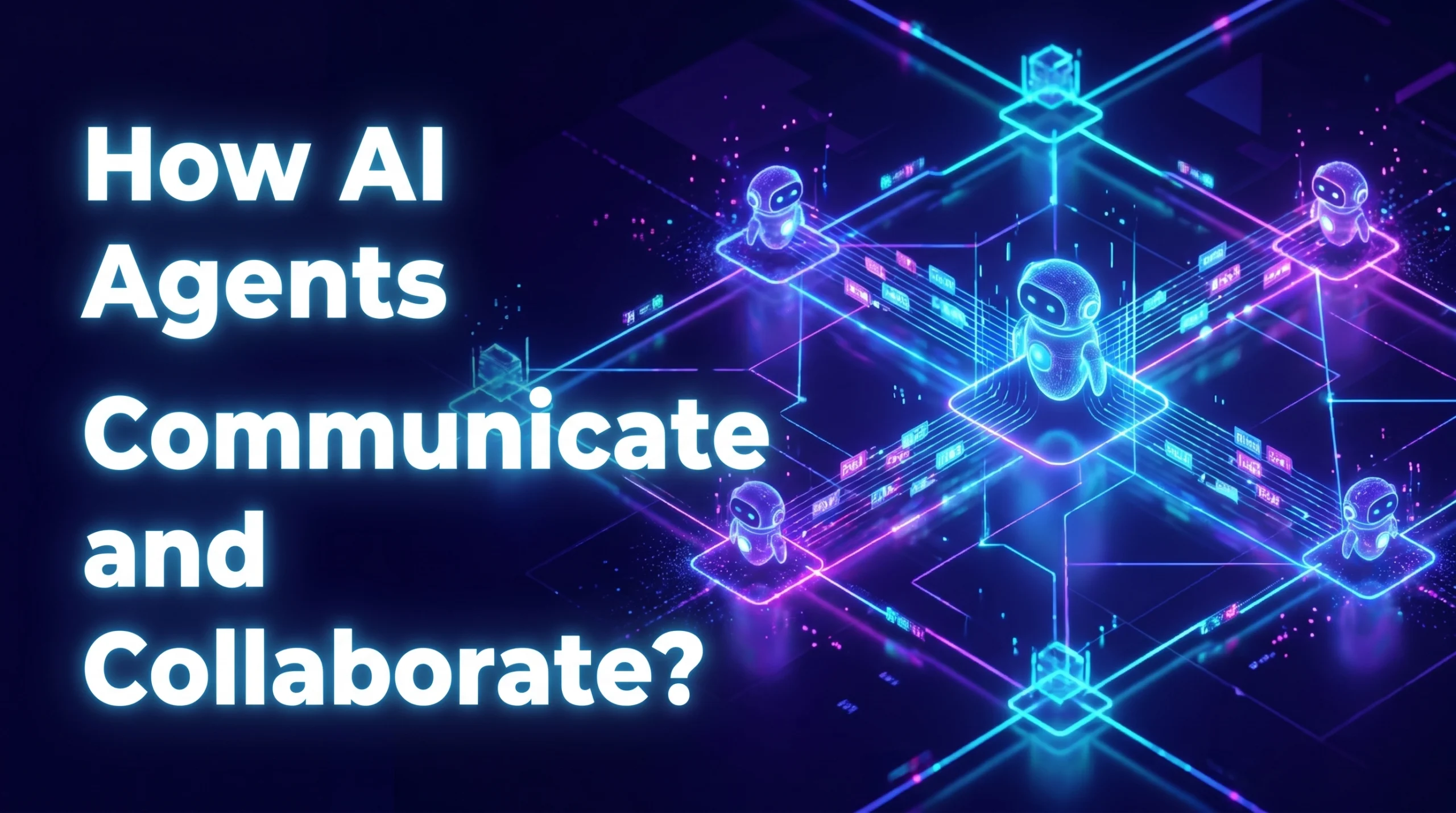
Agents in an orchestrated system do not usually work in complete isolation means without interacting with each other. They pass results, context, and data to one another as work progresses. This communication has to be clean and reliable for the desired result. If Agent B receives incomplete or garbled output from the Agent A, it cannot do its job properly and effectively.
Good orchestration systems handle all these by standardizing how information flows from one system to another. The output of one agent is packaged and properly delivered in such way that the next agent can understand it easily and use it directly, without any confusion or any ambiguity.
Coordination Logic
Actually, this is the decision-making engine behind the whole operation and process in the orchestration. Coordination logic is responsible for the answers questions like: “Should agents run one at a time or simultaneously?”, “What happens if an agent fails?”, “Should a task be retried, reassigned, or skipped?” like this type of questions.
Think of coordination logic as the rules of the road for traffic system. Just as traffic lights and lane markings prevent accidents on a busy road, same coordination logic prevents AI agents from interfering with each other and prohibited from the bad result. It ensures the whole system moves forward without gridlock.
Summary of Key Elements of AI Agent Orchestration:
All the above mentioned these three elements, “task assignment, communication, and coordination logic” make the backbone for every AI agent orchestration system, regardless of complexity.
Where AI Agent Orchestration Is Used
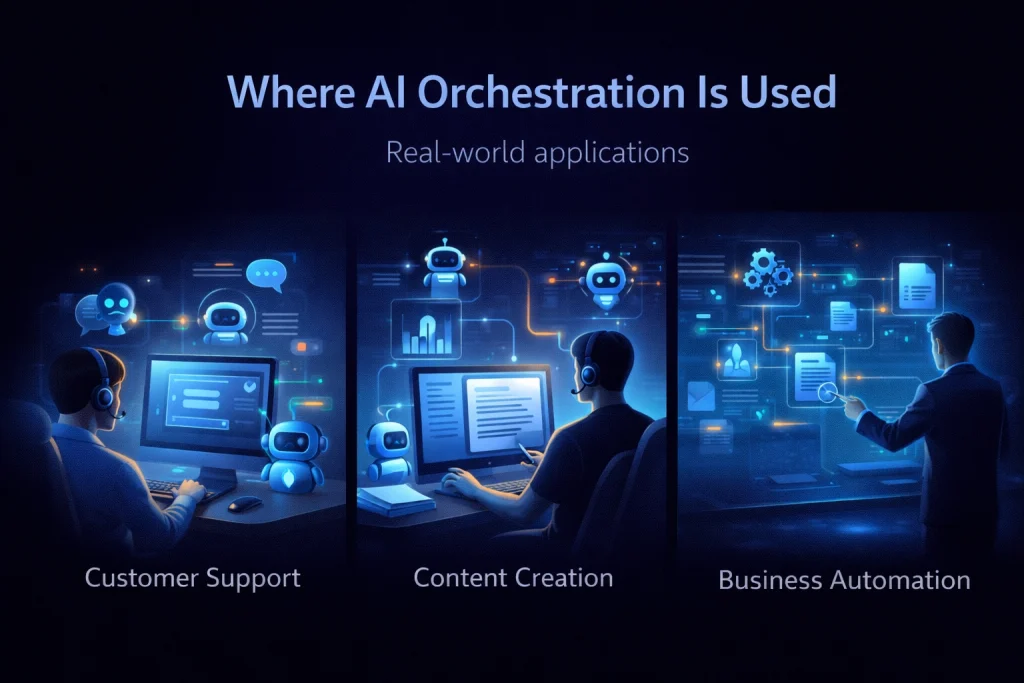
AI agent orchestration is not just a theoretical idea but also It is already being applied across a wide range of industries and use cases that are relying on the tech. Here are three of the most common areas where it mostly use today.
AI Agent Orchestration Is Used
Customer Support Automation
In modern customer support systems, the orchestration coordinates agents who “read incoming messages, pull up account information, check order statuses, draft responses, and escalate to a human if needed”. From all these steps, each step is handled by a specialized agent, and the orchestrator ensures they work in the right sequence and in proper order as expected. The result is faster, more consistent support, without overwhelming human agents with repetitive tasks.
Content Generation Systems
Content teams are increasingly using orchestrated AI pipelines where one agent researches a topic, another one outlines the structure, a third one writes the draft, and a fourth one reviews and polishes the language. Each and every agent has a focused and specified role for which it trained. The orchestrator ties them all together for the purpose that the final content is coherent and complete, not a disjointed mess produced by isolated tools running independently.
Business Workflow Automation
Companies use the orchestrated AI agents to automate the complex workflows and make their work easier. They have a lot of tasks like dealing with invoices, updating records, sending out messages, and making reports. These tasks are spread across systems. The orchestrator is like a manager who takes care of everything. It makes sure that when one task is done, the next one starts. This means people do not have to do everything by hand. It saves time. Reduces mistakes that people might make when they do the same tasks over and over.
Why AI Agent Orchestration Matters
As AI systems become more capable of doing many tasks with speed, that is why the ability to coordinate them effectively becomes just as important as building them in the first place, because due to coordination, more than one task or a complex task can be finished at a fast rate. Here is why orchestration is such a significant part or matter a lot for the modern AI design.
Better Efficiency
When agents are coordinated properly, those tasks that probably take hours to complete if you deal it manually or sequentially, after coordination now it can be completed in a fraction of the time, means in very fast rate. Some agents can even run in parallel, working on different subtasks simultaneously, while the orchestrator keeps everything aligned in such a manner to deal with them in proper order. The overall system moves faster because no one is waiting around for the instructions.
Reduced Errors
When one process ends, and another begins, then errors often occur at the switching time from one process to another. In uncoordinated systems, the information gets lost, misunderstood, or applied to the wrong task. Orchestration establishes clear and best switching protocols when control passes from one process to another. Every agent knows and understands very well what they received, from whom, and what is expected to return. This structure dramatically reduces the kind of small mistakes that snowball into big problems.
Scalable AI Systems
One of the biggest advantages of orchestration is how it enables growth, which is known as scalable AI systems. As your needs and requirements expand, then you can add new agents to the system without rethinking the whole architecture. The orchestrator simply learns about the new agent’s nature and begins assigning relevant tasks to it. This modularity means that you are not bounded into a rigid setup, but the system evolves alongside as your requirements grow.
Frequently Asked Questions
What is AI agent orchestration in simple terms?
AI agent orchestration is the process of coordinating different types of multiple AI agents for the purpose so that they can work together effectively and efficiently to complete tasks and achieve a common goal. It acts like a manager which assigns different roles, manages communication, and ensures all the agents collaborate smoothly with each other.
Why do AI agents need orchestration?
AI agents need orchestration because the individual AI agents are usually designed for the specific tasks. When you need to complete something complex, which often requires multiple steps and you need multiple agents working together for solving complex tasks. Without orchestration, they lack direction and proper order of solving for instance they might repeat tasks, skip critical steps, or work with incomplete data which is not acceptable for the users or the industries. Orchestration gives them structure and keeps everything on track that needs for the users in one place.
Is AI orchestration the same as automation?
They are related but not the same actually. Automation is completely about the replacing a manual process with a machine-driven or automatic one while the Orchestration is specifically about the coordination of multiple agents or systems so that they work together intelligently. You can have automation without orchestration, but the orchestration typically includes elements of automation as part of its process.
Can a single AI agent work without orchestration?
Absolutely, a single AI agent works without orchestration because a single AI agent can handle a narrow, well-defined task which does not need orchestration at all. Orchestration becomes necessary in the events where multiple agents need to collaborate with each other, when the task is too complex for one agent, or when different specialties need to combine their outputs to produce a final result.
Where is AI agent orchestration used in real life?
AI agent orchestration is used in real life across many industries today. Common examples include the “automated customer support systems which are handling queries end-to-end, AI-powered content pipelines, which is used for research and writing articles, business workflow tools, which process invoices and update records, and healthcare systems which coordinate data retrieval, analysis, and report generation without human involvement at each step.
Is AI agent orchestration difficult to implement?
At a beginner level, understanding the concept is not difficult at all, it is simply about the coordination. The technical implementation can vary in complexity depending on how many agents are involved and how sophisticated the coordination logic needs to be. Many modern frameworks and platforms exist that are specifically to help the developers to build orchestrated AI systems without needing to solve every coordination challenge from starting.
What is the main goal of orchestration in AI systems?
The main goal of orchestration in AI systems is to make multiple AI agents capable of working as a unified and an efficient team. Instead of managing each agent separately, the orchestration system creates a layer of intelligent coordination that ensures “every agent plays the right role at the right time”, so that the whole system delivers accurate, complete results.
Conclusion
AI agent orchestration is one of those concepts that sounds technical at first, but at its core, it is about something very human which is simply “coordination”. The same principle which makes an orchestra beautiful, a construction crew productive, or a sports team effective is what makes orchestration powerful in AI.
Multiple AI agents, each doing what they do best, guided by an orchestrator that keeps them aligned in proper manner, to communicate with each other, and moving toward a shared goal. In short this is the whole idea.
Whether you are exploring AI for your business, building your first intelligent system, or simply trying to understand about the technology which shaping the world around you, knowing what orchestration is gives you a real foundation to build on.
Ready to go deeper? Explore how individual AI agents are designed, and you’ll start to see exactly why orchestration is what brings it all together.