
Table of Contents
Overview of the AI agent
Every time a chatbot resolves your support ticket, a navigation app reroutes around traffic, or a recommendation engine surfaces the next show you’ll watch, an AI agent is making that decision. The term gets used constantly in AI discussions, but what it actually means is still unclear to most people who encounter it daily.
This guide explains what an AI agent is, how it works, why it differs from a regular chatbot, and where you’re already using agents without knowing it.
Quick Answer
An AI agent is a software based system which can perceive its surrounding environment, make decisions based on the nature of environment, and take actions to achieve specific goals. It works basically by analysing input, processing information, and responding wisely but without needing a human effort at every step. Think of it as software which does not just respond but also acts.
The Core Idea of an AI Agent
Here is the simplest way to think about it which refers to a regular computer program which does exactly what you tell it to do. You click a button; it runs a command. End of story.
But an AI agent is different than the simple programs because it has the ability that can observe a situation, figure out what needs to happen, and then do something about it, all on its own.
The formal definition:
An AI agent is any system that has the ability to perceives its environment through inputs, decide what to do about which is perceiving, and produces actions in response to achieve a defined goal.
That might sound complex, but the main idea is surprisingly simple. An AI agent is basically a decision-maker which gathers information, thinks about it, and then acts, sometimes in a loop, over and over again, until to reach the exact destination.
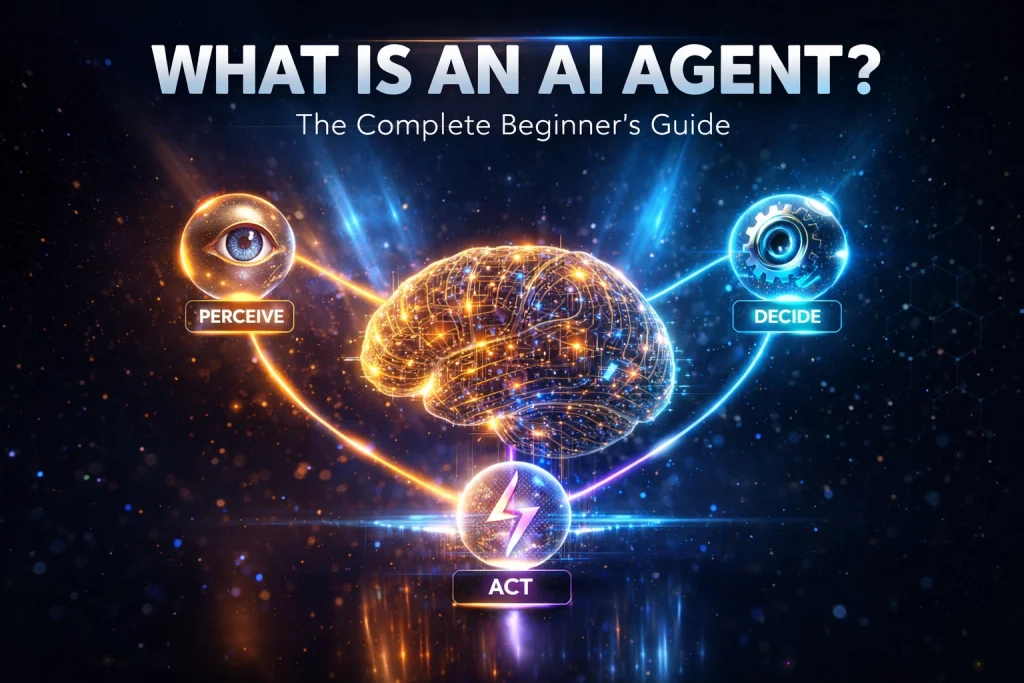
This idea is built around a simple loop:
- Perception → Decision → Action
This is actually the main difference that AI agent is different form the basic software. They do not just execute but also, they evaluate.
Input, Thinking, and Action (Simplified)
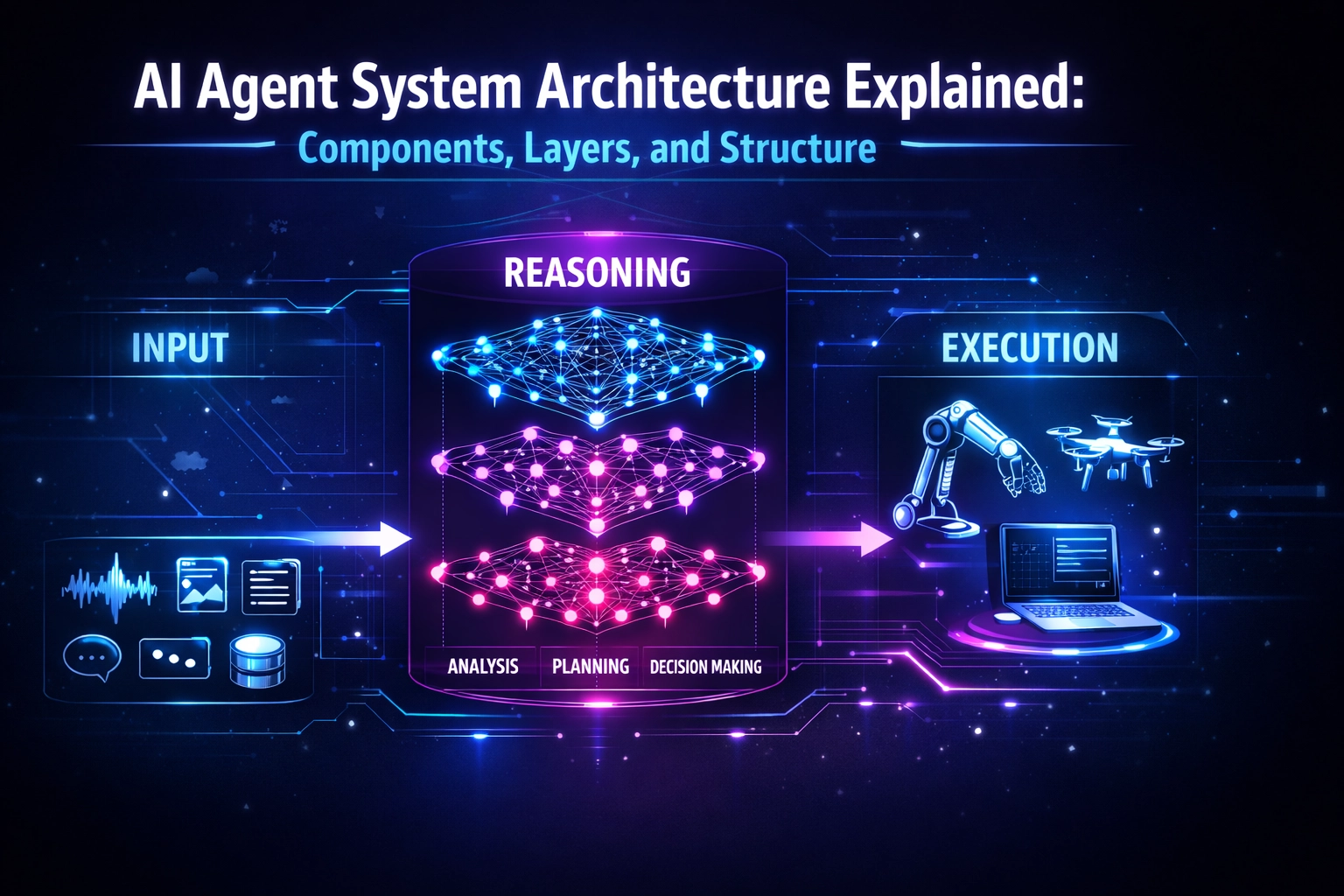
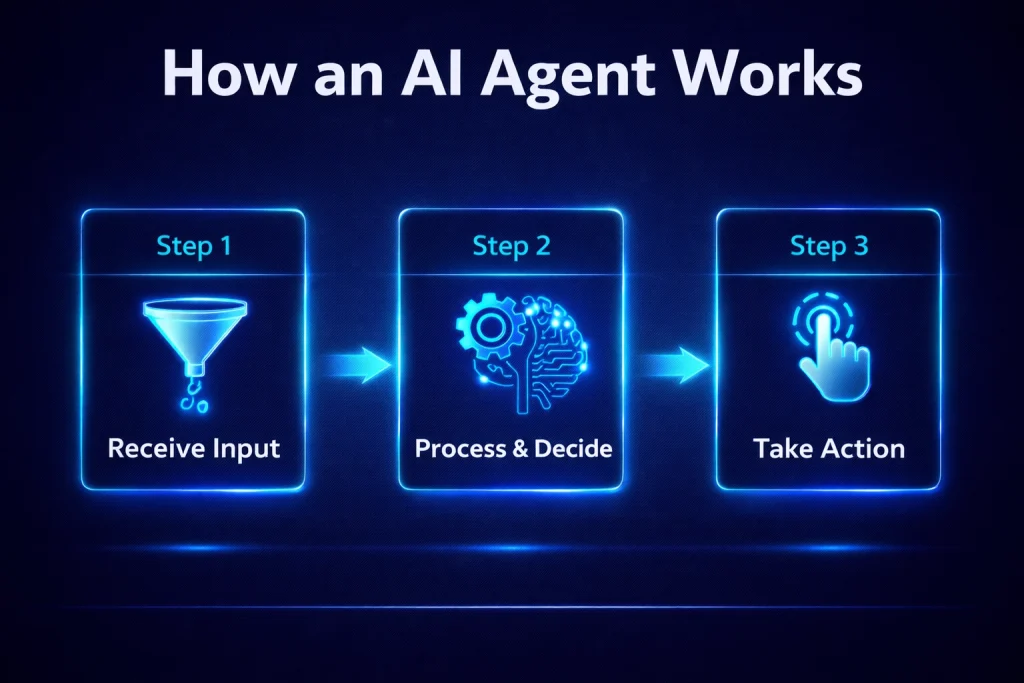
Every AI agent, no matter how simple or complicated but they operate through these three fundamental stages:
Input (Perception) The agent receives data from its environment. This could be text you typing, a sensor reading, a stream of numbers, a webpage, an email, or virtually any other kind of information. The environment is whatever but the agent is paying attention to the environment and will accept the data.
Processing (Decision-Making) The agent takes that input and process it through its reasoning system or according to the prepared model. Depending on how the agent is built, this could involve matching patterns, following rules, running a machine learning model, or querying a large language model but the result appears in the form of a decision: what should I do next?
Output (Action) Based on its decision, the agent perform some action. It might send a message, update a file, trigger another system, place an order, or flag something for human review and many more things but the action is the agent’s response to the world and it is the main characteristic which makes agents genuinely useful.
This perception → reasoning → action is the actual heartbeat of every AI agent.
How an AI Agent Works (Basic Flow)
Understanding that how AI agents work in simple terms does not require a deep and technical knowledge. Let’s walk through the basic flow, the goal is here clarity. Most follow a straightforward three-step process.
Step 1: Receiving Information
The Agent collects the data from its environment by understanding the nature and whatever environment it operates in that for getting of data.
Examples:
- For a customer support agent, it might be a user’s typed message.
- For a fraud detection system, it might be a stream of credit card transactions.
- For a self-driving car’s navigation system, it might be real-time sensor data from cameras and radar.
- For a recommendation system, it might be the tracking of user behaviors in any media platform
The main point is that the agent does not act on the instinct or memory alone but it responds to the current, real-time input. This is actually the main characteristic that makes it adaptive rather than static.
Step 2: Processing & Decision-Making
Once the agent has its input, the agent analysed the data and now it can figure out what to do with it based on the after analyzation of data. This is the moment where the “intelligence” appears in real by the hardware system.
Depending on the type of agent, the working and processing can be simple as matching a keyword and giving an answer, or it may be complex as running a multi-step reasoning chain through a large language model to think about lots of things and figure out several possible actions that what to do. This is where thinking happens.
The agent is essentially asking itself: what should I do next give what I know about the situation.?
Some agents follow strict and predefined rules. Others agents learn from the past experience that happen to them. The most advanced ones and the smart agents can deal with situations that are not clear and still make a good decision We will talk about these types of agents soon.
Step 3: Taking Action
When the agent fixed decision after fixing the agent acts. It produces an output and that output has a real effect on the world and will be meaningful.
Here is what makes this meaningful: the action often changes the environment the agent is operating in which can trigger a new round of input, processing, and action. This is really important because this creates a feedback loop that allows agents to handle complex, multi-step tasks.
For example:
A travel-booking agent might search for flights, which is the first action. Then it receives results, which is new input. After that it filters by price and time which is the processing part. Then it presents the options to the user, which is the second action. All of this happens in one chain of events.
That is the power of an agent. The agent does not just answer a question it works toward a result, which’s what the agent is supposed to do and that is the power of the agent.
Simple Examples of AI Agents in Real Life
AI agents are not only a future concept but they are already embedded in smart tools that you use every day. To make everything clear, here are a few and the most recognizable examples you might interact with them daily.
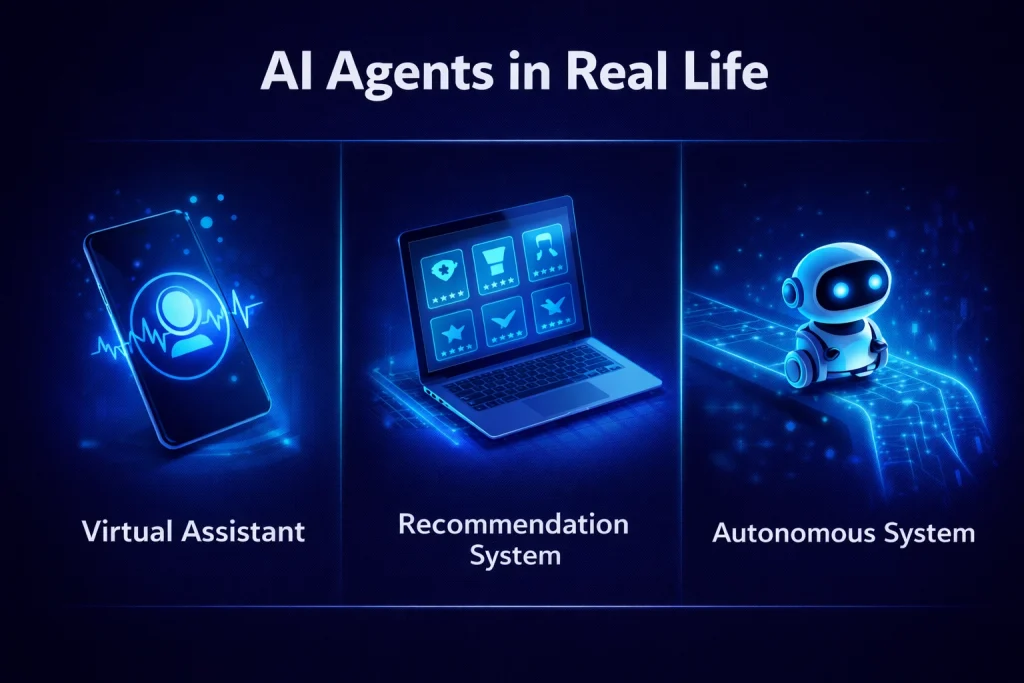
Virtual Assistants
Digital Voice Assistants like Siri, Google Assistant, Amazon Alexa, are the classic examples of AI agents which are operating in consumer products.
Actions of Virtual Assistant:
- Listen to your request
- Understand your intent
- Respond with an answer or action
Example:
- When you say “Set a reminder for 3pm tomorrow,” the assistant does not just record your words.
- Also, it parses your intent, determines what action is required, interacts with your calendar system, and confirms the task.
- If something is ambiguous, it asks a follow-up question also to ensure the best result for you.
That is perception, processing, and action which all happen in under a second.
Recommendation Systems
Platforms like Netflix, Spotify, YouTube, Amazon all these use AI agents to figure out what you might want next or what you most like.
These agents continuously track your behaviour (what you watch, skip, replay, search for), process it against patterns in their data, and take action and give recommendations to you according to your nature. For example, during scrolling if you stop and watching cricket videos then after in few scrolling the cricket videos start shown.
They are not just showing you a random list but they are actively working toward a goal: keep you engaged by surfacing content you are likely to enjoy and want.
Autonomous Systems
At the more advanced end, you have systems like self-driving car navigation, robotic warehouse logistics (think Amazon fulfilment centres), and automated trading algorithms.
These agents operate in fast-moving, high-stakes environments where human reaction times would not be fast enough. They perceive massive amounts of real-time data, make rapid decisions, and execute actions, for instance sometimes thousands of times per second.
These are more advanced but still follow the same basic structure.
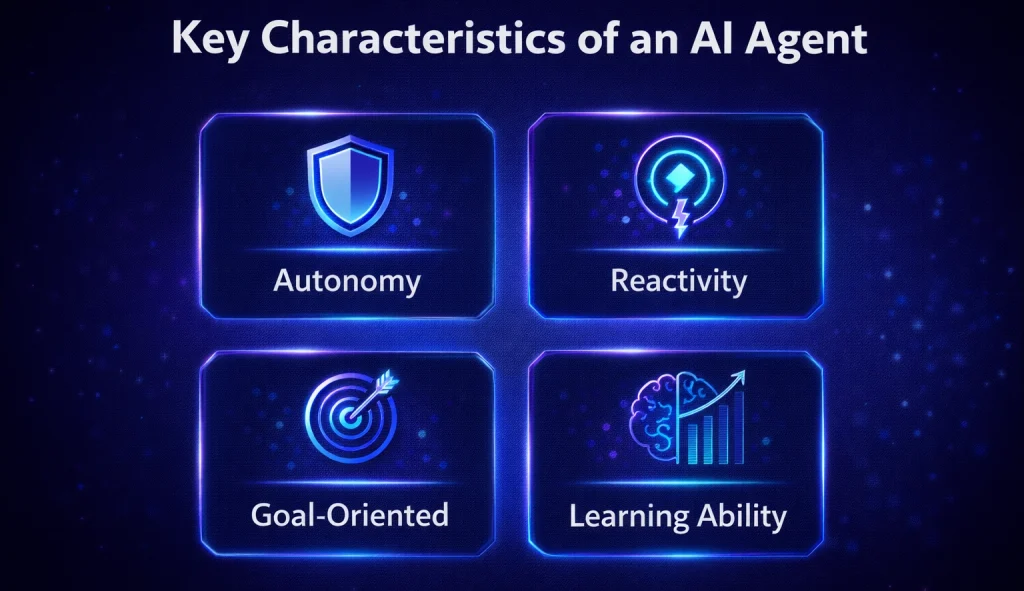
Characteristics of an AI Agent
Not every software system qualifies as an AI agent but what makes something an AI agent rather than just a regular program or software? There are four main AI agent functions and traits which make it worthy.
- Autonomy
- Reactivity
- Goal-Oriented Behavior
- Learning Ability (Basic Mention)
Autonomy
An AI agent can operate independently means without constant human control. It doesn’t need a human to make every decision or trigger every action but they make decisions on their own based on available data. Once it is deployed with a specific goal, it can figure out how to pursue that goal on its own or by itself.
This does not mean that agents are uncontrollable basically they operate within defined boundaries that’s why within those boundaries, they act without needing any constant instruction.
Reactivity
Agents are responsive in nature. They do not run a fixed script but they respond to what is actually happening in their environment.
If the situation changes, the agent adapts. This is a critical difference from traditional software, which follows a predetermined path regardless of the context.
For example:
- A trading bot reacts to market changes
- A smart home system adjusts temperature automatically
Goal-Oriented Behavior
Every AI agent is designed to achieve specific goals and ability of trying to achieve these goals. All of its decisions and actions are directed toward that goal.
This goal-orientation is what gives agents coherence. Without it, an agent would just be reacting randomly. With it, every action makes sense as part of a larger strategy.
Learning Ability (Basic Mention)
Many modern AI agents have some capacity to learn from experience and adjusting their behaviour over time based on feedback or new data.
This is not universal because some agents follow fixed rules that never change. But learning agents can improve their performance as they operate, which makes them especially scalable and powerful in the dynamic environments. We will touch more on this in the types section below.
Types of AI Agents (Beginner Overview)
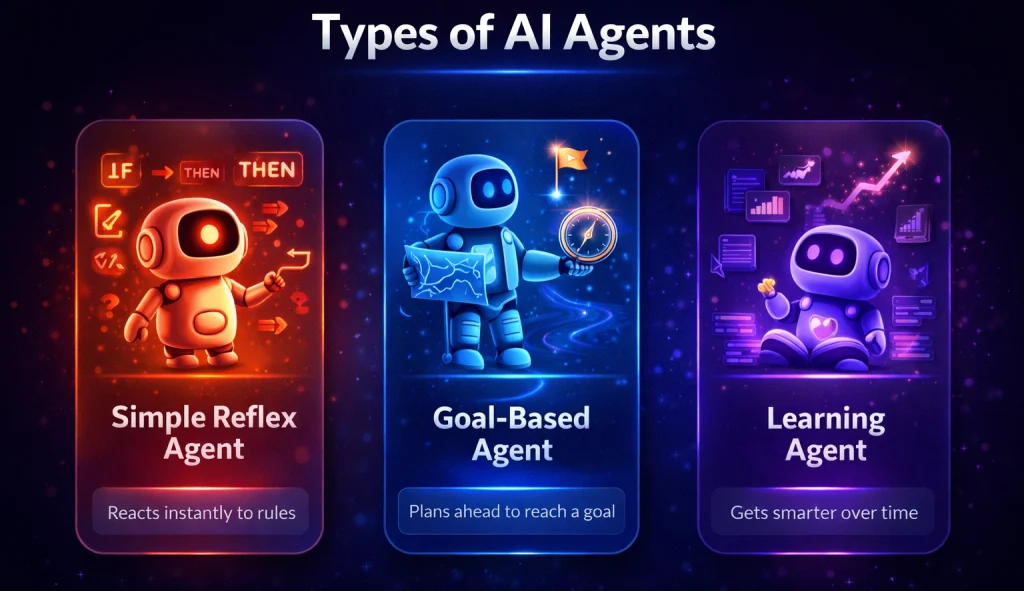
Not all AI agents are built the same they can be varied. But here is a simple breakdown of the three most common types, without getting too deep into academic classification systems.
- Simple Reflex Agents
- Goal-Based Agents
- Learning Agents
Simple Reflex Agents
These are the most basic kinds of AI agents. They operate on straightforward if-then logic: if this happens, do that.
Key activities:
- Act based on current input only
- Follow predefined rules
- No memory of past events
Example:
- A thermostat is a classic example. If the temperature drops below 68°F, turn on the heat. If it rises above 72°F, turn it off. In the example, there is no complex reasoning involved, just a direct response to a condition.
Simple reflex agents are fast and reliable, but they struggle with anything outside their predefined rules. They can’t handle novel situations or learn from experience.
Goal-Based Agents
These agents are more sophisticated. Instead of just reacting to immediate conditions, they work backward from a desired outcome.
Example:
- A GPS navigation system is a good example of it. Its goal is to get you from point A to point B as efficiently as possible. It does not just react to your current location, but it also plans a route, monitors your progress, and reroutes if something changes (like traffic or a missed turn).
Goal-based agents can handle more complex tasks because they’re thinking ahead, not just responding to the present.
Learning Agents
Learning agents take things a step further because the name of it specifies that these types of agents not only can work toward goals, but they can improve at pursuing those goals over time.
Example:
- A spam filter is a good example. It starts with the baseline rules for identifying spam. As it is exposed to more emails and as users mark things as spam or not spam it refines its detection patterns. It gets better when more it operates.
This capacity to learn from feedback is what makes some AI agents genuinely powerful over time.
AI Agent vs Chatbot (Common Confusion)
This is one of the most frequently misunderstood distinctions in the field of AI which is AI agent vs Chatbot
Key Differences in Function
A chatbot is built to have conversations wit users. Its primary job is to produce a relevant, coherent response according to the user input. Traditional chatbots follow scripts even more advanced ones powered by large language models are still, fundamentally, response generators.
An AI agent is built to accomplish tasks. It is not just generating a reply also it is taking actions, using tools, making decisions, and working toward a goal. Conversation might be part of how it operates, but it is not the end product.
Here is a simple way to think about it:
- A chatbot answers your question while An AI agent solves your problem.
If you ask a chatbot “What is the best flight from New York to London next Tuesday?” it will tell you how to look that up. If you ask an AI agent the same question, it will actually search flights, compare options, and possibly book one for you.
The difference is not in what they know but also in what they do.
When a Chatbot Becomes an AI Agent
The line between chatbot and agent has blurred significantly in the recent years.
A basic chatbot is one that just generates text responses and it is not an AI agent. But when you give that chatbot the ability to use tools (search the web, send emails, query a database, execute code), it starts to cross into the agent territory.
The defining threshold is action. The moment a system can take meaningful actions in the world beyond just producing text it is functioning as an agent.
This is why some deployments of ChatGPT, when connected to the external tools and plugins, can be considered as an AI agent, while the base model on its own is more accurately described as a conversational AI.
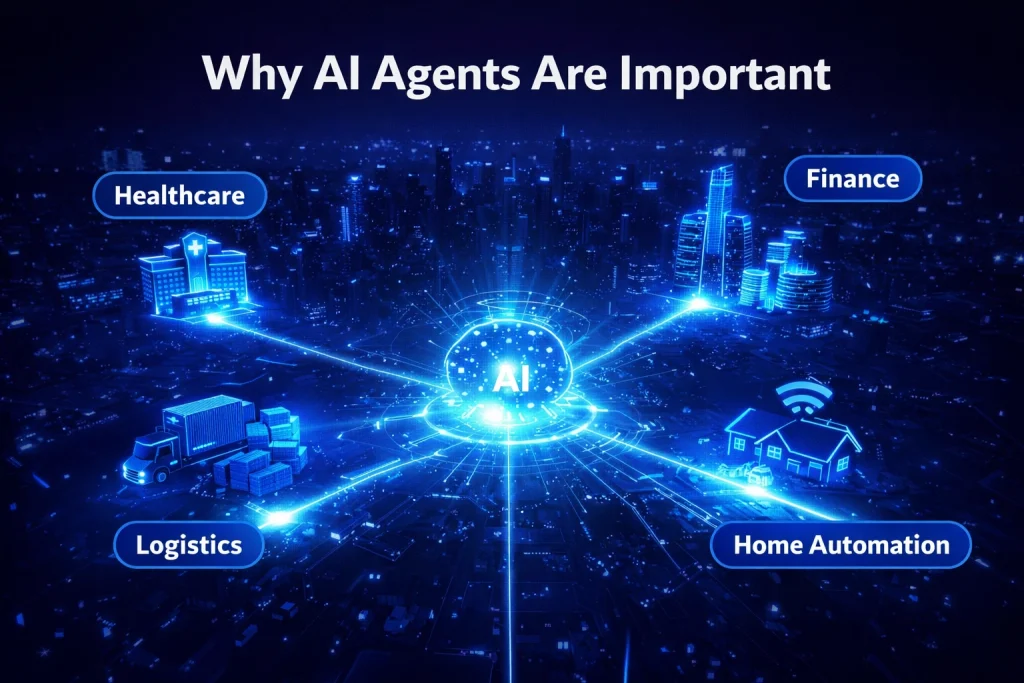
Why AI Agents Are Important
Understanding what AI agents does and why they matter is another is more curious topic.
Automation of Tasks
AI agents can handle repetitive, time-consuming tasks that require significant human effort. Such as Customer support routing, data extraction, report generation, scheduling all these things can be manged by agents at scale, faster and more consistently than manual processes.
This can help humans and make them free to focus on work that actually requires human judgment, creativity, and relationships.
Smarter Decision-Making
AI agents can process large amounts of information so quickly and reasoning about it systematically, they often surface insights and make decisions that humans probably miss or take much longer to reach.
In areas like medical diagnostics, financial risk assessment, and supply chain optimization, agents are not replacing human decision-makers but they are making those decision-makers significantly more effective.
Foundation of Modern AI Systems
Perhaps most importantly, AI agents are the building block of the advanced AI systems which are being built today. They are the building blocks behind:
- Smart assistants
- Autonomous technologies
- Personalized platforms
From autonomous research assistants to complex enterprise automation platforms, everything more advanced is built on top of the agent concept. Understanding what an AI agent is gives you the conceptual foundation to understand virtually everything else happening in AI right now.
FAQ of AI Agent
1. AI Agents in 2026: What’s Changed
Building AI agents has become significantly more accessible over the past year. Frameworks like LangGraph, CrewAI, and AutoGen now handle the orchestration layer that previously required custom engineering,letting developers focus on defining agent goals and tools rather than building the decision loop from scratch. For a practical side-by-side comparison of which framework fits which use case, see our guide to LangGraph vs CrewAI vs AutoGen.
2. What is an AI agent in simple words?
An AI agent is a system which can perceive its surrounding environment, make decisions based on the nature of environment, and take actions to achieve specific goals. It works basically by analysing input, processing information, and responding wisely but without needing a human effort at every step. Think of it as software which does not just respond but also acts.
3. How does an AI agent work?
An AI agent do and works in these three stages: in which first it receives input from its environment, then processes that information to make a decision is the second stage, and then takes an action based on that decision is the third stage. This cycle can repeat many times as the agent works to achieve its goal.
4. What are examples of AI agents?
Common examples of the AI agents include virtual assistants like Siri or Alexa, recommendation systems on Netflix or Spotify, fraud detection systems which is use by banks, and navigation systems in self-driving cars all these examples are the AI agents. Any system which perceives, decides, and acts can function as an AI agent.
5. Is ChatGPT an AI agent?
ChatGPT is a conversational AI, basically, because it generates text-based responses. However, when connected to the external tools (like web search, code execution, or file management), it can work as an AI agent because it can take real actions not only just producing text.
6. What is the difference between AI and AI agents?
The term “AI” is a vast term which covering any technology that can act like human intelligence while an AI agent is a specific type of AI which is designed not just to analyze or generate, but to autonomously perceive its environment and act within it to achieve a desired goal.
7. Do AI agents learn on their own?
Some agents learn and some do not. Simple rule-based agents follow fixed logic that never changes while more advanced agents which is known as learning agents can improve their performance over time based on feedback and new data.
8. Where are AI agents used today?
Today, in every industry AI agents are used like customer support automation, healthcare diagnostics, e-commerce personalization, financial trading, logistics optimization, smart home devices, cybersecurity threat detection, and in many more place.
Conclusion
AI agents are the foundation of everything more advanced being built in AI right now. Once you understand the perception → decision → action loop, the rest of modern AI architecture becomes significantly easier to follow.
For a deeper look at how multiple agents work together, see our guide to AI Agent Orchestration. To understand how agents compare to workflows and simple automation, our article on AI Agents vs Workflows vs Automation covers that distinction clearly.