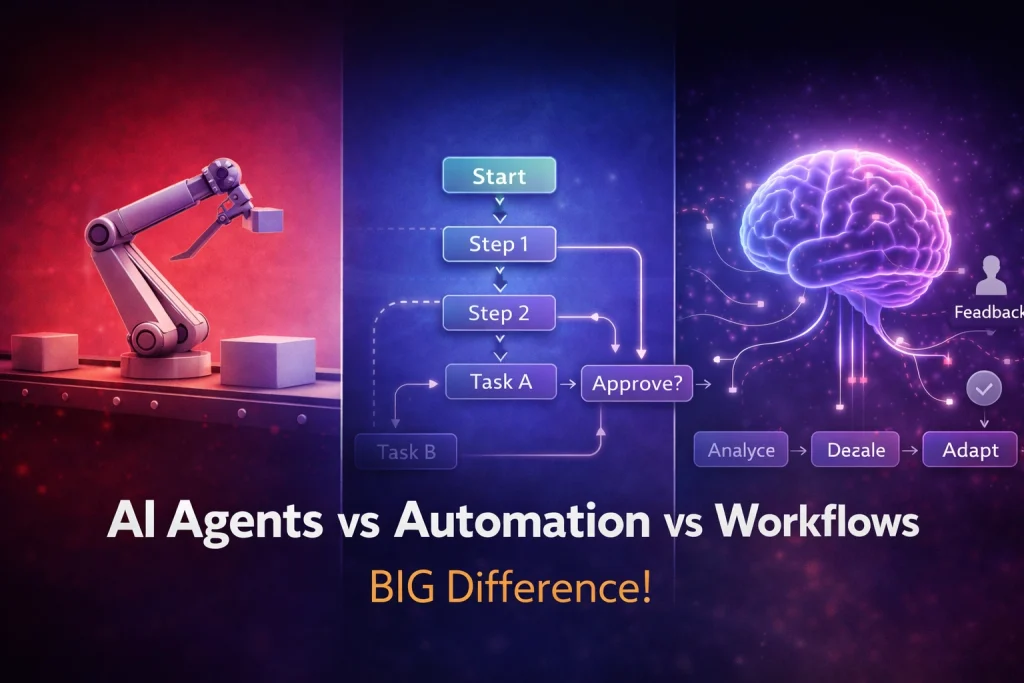
If you have spent any time in the exploration of modern technology solutions, you have probably noticed that AI agents vs workflows vs automation get more debated topics around in the tech as they look like the same thing but actually, they do not. Using the wrong term might seem like a minor issue, until you start building the wrong solution for a problem that needed something else completely.
This article cuts through the noise. You will get clear, side-by-side comparisons of all these three concepts, also a practical guidance on when and where each one makes sense, and a framework for thinking about them that you can actually apply on them easily. Everything will be friendly, not complicated. Then let’s start to explore about them
AI Agents vs Workflows vs Automation
Quick Answer
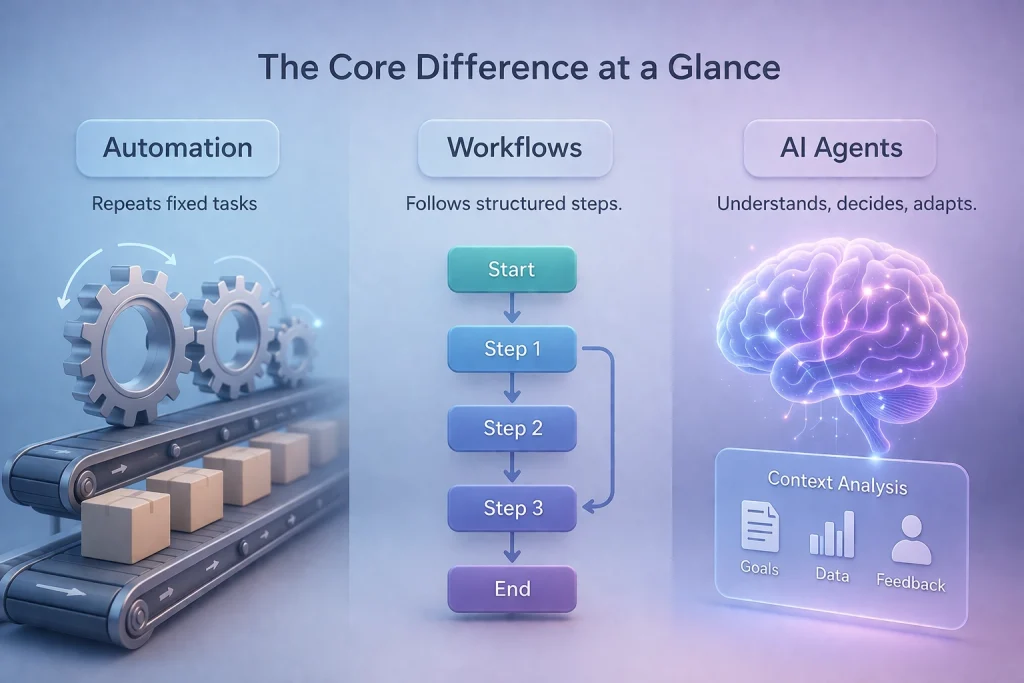
The terms AI agents, workflows, and automation are different fundamentally in “how they operate and decide”. Automation follows fixed rules to execute the repetitive tasks. Workflows organize predefined steps into specified and structured processes. AI agents have the ability to take a situation, make decisions, and adapt dynamically. In short: automation executes, workflows structure, and AI agents think.
The Core Difference in AI Agents vs Workflows vs Automation
Before diving deep into the topics in details, so the simple discussion helps to anchor each concept with a clear mental model. These three terms in tech are not on the same spectrum means actually they represent genuinely different approaches to getting work done with technology in an effective way.
Simple One-Line Definitions
Automation actually refers to the “Rule-based execution”. For instance, “If this happens, do that”. Every time, the same way and in same manner.
Workflow actually refers to “A structured sequence of steps”. Suppose “Task A leads to Task B, which leads to Task C” and each step is predefined and specific.
AI Agent refers to “A decision-making system”. Which means “It reads context, evaluates options, and chooses the most appropriate action”.
Here is the main idea: the difference is not just about complexity but also “It is about who (or what) is responsible for judgment”. Automation never exercises judgment but it follows the orders while A workflow still relies on predefined logic, someone else made the decisions upfront while An AI agent, however, carries its own decision-making capacity into every situation it faces in its environment.
Quick Comparison Table of AI Agents vs Workflows vs Automation
Feature
Automation
Workflow
AI Agent
Flexibility
Very low
Low to moderate
High
Intelligence
None
Minimal
Significant
Adaptability
None
Limited
Dynamic
Decision-making
Predetermined
Predetermined
Real-time
Task complexity
Simple, repetitive
Multi-step, structured
Complex, variable
Best use case
Known, consistent triggers
Organized multi-team processes
Ambiguous or unpredictable tasks
Failure handling
Breaks or halts
Follows fallback paths
Can reason through alternatives
How Automation Works (Rule-Based Systems)
Automation is the oldest and simplest terms among these three concepts and terminologies. At the main or in the core behind of automation, actually automation is about removing human effort from tasks which are predictable enough to be scripted.
Fixed Rules and Triggers
Every automated system is built based on a trigger-action relationship. Something happens is the trigger, and a predefined response fires is the action basically in automation. There is no evaluation between these two. There is no query or deciding events like “should I do this right now?” but the answer is always yes in any situation, as long as the trigger condition is satisfied.
Examples:
Examples of triggers include like “a form submission, a scheduled time, an incoming email from a specific domain, or a file landing in a particular folder” etc.
The corresponding actions might be: “send a confirmation message, generate a report, forward the email to a queue, or move the file to an archive” etc.
The system does not wonder whether the email is important or not. It does not consider whether the file actually belongs in the archive or not. But naturally, it just acts, because that is what it was told to do.
Predictable Outputs
This rigidity is actually the greatest strength for the automation. When a process needs to run the same way as every single time, without variation, without interpretation so automation delivers exactly that in the same way in present as you want in the past. The output is consistent and predictable because the inputs are fully controlled and there is no variation that’s why the result is predictable.
A payroll system which calculates hours and generates payment files on the 15th date of every month does not need to think. It needs to be correct and reliable. Automation handles that beautifully.
Where Automation Works Best
Automation is applicable in some place in scenarios like:
High-volume, low-variance tasks: The processing thousands of identical transactions or routing standard customer inquiries to the right inbox.
Compliance-driven processes: Any situation where the exact same steps must be followed for audit or regulatory reasons.
Error-prone manual tasks: Data entry, format conversions, or file transfers where human mistakes create downstream problems.
The moment for which a task requires and needs judgment capabilities even the simplest kind of but here this is the point where automation starts to struggle. That is where the workflows and agent’s needs for the solution of judgement tasks.
How Workflows Structure Processes
A workflow is considered to be a level above from simple automation. Where automation naturally can handle individual actions, while a workflow connects multiple steps, often involving multiple systems or people, into a coherent process.
Step-by-Step Task Flow
Simply just think about workflow that a workflow as a map of how work moves through an organization. It shows predefined steps that what happens first, what depends on what, and who (or what system) handles each stage sequentially.
Each of these steps connects to the next one and depends on the previous one. Some steps are automated (sending the offer email), and some involve human action (the hiring manager scheduling). The workflow is the container which holds it all together in one place.
Predefined Logic and Sequences
The intelligence in a workflow is fix and defined during at the design time of it, not in at runtime.
A workflow designer, a human, maps out all the possible paths:
what happens if the candidate declines,
what happens if the background check flags something,
what happens if onboarding materials are not signed within 48 hours.
This branching logic and techniques makes workflows more capable of doing something than single-trigger automation. But it is still structured and bounded around what was anticipated. If something unexpected happens which was not expected and defined at the design time of workflow, then the workflow either stalls, fails, or falls back to a generic path.
Workflow vs Simple Automation (Clarifying the Boundary)
This clarification is really matters between these two terms, because they are often confusing. Here is a useful and best way to think about it:
Automation is a single action which responding to a single trigger. It is transactional. In more simple way, there is no state, no sequence, no relationship to what came before or after.
A workflow is a sequence of actions, in which some are automated, and some are manual, which move a piece of work toward a goal. It maintains state across steps, knows about the place of task in a process, and can route work based on outcomes at each stage.
Practically, workflows often include automation. An automated email might be one step in a larger workflow. But the workflow itself is something bigger, it is the architecture that connects the steps into a meaningful process.
How AI Agents Think and Act
AI agents are a fundamentally come in different category from both automation and workflows. The defining characteristic of AI agent is not speed or scale but it is the ability to reason about a situation and decide what to do.
Decision-Making Ability
An AI agent does not want to be told exactly what to do. It receives a goal, reads the context available to it in the form of (data, instructions, conversation history, tool outputs), and determines the best action on its own to perform on the available data.
This is a more beneficial steps and make a remarkable revolution in the history of modern tech. With automation, you can decide as designer what happens in advance. With an AI agent, the agent decides within the defined boundaries you have set to it and take a decision like “what is the appropriate next step for the specific situation”.
For example:
A customer contacts support with an unusual refund request that does not fit to any standard policy. An automated system either rejects it or escalates it blindly without any review. An AI agent can read the request, assess the customer’s history, consider relevant policies, and decide whether to approve it, partially accommodate it, or escalate with a reasoned explanation already drafted.
Handling Dynamic Situations
The real value of AI agents shows up when situations do not follow a script. Dynamic situations, ones with ambiguity, missing information, or unusual combinations of factors, are exactly where rule-based systems break down and agents thrive.
An AI agent can handle gaps for example If there is any missing information and it needs; it can ask to clarifying question. If it encounters a situation first time and was not defined to at the design time, so it can reason from principles instead of using rules. If there is any tool it was planning to use it in the process, if it is not available, it can adapt it and try a different approach.
This ability to completely navigate uncertainty is what makes agents genuinely useful for complex knowledge work, not just task execution.
Learning and Adaptation
Many AI agents are built using large language models or other machine learning foundations, which means that their underlying capabilities were shaped by vast amounts of training data. In practical deployments, agents can also be equipped with memory, because the ability to recall past interactions and adjust their behaviour accordingly on the store data.
This is not quite the same as learning ability in the traditional machine learning sense, but the effect is meaningful: an agent which remembers the context of previous conversations can provide more relevant, personalized responses over time. For now, think of this as agents having better contextual awareness than their rule-based counterparts, not that they are constantly retraining themselves on the job.
Key Differences (Side-by-Side Breakdown)
Now that each concept has been unpacked individually, here is how they compare directly across the dimensions which matter most for real-world decisions. We will discuss about these in terms of these characteristics to make difference among them easily.
Flexibility
Intelligence Level
Ability to Adapt
Complexity of Tasks
Flexibility
Flexibility in the tech environment means to easily accept the changes according to the new updates.
Automation has essentially zero flexibility. The rules are the rules. If something changes, a new file format, a new exception case, a policy update, so someone has to go back and change the automation code or make configuration about it.
Workflows offer a little more flexibility through branching logic, but that flexibility is still predetermined and bounded due to the defined boundaries and steps. You can only take paths that were built into the workflow design.
AI agents are inherently flexible in nature. They easily adapt to what they encounter. You can give an agent a goal and general instructions, and it will figure out how to work within different conditions without needing to be reprogrammed for each one. These capabilities make them more useable and more powerful than others
Intelligence Level
There is no intelligence in Automation phenomena. It processes on given inputs according to its rules without any understanding of what those inputs mean.
Workflows have minimal built-in intelligence, the “smart” parts are the conditional paths designed by humans ahead of time. The workflow itself does not understand context; it just routes based on data values.
AI agents have genuine intelligence in the functional sense, they interpret context, reason through options, and generate novel responses. This is what enables them to handle tasks that could not be scripted in advance.
Ability to Adapt
Automation breaks when conditions change or the variation come across in data input. A slight variation from the expected input format can cause an entire automated pipeline to fail silently or produce wrong outputs which is the main disadvantage of this terminology.
Workflows can handle variation better, but only within the range of scenarios they were designed for. Step outside those scenarios, and you are in uncharted territory.
AI agents are built for adaptation. Changing conditions, unexpected inputs, new information mid-task, agents are designed to work through these situations rather than collapse under them.
Complexity of Tasks
Automation can handle simple, repeatable tasks best and easily. The task needs to be well-defined, consistent, and free of meaningful variation then it can handle these type of tasks easily.
Workflows can handle multi-step, multi-stakeholder processes, those things that are complex in their structure but not necessarily in their decision-making. The complexity is organizational, not cognitive.
AI agents are the right tool for tasks which require genuine cognitive complexity: nuanced judgment, open-ended research, synthesizing multiple sources of information, or navigating conversations where the right answer is not predetermined and already controlled or defined to the system.
When to Use Each (Practical Guidance)
Knowing the difference among Automation, Workflow and AI agent is useful. When to apply each one knowing is what actually matters. So let’s try to understand these…
Use Automation When…
The task is repetitive and the steps never change
The inputs and outputs are predictable and well-defined
Speed and consistency matter more than flexibility
Volume is high where human handling would be impractical
The cost of an unexpected edge case is low or easily caught downstream
Example: Automatically sending a receipt email every time when a purchase is completed. For this type of process, the trigger is always the same ultimately the action is always same. Automation is perfect and valid here.
Use Workflows When…
Multiple people, teams, or systems need to coordinate
The process has multiple stages and depends on sequential approvals or handoffs
You need visibility into where tasks are in the process
The process is complex in its organization but predictable in its logic
You want to standardize a process which previously lived in someone head
Example: The examples of workflows includes “Employee onboarding, triggering IT to provision accounts, HR to schedule orientation, managers to assign first projects, and finance to set up payroll”, but all in a structured sequence with dependencies between steps.
Use AI Agents When…
The task involves ambiguity that cannot be resolved by predetermined rules
The input varies significantly from instance to instance
You need the system to make judgment calls rather than just execute steps
The task requires synthesizing multiple sources of information in real time
You want the system to handle failure and unexpected situations gracefully
Example: An AI-powered research assistant which receives a broad brief that can (“summarize the competitive landscape for electric vehicle charging in Southeast Asia”), determines what to search, synthesizes findings across sources, identifies gaps, and produces a structured report for these, all without being told step by step what to do, how to do etc easily.
Frequently Asked Questions
What is the difference between automation and AI agent?
The difference between AI agents and automation is here that Automation follows fixed, predefined rules. Basically, it executes the same action every time a given condition is satisfied. AI agents, on the other hand, make timely decisions. They assess the situation, consider available options, and determine the best action even in scenarios which they have not encountered before. The fundamental difference between these is the ability of “judgment”: automation has no ability of judgement, while AI agents have the ability of judgement.
Are workflows same as automation?
Not quietly that workflows are the same as automation because Automation handles a single trigger-action in pairs. Workflows string multiple steps together, often combining automated actions with human tasks, into a coherent process. A workflow is typically use in the cases “when multiple parties or systems need to coordinate over several stages”. Automation is more like a single gear; a workflow is the whole engine.
Can AI agents replace automation?
In theory, AI agents could perform most tasks which automation can handles. But that is not a good idea because it is like using an expensive tool for a very simple job. For basic, repeated tasks, automation is quicker, cheaper, and more reliable. AI agents are better when you need thinking and decision-making. So, they should not replace each other but they work best when used together.
When should I use AI agents instead of workflows?
If your process is predictable and the logic can be mapped out in advance; a workflow is more appropriate. Then go to the AI agents when the task involves genuine ambiguity when the right action depends on context which cannot be anticipated, when the inputs vary too much to script, or when failure recovery requires reasoning rather than fallback paths.
Are AI agents more powerful than automation?
In terms of capability, yes an AI agent more powerful than automation. AI agents can handle wider range of tasks, including ones that are too complex or unpredictable for automation but “more powerful” does not mean “always better” because the Automation is faster, more consistent, and easier to verify for the tasks for which it is designed to handle. Power is only meaningful when it is applied to the right problem not in the versatile mood.
What is the simplest form of automation?
The simplest form of automation is a single if-then rule because if a specific event occurs, trigger a specific action for the result. For example, things like an automatic “out of office” reply, a warning when stock gets low, or a file moving to a folder when it is created. These are very simple actions. Something happens, and the system responds. There is no thinking, no decision-making, just a direct reaction.
How do workflows and AI agents work together?
A workflow can use an AI agent as one of its steps in working process, for example, routing a customer complaint to an AI agent to draft an initial response, then passing that draft to a human for final review before sending. Conversely, an AI agent might orchestrate a workflow itself, deciding which process to kick off based on its assessment for a situation. These two are increasingly being combined in sophisticated and complicated enterprise systems, where workflows provide structure and agents provide intelligence within that structure to give and make more efficient industry to cover more leads.
Conclusion
The conclusion is justifying all in one place:
Automation is for those tasks where the rules are known and predefined means fixed. It runs the same playbook every time, reliably and at scale, but it lacking the ability of think.
Workflows are for those processes where multiple steps and stakeholders need to coordinate with each other. They add structure and visibility to complex operations, but they still rely on human foresight to define every possible path in complex situation.
AI agents are useful when a task needs human-like judgment. They can understand patterns, deal with unclear situations, adjust when things change, and manage complex problems that simple automation or workflows cannot handle. Point to be noted that, they are harder to be build and manage.
To choose the right tool at in a situation, first ask and clarify from this type of questions: does this task need judgment or not? If not, simple automation or workflows are better for your task. If yes, especially when the task is unpredictable or depends on context, then an AI agent is the right choice for your task.
Understanding these differences is not just only theory. But it directly affects how you build your system, what you invest and where, and how well your systems actually perform.
👉 Next, explore about the “Single-Agent vs Multi-Agent Systems” to understand when one AI agent is enough for a task, and when you need a coordinated system for working together. For a deeper look “how agents coordinate across complex tasks”, see our full guide on AI Agent Orchestration.