
Python is the starting point for every data career in 2026; “data analysis, machine learning, big data processing, and AI” all depend on it. This roadmap covers the complete Python foundation in 40 structured learning hours, taking you from basic syntax to the NumPy and Pandas libraries that power real data work.
Table of Contents
Introduction:
Python appears in roughly 70% of data engineering and data science job postings, more than any other language. It is the primary language for data pipelines, machine learning models, and AI systems. Whether you are working with Pandas for data analysis, NumPy for numerical computing, or PySpark for distributed processing, Python is the connective layer across every data role.
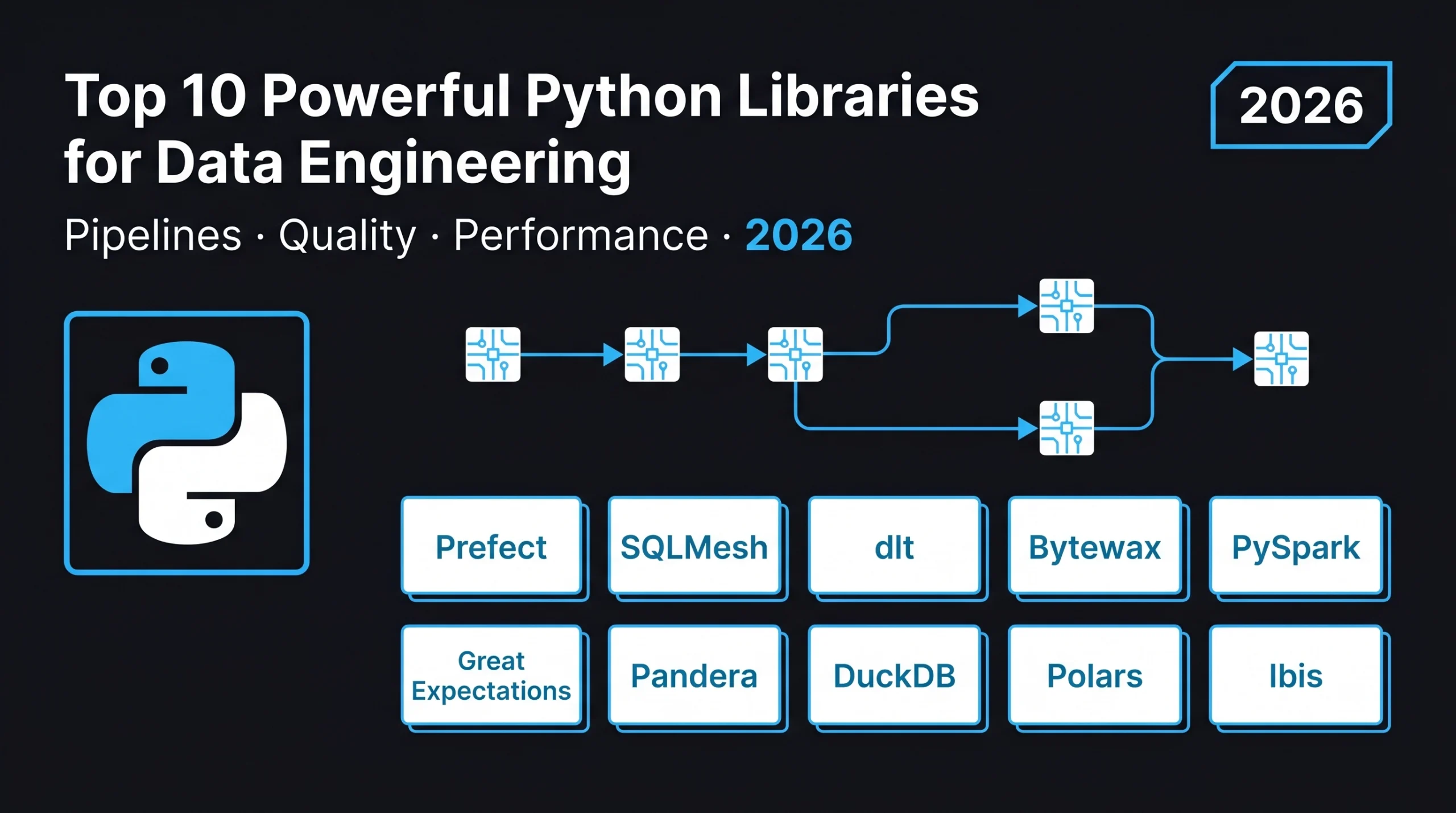
For the full picture of where Python fits in the data engineering stack, see our guide to Python Libraries for Data Engineering.
Python Foundation for Data Science Roadmap:
Here, this roadmap has different modules which are designed and mentioned from basic to advanced, which will make the complete Foundation for Data Science.
Module 1: Python Basics
The first step in everything is to clear the basics of it, so here the first step in your Python Foundation for Data Science is learning the basics, which are given below:
- Introduction to Python
- Installation of Python & IDEs
- Python objects and data types (numbers, strings, booleans)
- Operators (Arithmetic and comparison operators and Assignment operators, etc.)
- Operator precedence
These basics build the complete foundation which is necessary for working with different datasets and writing efficient Python scripts to handle data in a large organization.
Module 2: Python Control Statements
Everywhere naturally sometimes you will work based on conditions or apply conditions for working similarly in Data science, it often requires conditional logic and iterations when you deal with massive datasets. In this module, you will learn about conditional statements and Keywords:
- IF, IF-ELSE, and NESTED IF statements
- Loops (FOR, WHILE)
- BREAK and CONTINUE statements
Mastering these steps will help you to automate data tasks and control workflow in real projects, which is a very interesting fact.
Module 3: Python Data Structures
Sometimes you need to deal with the structured or unstructured data. So you need to efficiently and effectively handle the data which is the core skill of data science. In this module, we will cover those steps or methods that will help you to deal with the structure of data:
- Strings and built-in methods
- Lists, Tuples, Sets, and Dictionaries
- Object methods, comprehensions, and iterations for the above
These structures are crucial and necessary for data wrangling, cleaning, and transformation of data into useful form.
Module 4: Python Functions
This is an important step for the covering foundation of Python because functions make code reusable and scalable. Here you will learn:
- Basics of defining functions
- User defined functions ad Built in defined functions
- Function parameter passing
- Iterators and generator functions
- Lambda, Map, Reduce, and Filter functions
These are especially useful for data preprocessing pipelines and filtering the data from huge amount of data.
Module 5: Python NumPy Package
To cover and learn how to deal with the numerical computation of data, you should learn about NumPy, which is the backbone of numerical computing in Python. This module includes:
- NumPy Introduction
- Arrays as Data Structures
- Core NumPy functions
- Matrix Operations
With the help of NumPy, you can handle and deal with the large datasets and perform mathematical computations quickly on it and effectively.
Module 6: Python Pandas Package
Pandas is the most powerful data manipulation tool and skill for a data scientist to learn as a foundation. This module covers:
- DataFrame and Series (core data structures)
- Pandas functions
- Data munging and cleaning with Pandas
- Imputation and outlier analysis
- Pandas is the starting point for data work in Python.
- For a deeper look at how Pandas fits into the modern data engineering toolkit alongside faster alternatives like Polars and DuckDB, see our Python Libraries for Data Engineering guide.
In Python, this is the actual thing Pandas, which makes it is the favourite language for data analysis.
Necessary Python Tools & Platforms:
During your journey to learn Python Foundation for Data Science, you will work with industry standard tools like:
- Anaconda: package management and environment setup
- Google Colab: cloud based coding and experiments
- NumPy & Pandas: data analysis and computation libraries
FAQs about Python Foundation for Data Science
What is Python Foundation for Data Science?
The Python Foundation for Data Science is a beginner level roadmap that teaches and cover the Python basics, control statements, data structures, and important libraries like NumPy and Pandas to prepare you for advanced data science topics.
Why Python is important for Data Science?
Python is easy to learn also has powerful libraries, and is widely used in data analysis, machine learning, and AI fields for dealing with data. That is why starting with a Python Foundation for Data Science is essential.
How long does it take to learn Python Foundation for Data Science?
With full focus and Consistency it usually takes 40 learning hours (about 4 to 6 weeks for beginners) to complete the Python Foundation and become comfortable with the basics of coding and data handling for data science.
Do I need programming experience before starting Python Foundation for Data Science?
No, you do not need prior programming knowledge for learning python it is simple and easy. The course is designed for beginners, which covers the essential skills that starts with the very basics of Python.
What are the main topics covered in Python Foundation for Data Science?
The foundation includes:<br>Python basics<br>Control statements<br>Data structures<br>Functions<br>NumPy package<br>Pandas package
Which tools are used in the Python Foundation for Data Science?
You will use Anaconda for package management or offline practice, Google Colab for practice but it needs internet, and libraries like NumPy and Pandas for data handling and analysis.
Is Python Foundation enough to get a job in Data Science?
Python Foundation alone may not give you a data science job, but it is the first step toward data science jobs. After mastering in it, you will need to learn machine learning, big data, SQL, and AI also to become job-ready or able to do a job in data fields.
Can I learn Python Foundation for Data Science online?
Yes! Many online platforms teach Python Foundation courses with practical labs, including Colab and Jupyter notebooks for hands-on practice both free and paid.
How is Python used in real Data Science projects?
Python is used for cleaning data, analysing trends and insights of data, building predictive models based on the trends, visualizing results, and deploying machine learning solutions. Pandas and NumPy are the most common starting points.
What comes after Python Foundation for Data Science?
After completing the Python foundation, the natural progression is Data Science Foundation, then Machine Learning, then Advanced Data Science, Big Data tools like Spark and Kafka, and Business Intelligence. For the complete sequence with current 2026 skill weighting, see our guide to Becoming a Data Scientist in 2026.
Conclusion:
By completing the Python Foundation for Data Science (40 hours) with consistency, you will be equipped with the programming skills needed to advance into machine learning, big data, and AI. Think of it as your launchpad without this strong base or foundation, higher-level data science concepts become nearly impossible because they are all based on this roadmap.
If you are serious about a data career in 2026, Python is the right starting point, and this foundation is where that journey begins. Once you have completed this roadmap, the natural next steps are the Data Science Foundation, Machine Learning, and then the broader Data Engineer Roadmap if you want to move toward building pipelines and infrastructure.