
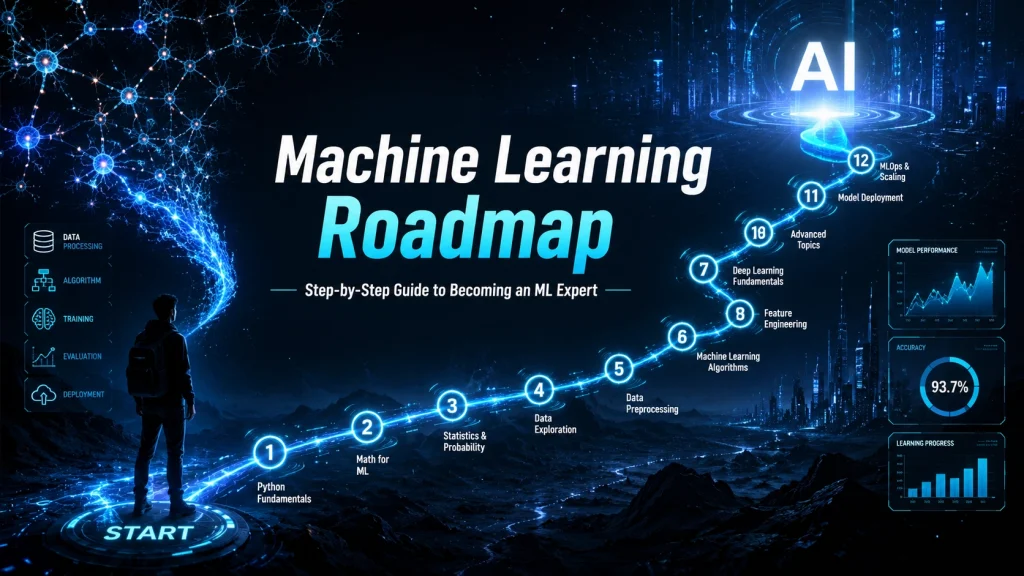
The Machine Learning Roadmap 2026 is a step-by-step guide covering 12 core ML modules: Introduction, Linear Regression, Logistic Regression, KNN, K-Means Clustering, PCA, Decision Trees, Naïve Bayes, XGBoost, SVM, ANN, and Advanced Concepts.
Table of Contents
Quick Answer: What Is the Machine Learning Roadmap 2026?
The Machine Learning Roadmap 2026, which is designed in such a way that 12 modules are presented to take beginners from zero knowledge to ML experts with the most demanded skills. It covers core algorithms (Linear Regression, KNN, SVM, Neural Networks), Python tools (Scikit-learn, Google Colab), and advanced techniques (XGBoost, PCA, Cross-Validation).
Key Takeaways: Tools and Platforms
- Now, machine learning is the backbone of modern AI, powering industries from healthcare to finance, which is driving a revolution in these areas.
- The Machine Learning Roadmap 2026 contains 12 structured modules from beginner to expert level.
- Core algorithms covered: Linear Regression, Logistic Regression, KNN, K-Means, PCA, Decision Trees, Naïve Bayes, XGBoost, SVM, and ANN.
- Tools: Scikit-learn, PyCharm, and Google Colab (free and cloud-based).
- The advanced module includes K-Fold Cross Validation, Grid Search CV, SMOTE, and Feature Selection.
- Total estimated time: 16–20 weeks of structured self-study.
- Starting today, with free tools gives you a measurable career advantage.
Overview:
Modern Technology is transforming every part of our lives, and in this transformation, machine learning (ML) is the actual backbone of this change.
If you have ever dreamed of becoming a Machine Learning Expert, then this year, 2026, is the actual year for you.
This year, in 2026, to understand how modern computers and machines learn, predict, and make valuable decisions, this will not only be a technical skill but also more valuable than ever, which acts or shows that it will be a core literacy and backbone of the digital companies in 2026 and beyond.
Machine Learning Roadmap 2026
Whether you are a student or just a data enthusiast to explore about data, or someone who wants to make and build intelligent systems, following the Machine Learning Roadmap 2026 will help you to develop the skills which are needed to lead you in the age of AI.
Let’s explore the full Machine Learning Roadmap 2026, which is divided into different modules. Which is helpful and gives you what you will learn in each module, why it matters, and how it shapes your future in 2026 and beyond also.
Why Machine Learning in 2026?
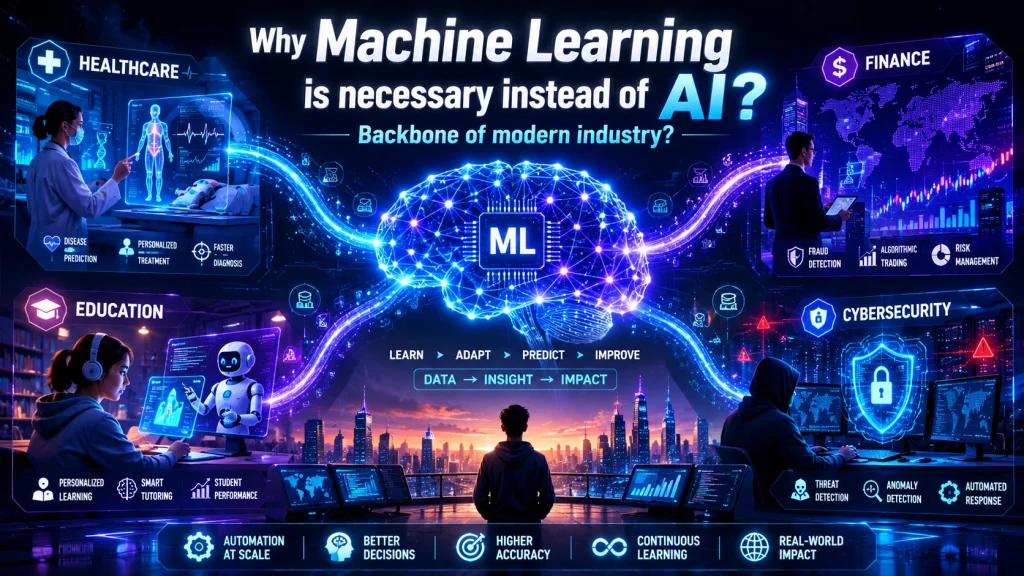
The world is based on completely data-driven decisions. From small healthcare to big finance organizations, entertainment to education, Artificial Intelligence (AI) and Machine Learning (ML) are all transforming industries faster than ever, which is very helpful and exciting work.
By 2026, experts in these technologies will lead towards innovation, creating smarter apps based on self-learning according to the environment, improving cybersecurity, and solving real-world problems using algorithms and automation techniques, which will lead to the successful data decision-making.
In simple and short words:
- Knowing about machine learning means knowing how to analyze, predict, and build models with different forms of data.
The better you understand these concepts, the better prepared you will be for the future jobs of the AI era in 2026 and beyond.
Prerequisites Before You Start Learning Machine Learning
What are the prerequisites you should know before starting the ML Roadmap 2026?
These are the main prerequisites that you should know before starting the ML Roadmap 2026:
- Python basics: Variables, loops, functions, and working with libraries (even one week of practice is sufficient)
- Elementary math: Basic statistics (mean, median, standard deviation) and algebra
- No degree required: This roadmap is designed for self-learners and career-changers
- Free prep resources: Python.org tutorials, Khan Academy statistics, or Google’s free Python Class

Important note:
This Machine Learning Roadmap 2026 is based on current industry hiring trends, which include widely adopted ML frameworks, and structured curriculum design principles that are used by the leading data science educators. All tools and algorithms referenced are actively used in production environments by professional ML engineers.
List of Machine Learning Modules to Learn in 2026 for Today and Future Use
Whether you are a student or just a data enthusiast who wants to explore data, or someone who wants to make and build intelligent systems based on trained data, following the Machine Learning Roadmap 2026 will help you to develop the skills which are needed to lead you in the age of AI.
Below is a complete Machine Learning Roadmap 2026, which is presented module by module for anyone who wants to become a Machine Learning Expert in 2026.
Module 1: Machine Learning Introduction
When you want to learn everything about Machine Learning, then start your journey by understanding that what is really Machine Learning (ML) and what it means and how it differs from the Artificial Intelligence (AI).
At the first stage you will explore about that:
- What is Machine Learning (ML)? Machine Learning (ML) vs Artificial Intelligence (AI)
- Machine Learning (ML) workflow and popular algorithms
- Clustering, Classification, and Regression
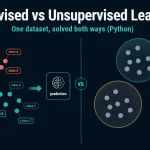
- Supervised vs Unsupervised Learning
Why is it necessary:
This is where your journey begins. By the end, you will learn how machines “learn”, “think”, “process on data”, and “make predictions”. It is the foundation for all Artificial Intelligence (AI) systems.
Module 2: Linear Regression
In this module, you will explore, learn and master the first algorithms, to learn it very well then follow these:
- What is Linear Regression and how does it model relationships
- The Regression and Best Fit Line concept will cover
- How to build and evaluate regression modeling in Python
Why is it necessary:
It is the foundation of all predictive analysis, which is used for forecasting and prediction tasks like predicting prices, trends, or sales. It is one of the most practical and important ML techniques for beginners.
Module 3: Logistic Regression
Next, in this, we are going to move to classification problems where outcomes are based on two results: yes/no or true/false.
This module includes:
- Introduction to Logistic Regression and its working
- Classification and Sigmoid Curve and its decision boundaries
- Model Evaluation in Python
Why is it necessary:
When you need a model that generates results and answers in the form of yes/no or true/false questions, logistic regression is your best choice.
Module 4: KNN (K-Nearest Neighbors)
A simple and powerful algorithm for pattern recognition is the K-Nearest Neighbors. You will learn and cover:
- Understanding the KNN concept and distance metrics
- How the algorithm finds the Nearest Neighbor to classify data
- Modeling and Evaluation in Python
Why is it necessary:
K-Nearest Neighbors (KNN) will help to identify patterns by comparing new data with existing ones or previous ones, which is great for recommendation systems and basic AI classification.
Module 5: K-Means Clustering
The next step is to understand about unsupervised learning, in which you will cover.
- Understanding Clustering (Unsupervised Learning) without labels
- K-Means Algorithm and centroid Theory
- Implementation of Clustering using Python
Why is it necessary:
This is helpful and used in customer segmentation, pattern detection, and data grouping. Actually perfect for those students who are interested in data analysis.
Module 6: Principal Component Analysis (PCA)
The next module will help to cover the Dimensionality reduction. You will cover:
- The Building Blocks of PCA
- How to Find Principal Components
- Modeling PCA in Python for data visualization and optimization
Why is it necessary:
PCA will help to simplify large datasets while keeping key insights. It is crucial for handling big data efficiently and effectively.
Module 7: Decision Tree
Here, this is the module that prepares your techniques that act like a human. This module will cover the:
- Decision Trees and Random Forests
- Bagging Technique for improved accuracy
- Model Evaluation in Python
Why is it necessary:
One of the easiest and most visual ML algorithms is the Decision Tree Algorithm which is used in credit scoring, medical diagnosis, and recommendation systems.
Module 8: Naïve Bayes
These module focus on understanding Bayes’ theorem and how probability drives intelligent predictions. So, this module covers the:
- Introduction to Naïve Bayes classification
- Bayes’ Theorem Explained
- Text Classification with Naïve Bayes
Why is it necessary:
This algorithm has the power to work on the email spam filters, text prediction, and sentiment analysis all skills in high demand.
Module 9: Gradient Boosting and XGBoost
This will boost your model’s accuracy, then learn about boosting:
- The logic behind Boosting Algorithm Basics
- Weak Learners Concept
- How XGBoost dominates Kaggle competitions
- Model Evaluation in Python
Why is it necessary:
Boosting algorithms dominate Kaggle competitions for their accuracy. Perfect for those who love data science challenges and problems to solve using data solving techniques.
Module 10: Support Vector Machine (SVM)
The SVMs are crucial for complex classification tasks. So you will learn about these:
- Introduction to SVM
- Kernel Trick Concept
- Modeling SVM in Python
Why is it necessary:
SVMs are the best and most powerful Algorithm for complex classification tasks like face recognition and image analysis.
Module 11: Artificial Neural Network (ANN)
This will give you knowledge about deep learning:
- Basic structure of Artificial Neural Network (ANN)
- How Backpropagation and Gradient Descent Work
- Model Building and Evaluation in Python
Why is it necessary:
This is where AI truly comes alive because it goes deep into Artificial Intelligence. Neural networks power everything from ChatGPT to self-driving cars.
Expert Perspective:
The well-known leading AI researchers consistently note that the most effective ML practitioners are those who master the fundamentals deeply before advancing to deep learning. Understanding linear algebra, probability, and core algorithms remains the irreplaceable foundation for anyone entering the field. The 12-module structure above reflects this principle: classical algorithms first, neural networks after.
Module 12: Advanced Machine Learning Concepts
Finally, master professional-level ML evaluation and optimization techniques, which is the professional and advanced concepts for Machine Learning 2026
- Model Metrics (AUC, R², Precision, Recall)
- K-Fold Cross Validation
- Grid Search and Random Search CV
- SMOTE (for Imbalanced Data)
- Feature Selection Techniques
Why is it necessary:
These techniques take your models from good to world-class models and will give unique identity among the other models. They help you tune, test, and deploy real production-level systems.
Estimated Time Per Module
| Module | Topic | Estimated Time |
| 1 | ML Introduction | 1 week |
| 2 | Linear Regression | 1 week |
| 3 | Logistic Regression | 1 week |
| 4 | KNN | 1 week |
| 5 | K-Means Clustering | 1 week |
| 6 | PCA | 1–2 weeks |
| 7 | Decision Tree | 1 week |
| 8 | Naïve Bayes | 1 week |
| 9 | XGBoost | 2 weeks |
| 10 | SVM | 1–2 weeks |
| 11 | ANN | 2 weeks |
| 12 | Advanced ML | 2–3 weeks |
| Total | Full Roadmap | ~16–20 weeks |
Industry-Validated Best Practices for ML Learners in 2026
- Always split data into training, validation, and test sets before training a model.
- Use K-Fold Cross Validation instead of a single train/test split for more reliable evaluation.
- Address class imbalance with SMOTE before training classifiers on skewed datasets.
- Monitor both Precision/Recall and AUC-ROC — accuracy alone is insufficient for production models.
- Also learn and gain a strong grip on version control because you will share your ML experiments and tools like MLflow or Weights & Biases.
ML Algorithm Comparison Table
| Algorithm | Type | Best For | Difficulty |
| Linear Regression | Supervised | Price prediction, forecasting | Beginner |
| Logistic Regression | Supervised | Binary classification (yes/no) | Beginner |
| KNN | Supervised | Pattern recognition, recommendations | Beginner |
| K-Means | Unsupervised | Customer segmentation, grouping | Beginner |
| PCA | Unsupervised | Dimensionality reduction, big data | Intermediate |
| Decision Tree | Supervised | Credit scoring, medical diagnosis | Beginner–Intermediate |
| Naïve Bayes | Supervised | Spam detection, text classification | Beginner |
| XGBoost | Supervised | Competition-level data accuracy | Intermediate |
| SVM | Supervised | Face recognition, image analysis | Intermediate |
| ANN | Supervised | Deep learning, speech, NLP | Advanced |
Entity Clarifications
- Scikit-learn: Open-source Python ML library developed by INRIA (France), the standard toolkit for all algorithms in this roadmap.
- Google Colab: Google’s free Jupyter notebook cloud environment — no local installation required, ideal for beginners.
- PyCharm: Python IDE by JetBrains, used for structured Python development and larger project organization.
- XGBoost: Optimized gradient boosting framework developed by Tianqi Chen, widely used in industry and Kaggle competitions.
Career Paths After Completing This ML Roadmap
Completing the Machine Learning Roadmap 2026 opens doors to these in-demand career roles:
- Machine Learning Engineer: build and deploy ML models in production
- Data Scientist: analyze data and generate predictive insights
- AI Research Analyst: work on algorithm development and innovation
- Data Analyst (AI-enhanced): apply ML techniques to business data
- NLP Engineer: specialize in text classification and language models
- Computer Vision Engineer: apply SVM and ANN to image/video analysis
Industries actively hiring ML professionals include tech, fintech, healthcare, e-commerce, cybersecurity, and autonomous vehicles.
The Future of Machine Learning Expert
In 2026, learning about ML will extend your knowledge beyond classrooms into clouds, AI labs, and online platforms.
Students who have started mastering machine learning today will be the innovators building tomorrow’s technology.
Machine Learning does not replace human intelligence, but it amplifies it in a better way than humans.
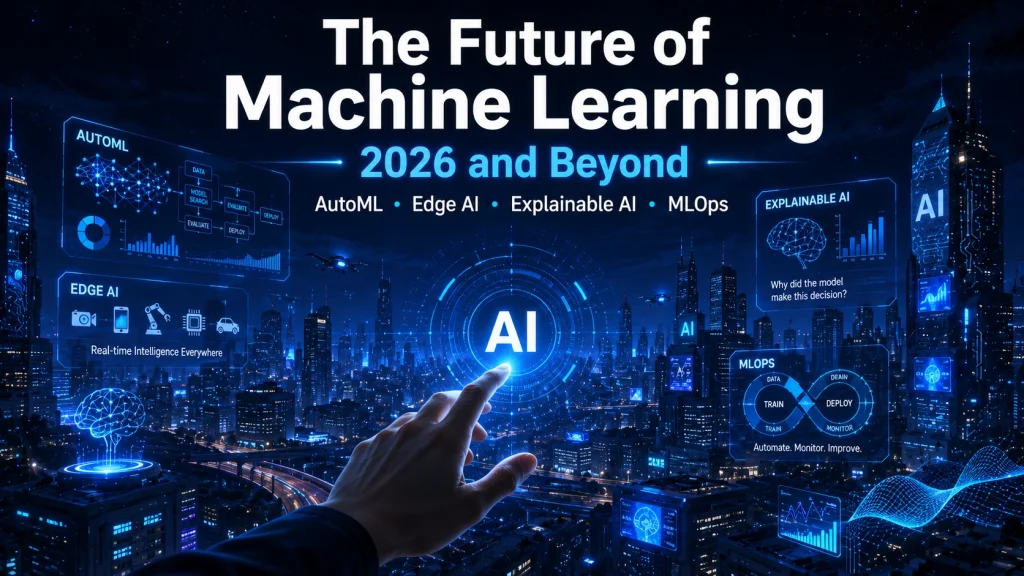
Future Trends in Machine Learning
- AutoML: Automated machine learning tools (Google AutoML, H2O.ai) will make model-building more accessible while raising the baseline expectations for practitioners.
- Edge AI: ML models running on local devices (phones, sensors) rather than the cloud, increasing demand for optimized, lightweight models.
- Explainable AI (XAI): Regulatory and ethical pressure is driving demand for ML engineers who can explain model decisions, especially in healthcare and finance.
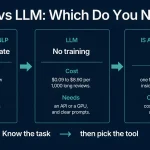
- LLM Integration: Large Language Models like GPT-4 and Claude are being integrated with classical ML pipelines for hybrid AI systems.
- MLOps: The discipline of managing ML model deployment, monitoring, and maintenance in production is becoming as important as model building itself.
Common Mistakes Beginners Make When Learning ML
- Skipping the math: Basic probability and linear algebra help you truly understand what algorithms do.
- Copying code without understanding it: Always rebuild models from scratch at least once per module.
- Ignoring model evaluation: Accuracy alone is misleading; always check Precision, Recall, F1, and AUC.
- Jumping to neural networks too early: Master simpler algorithms first; XGBoost and SVM still outperform deep learning on structured data.
- Not building real projects: Apply each module to a real dataset from Kaggle or the UCI ML Repository.
- Neglecting data preprocessing: Cleaning and transforming data is 60–80% of the real-world ML job.
FAQ: Machine Learning Roadmap 2026
Q: What is the best way to start learning machine learning in 2026?
The best way to start learning machine learning in 2026 is to follow the best structured roadmap, which begins with the foundational concepts and progresses through Linear Regression, Classification, Clustering, and Neural Networks. Using free tools like Google Colab and Scikit-learn lets you to practice immediately without any setup cost.
Q: How long does it take to complete the Machine Learning Roadmap 2026?
The full 12-module roadmap typically takes 16 to 20 weeks when studying consistently (approximately 1–2 hours per day). The timeline may vary based on your existing Python and math skills.
Q: Do I need a degree to follow the Machine Learning Roadmap 2026?
No there is no need for any degree which is required to learn machine learning. The roadmap is designed for self-learners, students, and career-changers. Basic Python programming and elementary math are helpful, but can be learned in parallel.
Q: What tools do I need to start machine learning in 2026?
There are some core tools that are needed to learn machine learning: Scikit-learn (Python’s most popular ML library), Google Colab (free cloud-based notebook, no local installation needed), and PyCharm (Python IDE). All these three tools are completely free.
Q: What is the difference between supervised and unsupervised learning?
Supervised learning which trains models on labeled data to make predictions (e.g., Linear Regression, SVM). Unsupervised learning finds hidden patterns in unlabeled data without predefined answers (e.g., K-Means, PCA). This roadmap covers both in the best way.
Q: Which machine learning algorithm should I learn first?
Start with Linear Regression because it introduces the foundational concepts of how ML models learn patterns from data, including the Best Fit Line, model evaluation, and Python implementation.
Q: Is machine learning worth learning in 2026?
Yes. ML is one of the most in-demand technical skills globally. AI and ML are transforming healthcare, finance, education, and cybersecurity. Professionals with ML expertise are building the next generation of intelligent applications.
Conclusion: Start Machine Learning Today
If you want to build a future-ready and best career, do not wait for 2026; start from today.
The earlier you begin with machine learning using the machine learning roadmap 2026, the sooner you will understand how machines think, predict, and learn. So, start learning today with free tools like Google Colab and Scikit-learn, and take your first step toward becoming a Machine Learning Expert in 2026.
Remember:
The students who understand technology today are not just part of the digital world, they are shaping it in a better way for his/her future.