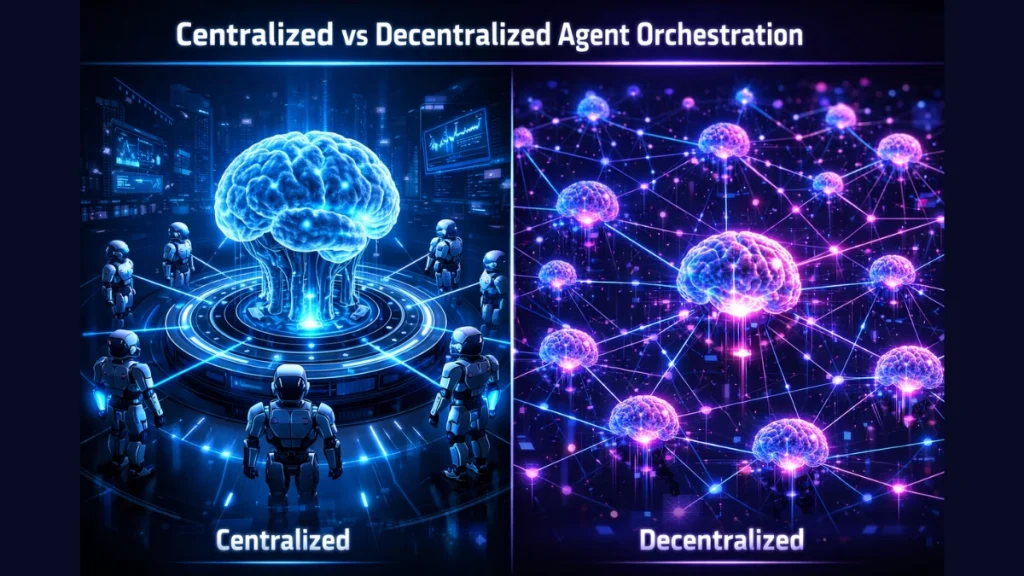
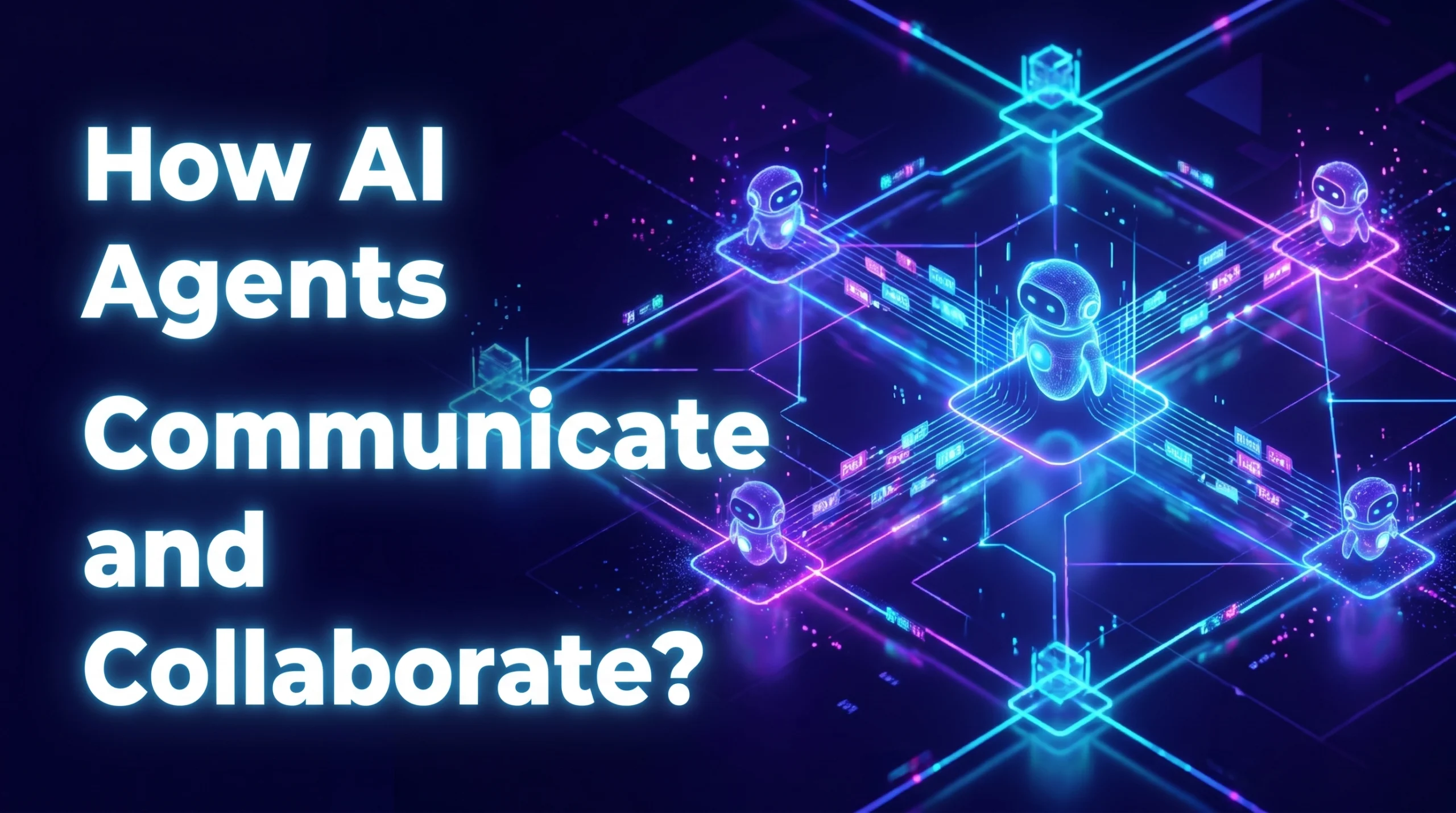
When multiple AI agents need to work together, the biggest design decision is not just about how they collaborate and coordinate, but rather “who controls the entire system”.
Here are a few questions that come to my mind:
“Should one central controller manage everything, or should agents operate independently and coordinate among themselves?”
These questions sit completely at the heart of centralized vs decentralized agent orchestration, and getting it wrong can quietly break a system that looks perfectly that is designed on paper.
This article completely breaks down both models clearly in terms of their differences, trade-offs, and when each approach actually makes sense, and which one is effective.
Centralized vs Decentralized Agent Orchestration
Quick Answer
Centralized agent orchestration uses a single controller to manage all agents, which ensures structured coordination and control for the entire system.
Decentralized orchestration allows all agents in the entire system to operate independently while making coordination with each other, to offer flexibility and scalability.
The Two Core Orchestration Models
Before diving deeply into the comparisons of the centralized vs decentralized agent orchestration, this helps you understand what each model actually looks like in reality.
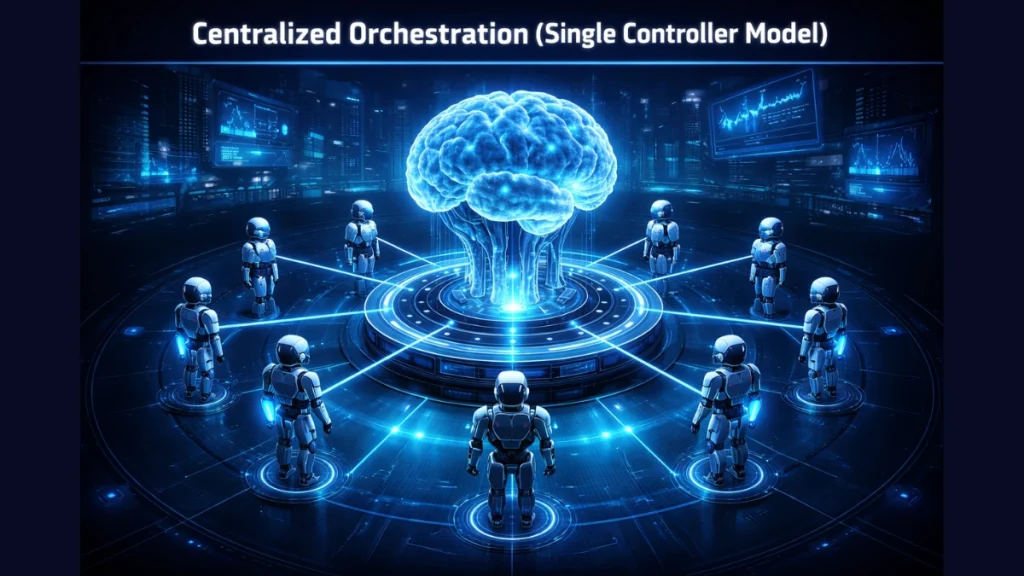
Centralized Orchestration is a (Single Controller Model)
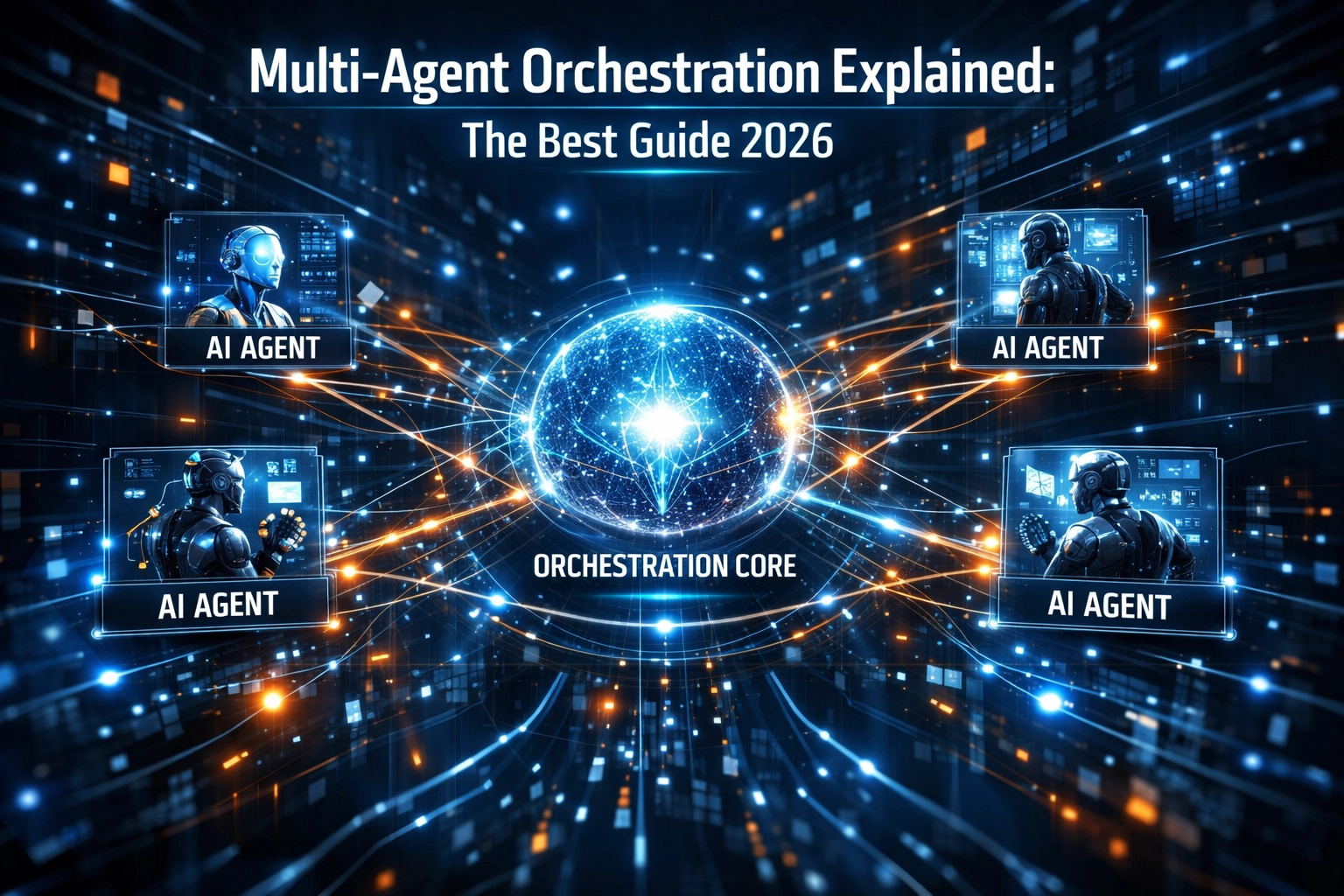
In a Centralized Orchestration, one main agent, called the orchestrator or controller, acts as the brain of the system operations, which sits at the top of the system to control and manage everything in the entire system.
It decides that:
What agent is responsible for the specific action
In what order are tasks executed
When actions should happen,
Just like the human brain, which controls all activities in the body.
Centralized Agent Orchestration
Key characteristics:
A single system assigns tasks and manages all tasks
Control flow and decision-making are clear and traceable
Monitoring, logging, and debugging happen in one place
Think of this as a manager assigning tasks to a team, in which every action is directed and tracked by the manager.
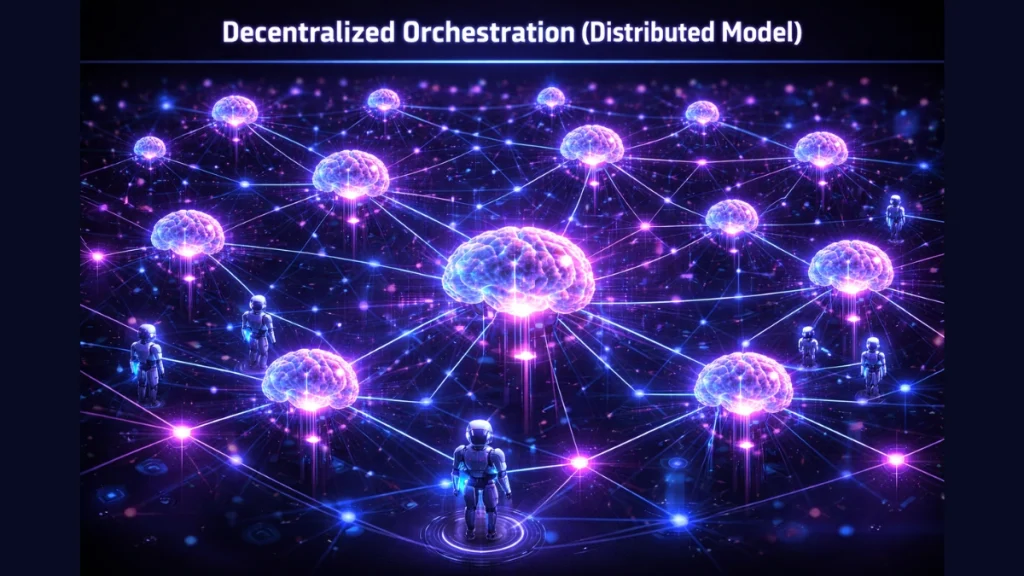
Decentralized Orchestration is a (Distributed Control Model)
In a Decentralized Orchestration, there is no single controller to act as a central entity that has full authority over the entire system to manage it, where all agents in Decentralized Orchestration make their own decisions and coordinate directly with each other to complete tasks.
Key characteristics:
No single controller owns the decision-making process, but the decisions are made collaboratively
Agents communicate peer-to-peer means directly with each other and adapt based on what others are doing
Each agent can act based on local context
The system is more autonomous and can handle unexpected situations in a more effective and efficient manner.
Suppose there is a team of specialists who are working on a complex project, where the actual manager does not deal with everything alone, but other team members also coordinate based on shared goals and make a direct communication when needed to solve the problems in an effective manner.
Decentralized Agent Orchestration
Key Differences Between Centralized and Decentralized Orchestration
The differences are not just about having “one controller or many,” this is only the surface difference.
The real impact starts where each design choice affects that:
How the system reacts when things get busy (load)
When something breaks (failure) or
When you need to update or scale it (change)
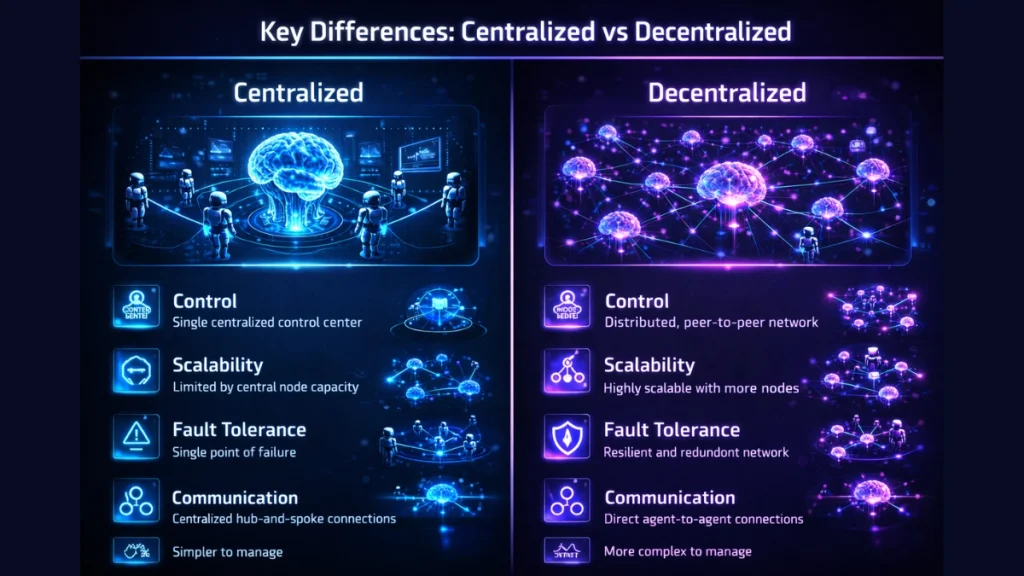
Key Differences Between Centralized and Decentralized Orchestration
Comparison Table:
Feature
Centralized
Decentralized
Control
Single controller
Distributed across agents
Communication
Through the central node
Peer-to-peer
Scalability
Limited by the controller
Highly scalable
Fault tolerance
Single point of failure
Resilient to failures
Complexity
Easier to build
Harder to design
Control Structure
Centralized: In this, only one authority acts as the main controller, which makes decisions and controls all agents in the centralized orchestration system.
Decentralized: The control is shared across different agents to:
negotiate, vote, or follow protocols to decide what happens next, without asking anyone.
Centralized systems are easier to understand because you can look at one place to understand the system state and what is going on. In comparison, Decentralized systems are harder to understand because the behaviour comes from many agents working together in the system.
Communication Flow
Centralized: All communication goes through the central point, where agents do not talk to each other directly in peer-to-peer, but they report to the main controller while working.
Decentralized: All agents have the ability to communicate directly without any hesitation or hurdles while working. An agent can ask another agent directly for information, pass a result, or trigger a follow-up action without going through any central point or requesting the controller.
Scalability
Centralized: This model scales based on the capacity of the controller. When more agents are added, the controller must handle more instructions, more states of tracking, and more coordination overhead. Eventually, it becomes the limiting factor for this type of model.
Decentralized: Scalability is the main factor of the decentralized system. This model scales more when the number of agents increases. Adding new agents does not make burdens, but they simply join the network to start coordinating with their peers to make the system more responsive and more adaptable.
This is one of the most underappreciated differences. Many teams start with centralized orchestration because it is simpler, then run into scalability ceilings only after the system grows. Planning for scale from the start changes the architecture decision significantly.
Fault Tolerance
Centralized: In a centralized system, the controller is the main single point of failure. If it fails, then the entire system fails, even if all other individual and connected agents are perfect and working.
Decentralized: Failure of one agent does not stop the entire system from working; only the affected system can stop working, but other remains working. This makes the decentralized systems inherently more resilient.
Real-world implication: If the central controller crashes, the entire system may stop. In decentralized setups, other agents can continue working.
Complexity
Centralized: Simpler and easier to design, implement, and understand. The logic lives in one central place.
Decentralized: The decentralized system requires significantly more complex coordination logic than a centralized one because you need some set of protocols for how agents discover each other, how they resolve conflicts, and how they handle partial failures. The coordination logic is distributed throughout the whole system, which makes it a complex system and harder to trace and test.
Each participant reacts to events and coordinates independently
These patterns come directly from distributed systems and microservices design, and it maps directly to the AI agent systems.
Understanding this helps strengthen your architectural decisions and aligns your design with proven system patterns in AI agent systems.
Orchestration vs Choreography
Advantages and Limitations of Centralized Orchestration
Advantages of Centralized Orchestration
Easier control and visibility: When something goes wrong, you have the opportunity to look at the central place. Activities like Logs, state, and decisions are centralized, which helps in making debugging much faster.
Predictable behaviour: the behaviour is predictable because one controller manages the flow, and the system behaves consistently. You can understand execution order, dependencies, and outcomes without guessing how agents will coordinate.
Simplified monitoring: due to the central system, Dashboards, alerts, and observability tools have one integration point. This is not a minor benefit; teams operating AI agent systems at scale will tell you that visibility is often more valuable than raw performance.
In practice, centralized systems are ideal when correctness matters more than flexibility.
Limitations of Centralized Orchestration
Single point of failure: This problem is easy to notice, but the bigger risk is less obvious:
Even a small or temporary slowdown in the main controller can slow down the whole system, not just one part.
Bottlenecks under heavy load: As the task volume increases, the controller spends more time managing coordination than agents spend doing actual work. This ratio gets worse as systems scale.
Less flexible in dynamic environments: a situation where your environment changes faster than the expected rate, the centralized controller needs to handle all adaptations, which often requires more complex logic and tighter coupling, which is possible in the decentralized system.
Advantages and Limitations of Decentralized Orchestration
Advantages of Decentralized Orchestration
High scalability across many agents: The best advantage of this system is its high scalability, because the addition of agents is possible without redesigning the system.
Fault tolerance and resilience: When one agent fails, the rest of the system does not collapse and tolerates the burden. Agents adapt and continue their process. This is especially important in long-running workflows.
Adaptive and flexible behaviour: in this system, all agents can work on their defined conditions without waiting for a central authority to approve or direct each action. In the fast-changing environments, this is a significant operational advantage to make the system more adaptive.
Limitations of Decentralized Orchestration
Harder to design and manage: Writing the logic for how agents coordinate without a central brain requires careful protocol design and expertise, too. Common problems, like two agents attempting the same task simultaneously, or agents waiting on each other in a cycle, are easy to introduce but hard to detect.
Complex communication patterns: Peer-to-peer coordination generates more communication overhead. Agents need to send and receive more messages, and the patterns are less predictable.
Difficult in debugging and coordination: When something goes wrong in a decentralized system, tracing the main root cause means reconstructing a distributed decision-making chain, which is significantly harder than checking in a central place.
Expert insight: The biggest challenge is not building decentralized systems, but it is controlling the emergent behaviour of this system. Agents may act correctly individually but create unexpected outcomes collectively.
How to Choose the Right Model or When to Use Centralized vs Decentralized Orchestration
The right model is not about which one is “better” in the Centralized vs Decentralized Orchestration, it is about which one is well-suited for your situation.
Use Centralized When
You need strict control and predictability, Such as in regulated industries, compliance-sensitive workflows.
Your System small to medium in size: If you are managing a few agents with clear roles, a central system is quicker to build and easier to maintain.
Simpler, sequential workflows are involved: If agents work in a clear order with little need for parallel adaptation, centralized control is the natural fit for it because the workflows are clearly defined and stable.
Use Decentralized When
You need scalability across many agents: This system coordination prevents a central controller from becoming a bottleneck.
The environment is dynamic or unpredictable: The Agents that adapt locally in the domain of the agent personally handle changes better than those waiting for central instructions.
Agents must operate independently: In unreliable networks, the agents that do not depend on constant central contact are more resilient.
Real-World Scenario Comparison (Conceptual)
Centralized Example
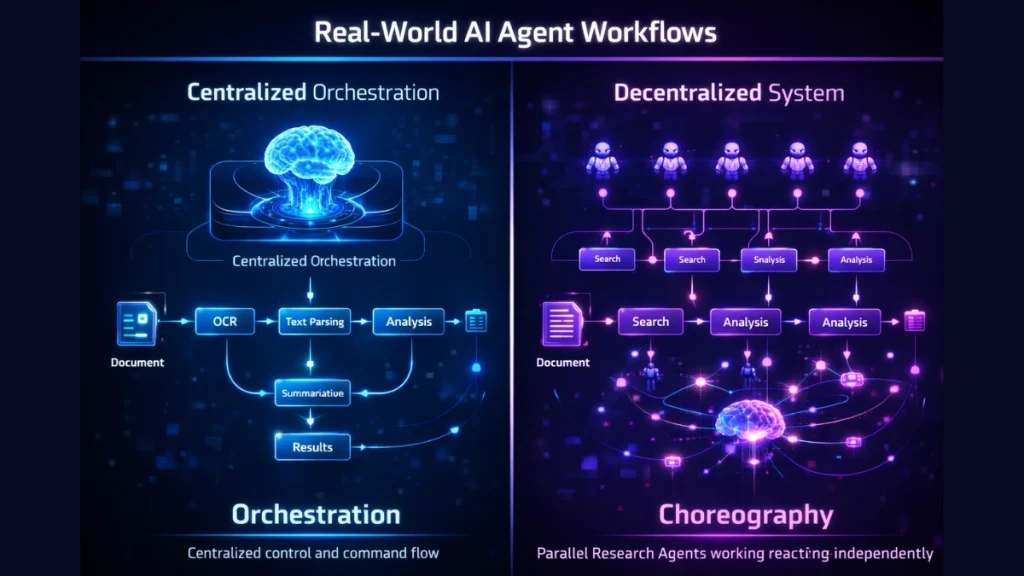
Imagine a document processing system where multiple specialized agents handle different steps:
One agent extracts text, one agent classifies content, and one agent routes to the right output.
A central controller receives each document, assigns it to the extraction agent, waits for the result, passes it to the classifier, and then routes based on the classification output.
This works well, and the workflow is predictable; each step is traceable, and failures are easy to diagnose. But if document volume grows, the controller becomes the limiting factor, even if each agent has capacity to spare.
Outcome: Predictable, but slower to adapt if something changes.
Decentralized Example
Now imagine a research assistant system where multiple agents work on different parts of a complex query simultaneously.
One agent searches recent data,
another pulls background context,
another evaluates source credibility.
This handles parallelism naturally and adapts when one source is slow or unavailable. But if two agents draw conflicting conclusions, the resolution of that conflict requires coordination logic that must be built into the agents themselves, not handled by a central one.
Outcome: Faster adaptation, but less predictable behaviour.
Real World AI Agents Workflows
Where Systems Fail in Practice (Hidden Trade-offs)
Most explanations stop at the surface-level differences, but in real-world practice, failures happen due to deeper issues:
Centralized systems often fail when:
The controller becomes overloaded
Latency increases due to coordination overhead
Small delays cascade across the system
Decentralized systems often fail when:
Agents make conflicting decisions
Coordination loops or deadlocks occur
System behaviour becomes unpredictable
These are not theoretical problems; they are common in real-world systems.
Hybrid Orchestration (What Most Systems Actually Use)
In real-world systems, the choice is rarely purely centralized or decentralized.
Instead, many systems use a hybrid approach:
Central control for critical workflows
Decentralized coordination for parallel or adaptive tasks
This allows:
Control where needed
Flexibility where possible
Hybrid models often emerge naturally as systems scale.
FAQ of Centralized vs Decentralized Orchestration
What is the main difference between centralized and decentralized agent orchestration?
Centralized agent orchestration basically depends on a single controller, which is used to manage all agents, ensuring the structured coordination and control for the entire system. The decentralized orchestration enables all the agents in the entire system to operate independently while coordinating with each other, to offer flexibility and scalability.
Which orchestration model is better for scalability?
Decentralized orchestration is best for the term scalability because it scales more naturally when there is adding more agents; it does not increase load on a single control point, this ability making it better suited for large or growing systems.
Is centralized orchestration easier to implement?
Centralized systems are easier to implement due to their simple design as compared to decentralized systems. The logic is concentrated in one main central agent, which makes the development and monitoring of the system easier.
Why is decentralized orchestration more complex?
Agents must coordinate without a shared authority. This mechanism requires designing protocols for: communication, conflict resolution, and task allocation for the system. All these tasks are distributed across different agents, which makes it harder to trace when problems arise.
Can both models be combined?
Yes. Hybrid architecture is the main practical example of the combination of centralized and decentralized systems.
Which model is more reliable?
Decentralized systems are more reliable due to their ability to tolerate more faults, where no single failure point can bring the whole system down or stop working.
Does decentralized mean no coordination?
Not at all, coordination still happens in decentralized systems; it is just distributed among agents instead of managed centrally. Agents follow shared protocols, communicate directly, and collectively manage task completion. The difference is that no single agent is permanently in charge.
Conclusion
Centralized and decentralized agent orchestration represent two fundamentally different ways of thinking about building the best controlling AI system.
Centralized models offer clarity, control, predictability, and simpler operations, at the cost of scalability and resilience.
Decentralized models offer flexibility, fault tolerance, and natural scalability, at the cost of design complexity and harder debugging.
No one is universally superior. The better question is: what does your system actually need? So, the right choice depends on your system’s size, complexity, and performance goals.
Start with a centralized approach if your system is small, structured, or needs strict control.
If your system is large, fast-changing, or involves many agents working at the same time, go with a decentralized design from the beginning, as it is much harder to switch to it later.
If you need both control and flexibility, you can combine the two. Many strong systems use a mix:
central control where order matters, and
decentralized coordination where flexibility is needed.