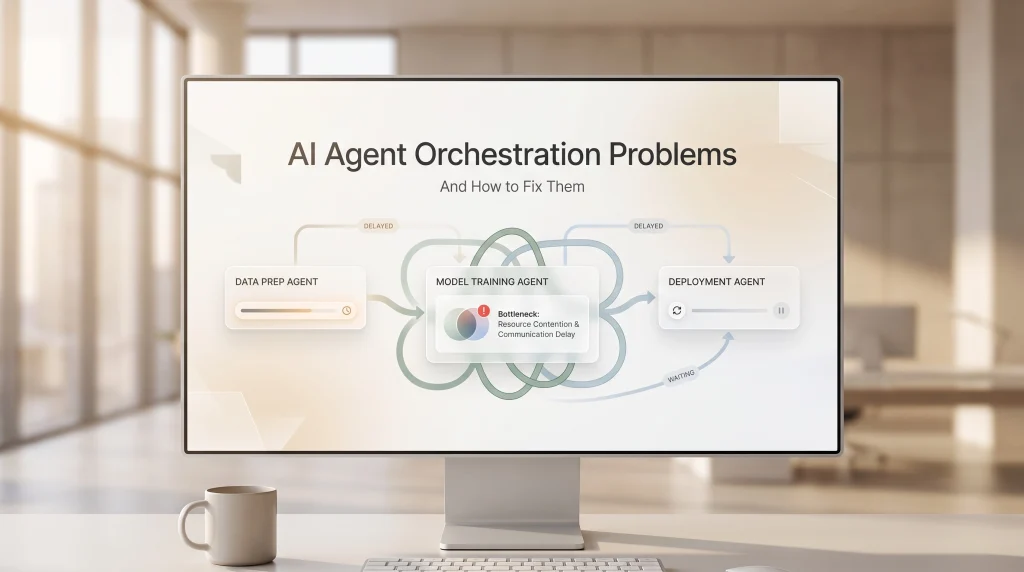
AI agent orchestration problems rarely appear, but all at once. Most of the systems fail gradually due to these reasons, such as coordination delays, unreliable task handling, and hidden communication bottlenecks.
The AI agent orchestration challenge is not just about identifying problems, but also about understanding which issues create the biggest downstream failures in the system before they become expensive for the orchestration system.
This guide focuses on the most common AI Agent Orchestration problems, why they happen in real production systems, and also the fastest and most practical ways to fix them.
AI Agent Orchestration Problems
Quick Answer
AI agent orchestration problems usually come from the coordination complexity, communication failures, and unreliable task execution.
Small issues often quickly grow into larger system-wide failures
Most bottlenecks (slowdowns) appear during growth and production deployment
The best fixes focus on simplifying the coordination and improving reliability
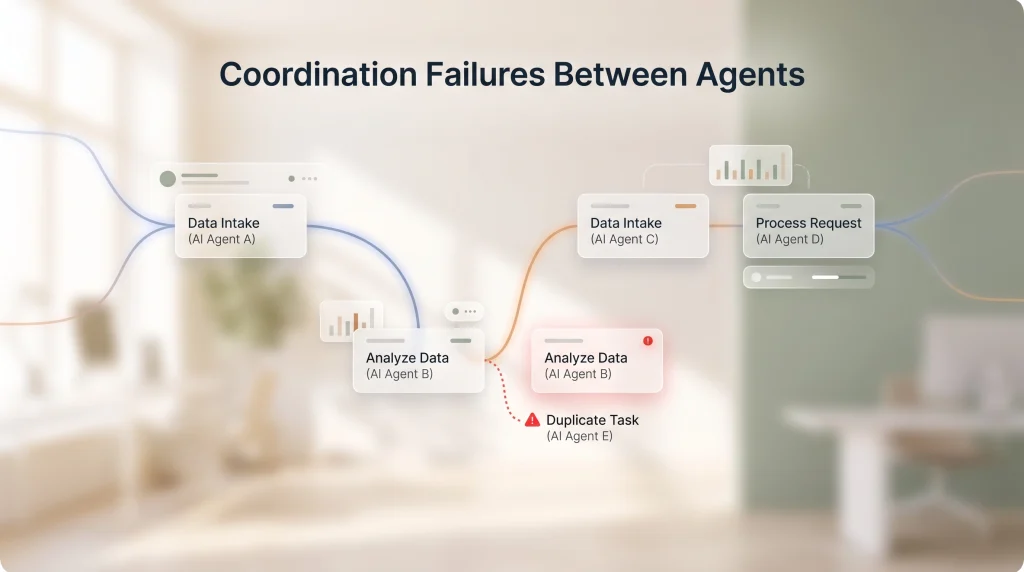
Coordination Failures Between Agents
Coordination failure is one of the most common reasons which multi-agent systems underperform in the production or AI orchestration. It happens basically when agents do not have clear and specified boundaries, as a result, they interfere with each other instead of working together in the Orchestration system.
Coordination Failures Between Agents
Conflicting Decisions Between Agents
When two agents want to attempt and handle the same task at the same time, as a result, they can produce conflicting outputs. In practice, this happens with tools like LangGraph when agent graphs are not structured with strict ownership rules, so the conflict occurs.
One agent updates a shared state. Another reads stale data (outdated data). Both produce outputs, but neither is correct.
This creates a subtle (meaning small, not obvious, or hard to notice) but costly failure: the system looks like it is working, but its decisions contradict each other downstream.
Task Duplication and Execution Overlap
Without task ownership logic, multiple agents may execute the same job in parallel with each other. This is not just inefficient; it creates duplicate actions in the downstream systems.
Think of an orchestration pipeline where an email agent and a notification agent both trigger because neither knew the other had already fired. Teams using frameworks like CrewAI or AutoGen often run into this early. Adding more agents without defining roles makes it worse, not better.
If Coordination Slows → System Efficiency Collapses
Here is the real issue: coordination overhead compounds. Every new agent you add without a clear role assignment increases the number of potential conflicts not linearly, but exponentially.
In production systems, coordination failures rarely cause immediate crashes. They accumulate silently, which degrades output quality before teams realize what’s happening.
Fix: Role Boundaries and Structured Task Ownership
Define strict input/output contracts for every agent
Use a shared state manager with read/write permissions per agent
Assign task ownership at design time, not at runtime
Tools like LangGraph’s state graph architecture make this enforceable
Communication Bottlenecks That Break Systems
More agents mean more messages, and more messages, without the right design, mean more delays. Communication is the hidden bottleneck(slowdown) that most teams do not notice until production.
Message Overload and Delayed Responses
In the AI orchestration systems where multiple agents communicate frequently, basically, they are actually:
Passing context,
Requesting confirmations, or querying shared memory;
As a result, the message queues can fill up fast.
If an orchestrator is waiting for three agents before it can proceed, so the slowest agent will set the pace for the entire pipeline. This is a classic multi-agent orchestration issue that teams face when scaling from 3 to 10+ agents without redesigning communication patterns.
Dependency Chains That Create Cascading Slowdowns
A dependency chain is when Agent B cannot start until Agent A finishes, and Agent C waits on B. Then, as a result, every delay in the chain gets multiplied.
What started as a 200ms latency in one agent becomes a 2-second delay at the output.
The real issue is that most teams build these chains without realizing it, because sequential workflows feel logical at design time.
In Practice: Why More Agents Can Reduce Performance
A team adds specialist agents to improve output quality. Each new agent adds one more communication hop, and latency doubles. The user experience degrades, despite better individual-agent accuracy.
This is one of the most overlooked multi-agent orchestration issues in the production systems. More agents do not automatically mean better results.
Fix: Reduce Unnecessary Communication Paths
Map all agent communication flows before adding new agents
Identify and parallelize independent tasks that do not chain what does not need to be chained
Use async messaging where real-time confirmation is not required
Reduce shared-state reads, pass data forward instead of requesting it repeatedly
Unreliable Task Execution and Recovery Problems
Important to note that even well-designed orchestration systems face task failures. The problem is not that tasks fail; it is that most systems have no reliable way:
To detect, handle, or recover from them.
Failed Tasks with No Retry Handling
When an agent calls an external API and gets no response, what happens? In many production setups, nothing. The task silently dies. The orchestrator does not know. Downstream agents wait indefinitely or proceed without the data they need.
This is one of the most damaging AI orchestration failures points that teams encounter in the production. It is invisible until users report errors.
Agents Stuck in Incomplete Workflows
An agent that receives a malformed input may not crash; it may just loop. Or return a partial response. Or pause waiting for a clarification that never comes.
In LangChain-based workflows, for example, agents can enter indefinite tool-calling loops if exit conditions are not clearly defined. The result is a frozen pipeline that consumes resources without producing the output.
A Common Failure Pattern: Silent Task Failure
In production systems, the most dangerous failures are the quiet ones. An agent marks a task as “complete” but returns empty output. The orchestrator moves on. The user receives a broken final result, with no error message and no trace of where it went wrong.
This pattern is far more common than outright crashes, and far harder to catch without proper output validation.
Fix: Fallback Systems and Retry Policies
Define explicit success and failure states for every task; never leave outcomes ambiguous because ambiguity leads to misconceptions
Most importantly, implement retry logic with exponential backoff for all external calls
Add timeout handlers so agents do not block indefinitely
Use dead-letter queues or fallback agents for tasks that repeatedly fail
Validate agent output format before passing it to the next step
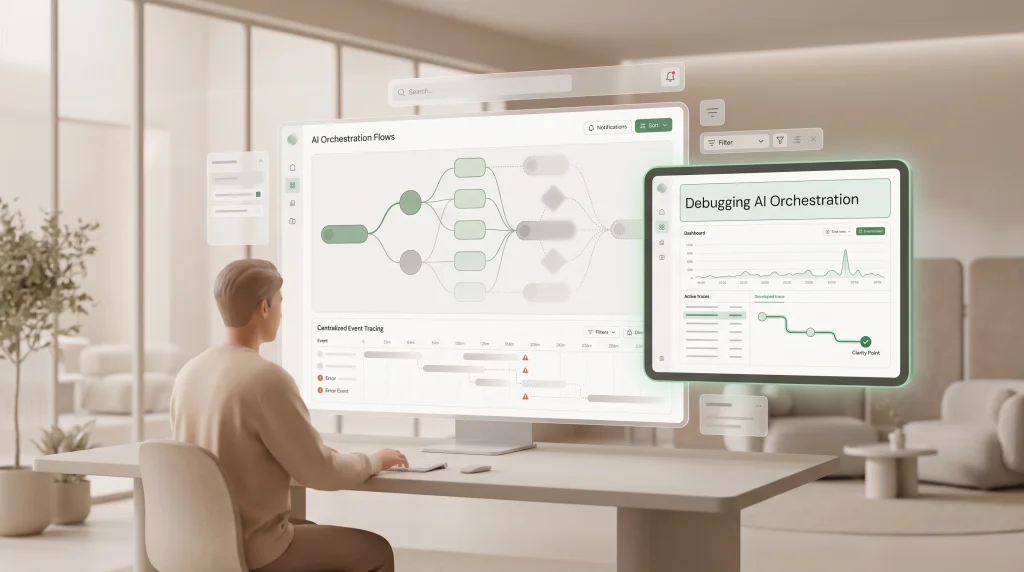
Debugging and Observability Problems in Production Systems
Orchestration debugging is genuinely hard because when something goes wrong in a multi-agent system, you can’t just check one log. The failure usually lies not inside any single agent but somewhere in the interaction between agents.
Debugging Ai Orchestration
Why Orchestration Failures Are Hard to Trace
In a traditional application, a bug has a clear stack trace. In a multi-agent system, the failure is often distributed.
Agent A produced a valid output.
Agent B interpreted it incorrectly.
Agent C acted on that bad interpretation.
By the time you see the error, you are three steps away from the actual source.
Missing Logs and Poor Visibility Between Agents
Most teams add logging to the individual agents, but miss the in-between. The communication layer, the messages passed, the decisions made, and the context shared often have no log at all. This is a critical gap in observability.
Teams using LangSmith or similar tracing tools dramatically reduce debugging time by capturing full agent interaction traces, not just individual outputs.
In Production Systems: Debugging Becomes the Main Bottleneck
In the production of multi-agent systems, the engineering teams often spend more time on debugging orchestration behaviour than building new features, because this is a direct consequence of under-investing in observability at design time.
What this means is:
Observability is not a nice-to-have; it is the difference between a system that can be maintained and one that becomes too expensive to operate.
Fix: Centralized Monitoring and Event Tracing
Assign a unique trace ID to every orchestration run, propagate it across all agents
Log all inter-agent messages, not just internal agent actions
Use tools like LangSmith, Weights & Biases, or Helicone for full-pipeline tracing
Set up alerting on failure patterns, don’t rely on manual log review
Create dashboards showing per-agent success and failure rates in real time
Cost and Resource Problems Most Teams Ignore
Poor orchestration design is expensive. The costs often do not show up until a system is already running at scale. By then, fixing them requires rearchitecting, not just tuning.
API Cost Explosion from Unnecessary Agent Activity
Every agent call costs money. When agents retry unnecessarily, re-process data they’ve already seen, or request LLM completions for trivial decisions, costs add up fast.
A poorly designed workflow with five agents that each call an LLM three times per task can burn 15x the expected API budget on a single pipeline run.
Infrastructure Waste Caused by Poor Orchestration Logic
Over-provisioned compute, idle agents waiting in queues, and redundant task executions all represent direct infrastructure waste. Teams running on AWS or Azure often underestimate the idle cost of always-on orchestration workers that trigger far more than necessary.
Enterprise vs Startup Cost Trade-offs
Enterprises can absorb higher initial costs; their priority is reliability. Startups cannot.
For early-stage teams, the rule is clear: design for cost efficiency from day one, because retrofitting is expensive. This means fewer agents, tighter task boundaries, and aggressive caching.
Contrarian Insight: More Automation Can Increase Operational Cost
More automation does not always mean reducing the operational cost. In poorly orchestrated systems, the addition of automation layers increases:
The number of LLM calls,
API hits, and
Compute cycles,
Raising cost even as manual work decreases.
The fix:
Audit every agent call,
Cache LLM outputs for repeated inputs,
Use smaller models for low-complexity decisions, and
Set per-run cost tracking from the start.
Decision Framework: How to Identify the Real Problem Fast
When something breaks in a multi-agent system, teams often reach for the wrong fix first. This decision framework gives you a fast path to the actual source of the failure.
If Latency Rises → Check Communication Load First
Before adding compute, check how many messages are being passed per pipeline run. Rising latency almost always points to communication overhead, not processing power.
If Tasks Fail → Inspect Dependency Chains
Inconsistent task failures are almost always caused by a hidden dependency, one agent waiting on another that is slow, blocked, or returning partial output. Trace the dependency chain before changing agent logic.
If Costs Spike → Reduce Redundant Agent Actions
Unexpected cost increases mean agents are doing more work than they should. Audit which calls are happening more than once per run, and add caching or deduplication before scaling anything.
Rule of Thumb: Fix Orchestration Flow Before Scaling Infrastructure
Adding more compute to a broken orchestration design just makes the broken design run faster and cost more.
In practice, teams which fix the flow first, before scaling, basically solve the majority of their performance and cost problems without changing the overall infrastructure at all.
If you are not sure where to start, trace one complete pipeline run end-to-end. Find the step with the highest latency or failure rate. That is your first fix, regardless of what the logs say elsewhere.
When NOT to Increase Orchestration Complexity
Not every problem needs a more complex solution. Many multi-agent orchestration issues get worse when teams add more agents, more layers, and more coordination logic to fix them.
Over-Orchestrated Systems Become Fragile
Every orchestration layer means you add another point of failure.
A system with eight agents, three orchestrators, and a complex state machine has dozens of interaction paths, each one a potential failure mode.
Over time, this complexity becomes a liability, but not an asset.
When Simpler Workflows Outperform Multi-Agent Coordination
For tasks which are:
Sequential, well-defined, and low in decision complexity,
A single-agent workflow with good tooling often outperforms a multi-agent setup.
The coordination overhead of the multi-agent approach adds latency without adding capability.
What this means is: before adding a new agent, ask whether the task actually requires independent reasoning, or just a new tool or a better prompt.
A Common Mistake: Solving Every Problem with More Agents
Teams often treat multi-agent orchestration as the default answer to any scalability or quality problem. In reality, adding agents to an already complex system frequently makes coordination, debugging, and cost problems significantly worse.
Audit your current architecture before adding agents
Ask: Can this be solved with a better prompt, a new tool, or cleaner data instead?
Start with the minimum viable agent count, scale up only when there’s a clear bottleneck
Simplicity has a real return on investment. The best-performing systems are not the most complex; they are the most maintainable.
FAQ
1. What is the most common problem in AI agent orchestration?
The most common problem is coordination failure between agents. Agents create conflicting actions when roles aren’t clearly defined Tasks become duplicated or delayed across the system Small coordination errors spread into larger downstream failures
2. Why do multi-agent systems fail in production?
Most failures happen because system complexity grows faster than visibility. Communication becomes difficult to manage at scale Debugging becomes harder as agent count increases Hidden dependencies create cascading failures across the pipeline
3. How do you fix orchestration bottlenecks?
Start by identifying the real source of delay — don’t assume it’s compute. Reduce unnecessary agent communication paths Simplify task dependency chains Improve monitoring and tracing before scaling infrastructure
4. Why does adding more agents sometimes reduce performance?
More agents increase coordination overhead faster than they add capability. Communication load rises rapidly with each new agent added Decision conflicts become more frequent across the system In practice, complexity often grows faster than performance gains
5. What is the biggest orchestration mistake teams make?
The biggest mistake is adding complexity too early, before the simpler path is exhausted. More orchestration layers increase fragility across the whole system Systems become harder and more expensive to debug at scale Simpler, well-scoped workflows often outperform complex multi-agent setups initially
Conclusion
Most AI orchestration failures are not caused by the intelligence limitations in the agents themselves but rather come from the system:
Complexity,
Coordination gaps,
Communication overhead,
Poor observability, and
Architectural decisions made too early.
In practice, the strongest orchestration systems are not the most complex ones. But they are the ones which designed to stay understandable, debuggable, and resilient as they grow.
The best approach: fix the flow before you scale the infrastructure. Improve visibility before you add agents. And treat simplicity as a feature — not a limitation.