Between 2024 and 2026, the way AI developers discuss their work changed significantly. Previously, conversations focused on prompt engineering, which involves writing better instructions to guide the language model and to get improved outputs from a language model, such as ChatGPT.
Now, the discussions with the model have shifted to other important topics. These include what information is available for the model’s responses, how that information is chosen, and how it is handled over a long series of steps. This change is now known by the name of context engineering.
In June 2025, Andrej Karpathy a former Director of the AI at Tesla and one of the most cited figures in the field of applied machine learning, has stated publicly that the context engineering is not prompt engineering; basically, it is the core skill in serious LLM applications.
Also, Shopify CEO Tobi Lütke followed with his own framing, and describing the context engineering in these words such as “the art of providing all the context: task to be plausibly solvable by the LLM” and the term “Context” better describes the a,ctual skill than prompt engineering.
Those weren’t isolated opinions about the new term. DataHub’s 2026 State of Context Management Report found that 82% of IT and data leaders agree that the prompt engineering alone is no longer sufficient to power AI at scale, which is now right.
This guide explains that basically:
What is context engineering?
How does it differs from the prompt engineering?
Why the distinction matters for anyone building real AI systems?
What the five core components of context engineering?
Table of Contents
Quick Answer
Context engineering involves the process of designing and managing all the required information for an AI model that is used when creating responses. This includes memory, retrieved documents, tool outputs, conversation history, and system instructions. It is different from prompt engineering, which focuses only on how to phrase a single instruction to the model.
In simple terms, prompt engineering is about how you ask, while context engineering is about that what the AI knows when it responds.
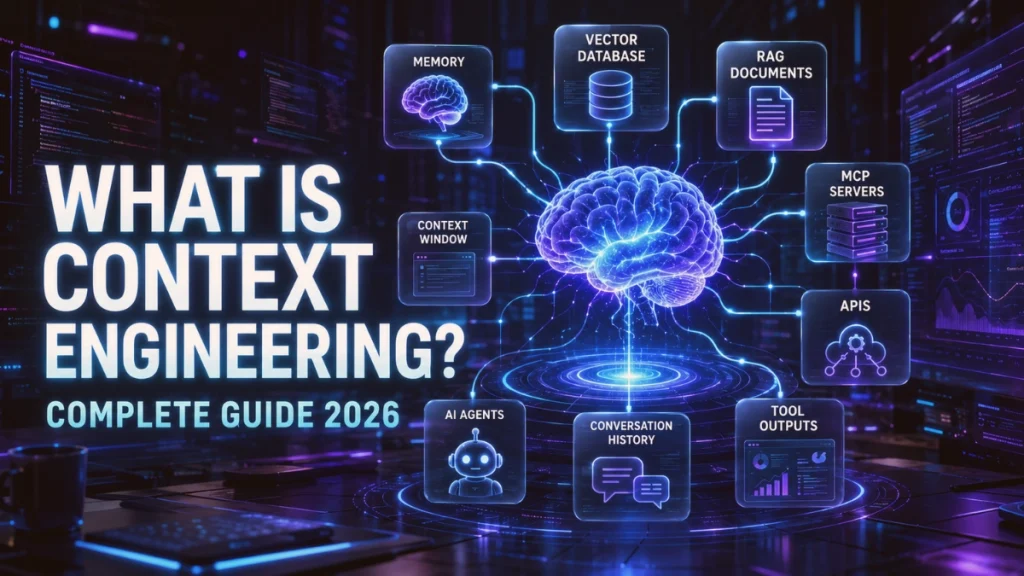
What Is Context Engineering? Complete Guide 2026
1. The Shift Happening Right Now
From about 2022 to 2024, prompt engineering was a main topic in AI development. It was the main skill that people wanted to learn to get better results from the language models, whether it was ChatGPT or other models. By choosing words carefully, structuring of questions properly, and using techniques like chain-of-thought or few-shot examples, due to which the model would deliver improved performance.
That approach worked well for a specific class of tasks, isolated, one-off queries where you had a clear input, wanted a clean output, and didn’t need the system to remember anything or take sequences of actions. For simple chatbots, content generation, and individual Q&A tasks, prompt engineering remained effective.
As AI applications have become more complex, like agents which perform multiple actions, systems that find documents and use external tools, and workflows that operate for longer periods such as run for minutes or hours rather than seconds, one major limitation has become clear. Prompt engineering does not keep track of past interactions. It treats the context as a fixed piece of text, remembers nothing between uses, and does not have a way to decide what information should be included when the model operates.
Context engineering started in the mid-2025 as a solution to a limitation in the prompt engineering. It doesn’t replace prompt engineering, but it looks at the problem from a higher level. A good prompt is still important, but it is just one part of a bigger design issue. This larger issue involves understanding the entire information environment where the model works and figuring out how to build and manage that environment.
2. What Is Prompt Engineering? (Quick Recap)
Prompt engineering is the process of writing, creating and giving clear instructions to get better responses from a large language model. This practice started to become known around 2020 with the public release of GPT-3 and gained popularity in 2022 and 2023 as these models became widely used.
The main skills behind the prompt engineering include giving clear instructions, using examples, specifying the format of the output, and breaking down complex tasks into smaller steps. For simple tasks, a well-crafted prompt can still make a significant difference.
The limitation of prompt engineering is that it has nothing to say about state, memory, or system design. It tells you how to phrase the question; it has no answer for what the model should know before the question arrives, how information from a previous step gets carried forward, or what happens when the context window fills up. Those are context engineering problems, and prompt engineering has no framework for solving them.
3. What Is Context Engineering?
Context engineering involves the systematic designing, organizing, and managing the information environment that an AI model accesses during inference.
That definition is dense, so it’s worth unpacking:
“During inference” means at the moment when the model generates a response.
The “informational environment” is everything the model can see at that moment, not just the question you typed, but the system instructions defining its role, the conversation history from earlier turns, any documents retrieved from a knowledge base, and the results of any tools it has already called.
“Designing, organizing, and management” signals that this is ongoing architectural work, not a one-time writing task.
Context engineering emerged in the mid of 2025 and is best understood as a transition from treating AI as a single interaction to treating it as a system. Prompt engineering is a local fix applied to one interaction at a time. Context engineering is system design applied to the entire information flow that makes an AI capable of behaving reliably across many interactions.
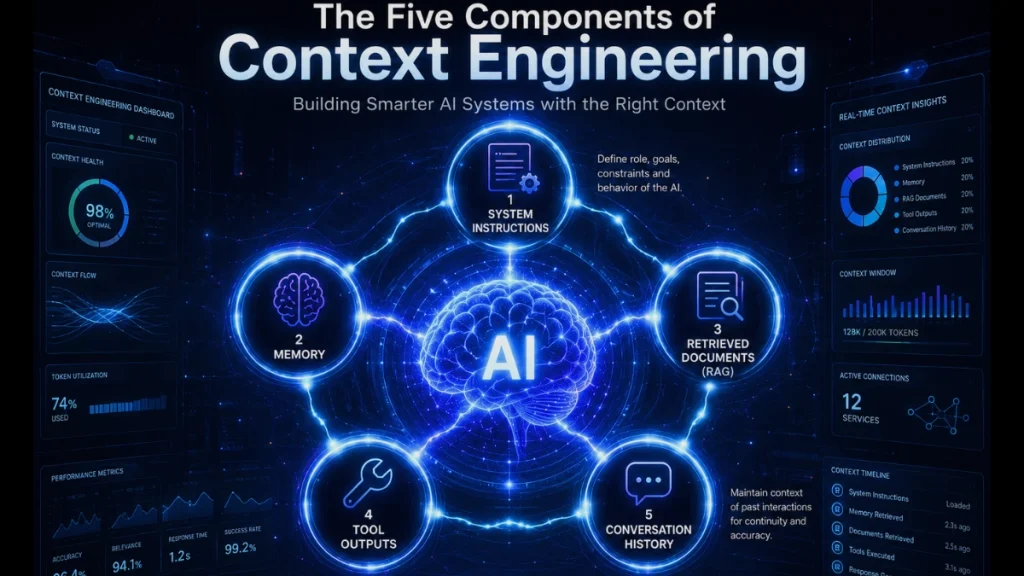
What “context” actually includes breaks down into five distinct components:
System instructions: The persistent rules, role definitions, and operating constraints that shape how the model behaves across every interaction, not just the current one.
Memory: Information stored from previous interactions and retrieved when relevant, enabling the model to know things it wasn’t told in the current conversation.
Retrieved documents: Content pulled in real time from knowledge bases, document stores, or external sources, giving the model accurate, current, specific information rather than relying solely on what it learned during training.
Tool outputs: The results returned when an agent calls an external tool: a database query, a web search, an API call, a calculation. These results become part of the context the model reasons over.
Conversation history: The record of what has been said in the current interaction, which the model uses to maintain coherence and avoid contradicting itself.
Context engineering is the discipline of deciding what goes into each of those five slots, when, in what format, and at what level of detail.
For a complete breakdown of how agent memory actually works across sessions, see our guide to AI agent memory.
4. Prompt Engineering vs Context Engineering: The main Differences
The One-Line Distinction
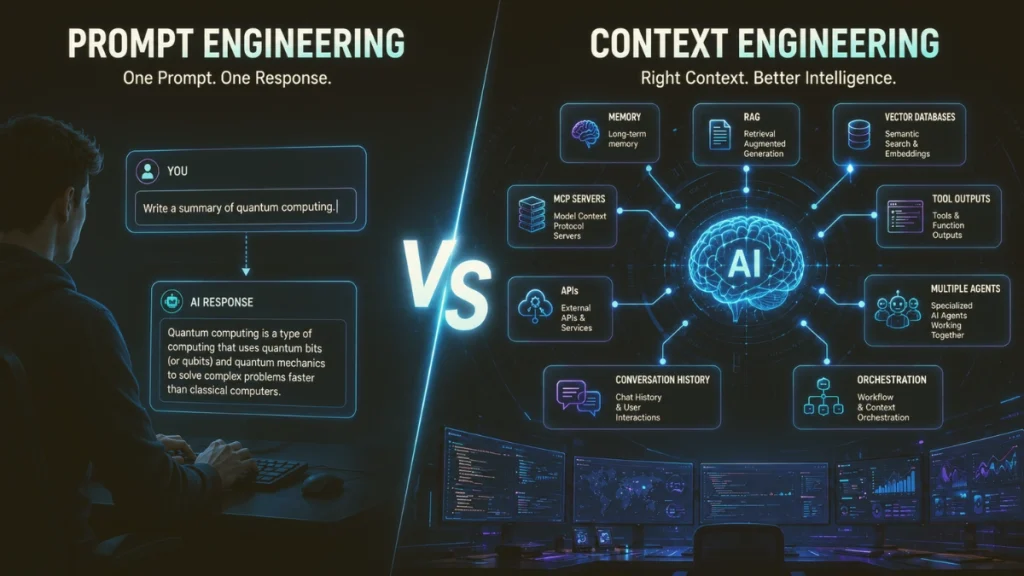
Prompt engineering answers the question: “how should I ask the AI?” while Context engineering answers the question: “what should the AI know when it answers?”
Prompt Engineering vs Context Engineering: The main Differences
Modern AI applications don’t run as single-turn interactions. An agent handling a customer support request might check a knowledge base, look up account history, call an API, draft a response, and route to a human if needed, all within one session. An AI research assistant might run for twenty minutes, generating intermediate findings that inform later steps. A multi-agent workflow might involve three or four specialized agents passing context between them.
In every one of those scenarios, a well-worded prompt is table stakes, necessary but not sufficient. What determines whether the system actually performs well is whether each model, at each step, has access to the right information at the right time in the right format. That’s a context engineering problem, and it doesn’t have a prompt engineering solution.
The context window, the total amount of text a model can process at once, is finite. Every token used for irrelevant history, redundant instructions, or unfiltered tool output is a token that could have held information the model actually needed. Context engineering is fundamentally about making that limited space count.
5. The 5 Core Components of Context Engineering in Practice
The 5 Core Components of Context Engineering in Practice
A) System Instructions
System instructions are the persistent behavioural blueprint for an AI system. They define the model’s role, its constraints, the format of its outputs, and the principles it should apply, and unlike a prompt, they’re present in every interaction without the user needing to restate them.
Poorly designed system instructions produce models that behave inconsistently: confidently performing tasks they were supposed to decline, ignoring formatting rules, or switching tone between responses. Context engineering treats system instructions as architecture, not boilerplate, they’re designed deliberately and iterated on like code.
B) Memory Management
Memory in an AI system refers to any mechanism that carries information across the boundary of a single interaction. Two categories matter:
Short-term memory is the conversation history within a current session, what was said earlier in this conversation. Managing short-term memory means deciding how much history to retain verbatim, what to compress into a summary, and what to drop entirely as it becomes less relevant.
Long-term memory is information stored between sessions and retrieved when relevant, facts about a user, past decisions made by the agent, domain knowledge accumulated over time. Long-term memory typically lives in a vector database or dedicated memory tool, and context engineering defines when to write to it, when to retrieve from it, and how retrieved memories are prioritized against current information.
C) Retrieval-Augmented Generation (RAG)
Retrieval-Augmented Generation, commonly called RAG, is the technique of pulling relevant documents from an external knowledge base in real time and injecting them into the model’s context window when they’re needed.
Instead of the model guessing at facts from training data that may be outdated or incomplete, RAG gives it current, specific, and accurate information at inference time. A customer-facing AI that needs to answer questions about a company’s product catalog, refund policy, or technical documentation uses RAG to retrieve the relevant sections rather than relying on the model’s memory of that content.
Context engineering decisions around RAG include: what gets indexed in the knowledge base, how the retrieval query is formed, how many documents are retrieved, how they’re ranked by relevance, and how they’re formatted before entering the context window.
D) Tool Outputs
When an AI agent calls an external tool, a web search, a database query, a code interpreter, a REST API, the result comes back as text and enters the context window as part of the information the model reasons over.
Unmanaged tool outputs cause real problems. Raw API responses are often verbose, formatted for machine consumption rather than model comprehension, and filled with irrelevant fields. Injecting a 5,000-token JSON response when the model needed two data points wastes context space and can actively confuse the model’s attention.
Context engineering handles tool outputs by filtering, formatting, and summarizing results before they reach the model, ensuring that tool outputs contribute signal rather than noise.
E) Context Window Management
The context window is the total amount of text, measured in tokens, where one token is roughly three-quarters of a word, that a model can process at once. Current large models support context windows ranging from tens of thousands to over a million tokens, but even a million-token window fills up in long-running agentic workflows.
Context window management is the practice of deciding what’s most important to include when you can’t include everything. That means compressing old conversation history into summaries, dropping retrieved documents that are no longer relevant, pruning tool outputs to their essential information, and prioritizing recent, high-signal content over older or less relevant material.
A model operating with a well-managed context window performs substantially better than the same model operating with a bloated, unfiltered one, even if the underlying model capability is identical.
6. Why Context Engineering Matters for AI Agents Specifically
AI agents, systems that take sequences of actions, call tools, and maintain state across multiple steps, are the primary force driving context engineering’s rise as a discipline.
An agent with poorly managed context exhibits specific failure patterns: it repeats actions it already took because it lost track of its history, it ignores relevant information it retrieved three steps earlier because that information was buried under newer content, it contradicts a decision it made in a prior turn, or it calls a tool unnecessarily because it forgot the output from the last time it called the same tool. These are all context failures, not model failures. The underlying AI might be entirely capable of the task, but it can’t perform well on information it can’t see or has forgotten.
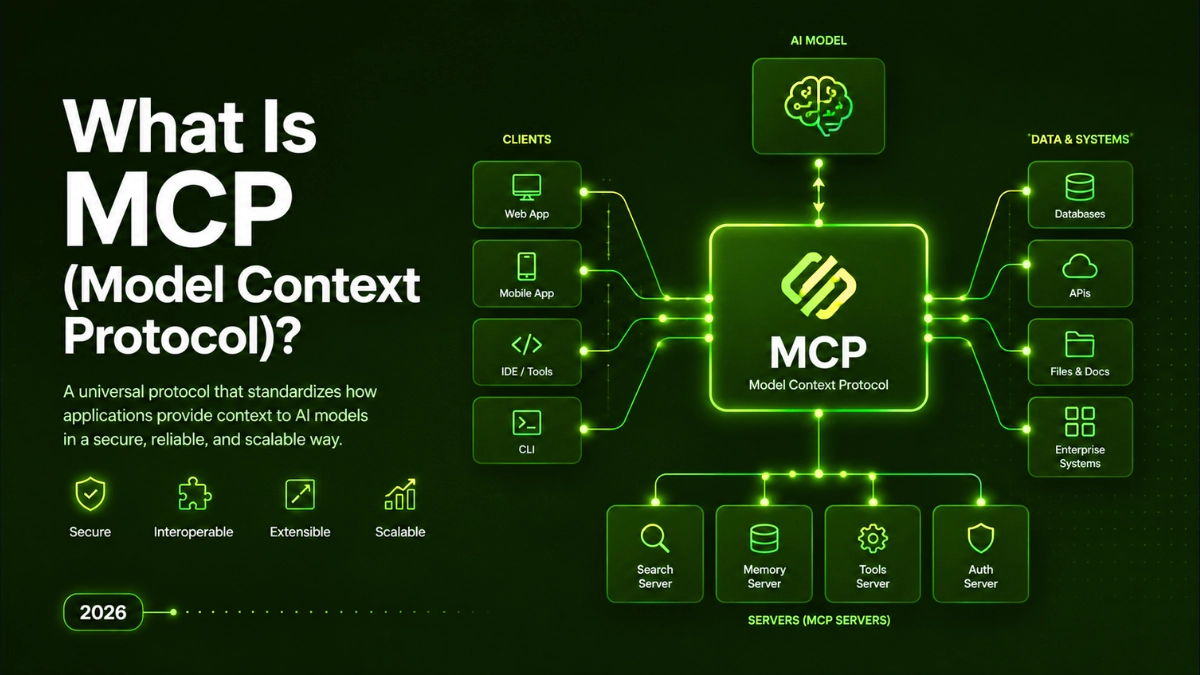
Model Context Protocol (MCP), the open standard created by Anthropic in November 2024 and now governed by the Linux Foundation’s Agentic AI Foundation, is fundamentally a context engineering tool. MCP standardizes how external information from tools, databases, and data sources reaches an AI agent’s context window, solving the tool output component of context engineering at the infrastructure level. For more on MCP, see our complete guide to Model Context Protocol.
The enterprise investment data reflects how seriously organizations are taking this. Gartner research identifies context engineering as a recognized enterprise priority, with 89% of teams planning to invest in context management infrastructure within the next 12 months. The consistent finding from organizations that have deployed AI agents at scale: the teams getting the best results don’t necessarily have access to better models, they have better context design.
7. How Context Engineering Connects to Tools You Already Know
Context engineering isn’t an abstract discipline that lives separately from the tools in the modern AI development stack, it’s the principle that those tools are designed to implement.
MCP (Model Context Protocol) solves the tool output and retrieval components of context engineering at the protocol level. When an MCP server delivers a database result or file system read to an agent, the formatting and delivery of that information is standardized — which is a direct implementation of context engineering principles. See our guide to What Is MCP for a full explanation.
LangGraph implements context engineering through its explicit state management model. Every node in a LangGraph workflow has access to a defined state object, and context engineering decisions, what gets stored in state, what gets passed between nodes, what gets dropped, are first-class design choices in every LangGraph project. Our LangGraph vs CrewAI vs AutoGen comparison covers how these frameworks handle state differently.
RAG (Retrieval-Augmented Generation) is the retrieval component of context engineering made practical, the mechanism by which relevant documents enter the context window at inference time rather than being baked into the model’s weights at training time.
Vector databases (Pinecone, Weaviate, pgvector, Chroma) are the storage layer for the long-term memory component of context engineering. They enable semantic retrieval, finding documents based on meaning rather than exact keyword matches, which is what makes RAG effective.
8. Practical Tips: How to Start Applying Context Engineering
1. Audit what’s currently in your context window. Before optimizing, understand what’s already there. Many teams discover their context is dominated by verbose system instructions or unfiltered tool outputs that take up space without adding value.
2. Separate context failures from model failures. When an AI system gives a wrong or inconsistent answer, the instinct is to blame the model. Before doing that, check the context it was given. A model confidently producing incorrect output often has incorrect or missing information in its context, the model isn’t wrong; it’s working with what it has.
3. Design context tiers deliberately. Categorize information into three buckets: what should always be in the context (core system instructions, essential facts), what should be retrieved conditionally (documents relevant to the current task), and what should be compressed or dropped (old history, completed intermediate steps). Explicit tiering prevents context from growing uncontrolled.
4. Implement memory with audit in mind. Long-term memory that you can’t inspect, correct, or explain becomes a liability. Start with minimal memory, only store what you can read back and verify makes sense, before expanding.
5. Use MCP to standardize how external tools deliver information. Rather than writing custom context injection logic for every tool your agents call, MCP servers handle formatting and delivery at the protocol level, making tool outputs consistent and easier to manage.
9. Frequently Asked Questions
What is context engineering in simple terms?
Context engineering involves the process of designing and managing all the required information for an AI model that is used when creating responses. This includes memory, retrieved documents, tool outputs, conversation history, and system instructions. It is different from prompt engineering, which focuses only on how to phrase a single instruction to the model. In simple terms, prompt engineering is about how you ask, while context engineering is about that what the AI knows when it responds.
Is prompt engineering dead?
No. Prompt engineering remains relevant for simple, one-off interactions where a well-crafted instruction meaningfully improves output quality. What’s changed is that prompt engineering is no longer the ceiling skill for serious AI development, it’s one component of a larger discipline. For production AI systems, agents, and multi-step workflows, context engineering is the more consequential skill, and prompt engineering alone isn’t sufficient to build reliable systems at that level.
What is the difference between context engineering and RAG?
RAG (Retrieval-Augmented Generation) is a specific technique: pulling relevant documents from a knowledge base and injecting them into the model’s context window at inference time. Context engineering is the broader discipline that RAG is one part of. Context engineering also covers system instructions, memory management, tool output handling, and context window prioritization. RAG solves the retrieved documents component of context engineering; context engineering addresses all five components together.
Who coined the term context engineering?
The term was popularized significantly by Andrej Karpathy in June 2025, when he stated that context engineering, not prompt engineering, is the core skill in serious LLM applications. Shopify CEO Tobi Lütke also used the phrase around the same period, describing it as capturing the actual skill of working with LLMs more accurately than prompt engineering. While the exact first use is difficult to attribute to a single person, these two figures drove the term into mainstream AI development discourse.
Do I need to know Python to do context engineering?
Basic context engineering, designing what information goes into a system prompt, structuring retrieval queries, organizing conversation history, doesn’t require Python. Applied context engineering at the system level, which involves building retrieval pipelines, managing vector databases, implementing memory systems, and integrating tool outputs, does require programming knowledge. Python is the dominant language in this space, with libraries like LangChain, LlamaIndex, and the dbt and LangGraph ecosystems all primarily Python-based.
What tools support context engineering?
The main tools in the context engineering stack are: => LangGraph and CrewAI for agent orchestration and state management; => Pinecone, Weaviate, Chroma, and pgvector for vector storage and long-term memory; => MCP (Model Context Protocol) for standardized tool output delivery; => LlamaIndex and LangChain for RAG pipeline construction; => Supermemory and similar tools for cross-session memory management. Most of the major LLM providers (Anthropic, OpenAI, Google) also expose context management features through their APIs.
Is context engineering the same as prompt chaining?
No. Prompt chaining is a specific technique where the output of one LLM call becomes the input of the next, linking prompts in a sequence. Context engineering is the broader architectural discipline of which prompt chaining is one small part. Context engineering covers the full design of an AI system’s information environment: memory, retrieval, tool outputs, history management, and system instructions. Prompt chaining doesn’t address memory, doesn’t address retrieval, and doesn’t address context window management, all of which are central concerns of context engineering.
10. Conclusion
Context engineering is the infrastructure that makes reliable AI judgment possible at scale. It doesn’t replace the need for good model selection, good system design, or good judgment from the humans building these systems, but without it, even the most capable models will produce inconsistent, unreliable outputs in any application that goes beyond simple, isolated interactions.
The trajectory here is clear. As AI moves from chatbots to agents, from single queries to multi-step workflows, from experiments to production systems, the information environment each model operates within becomes as important as the model itself. A better prompt gets you a better answer once. Better context gets you better answers every time.
For developers and teams building in this space, the practical starting point is the same as it is for any systems discipline: audit what you have, understand what’s actually reaching your model, and design the information environment deliberately rather than letting it accumulate by default.
For the infrastructure layer that makes context engineering practical, our guide to Model Context Protocol (MCP) covers the standard that’s emerging as the universal layer for connecting AI agents to external context sources. For the agent frameworks that implement context management at the orchestration level, our comparison of LangGraph vs CrewAI vs AutoGen covers how each framework approaches state and context differently. And for the broader architecture these tools fit into, our guide to AI Agent Orchestration covers the system design decisions that sit alongside context engineering in any serious agentic application.






1 comment