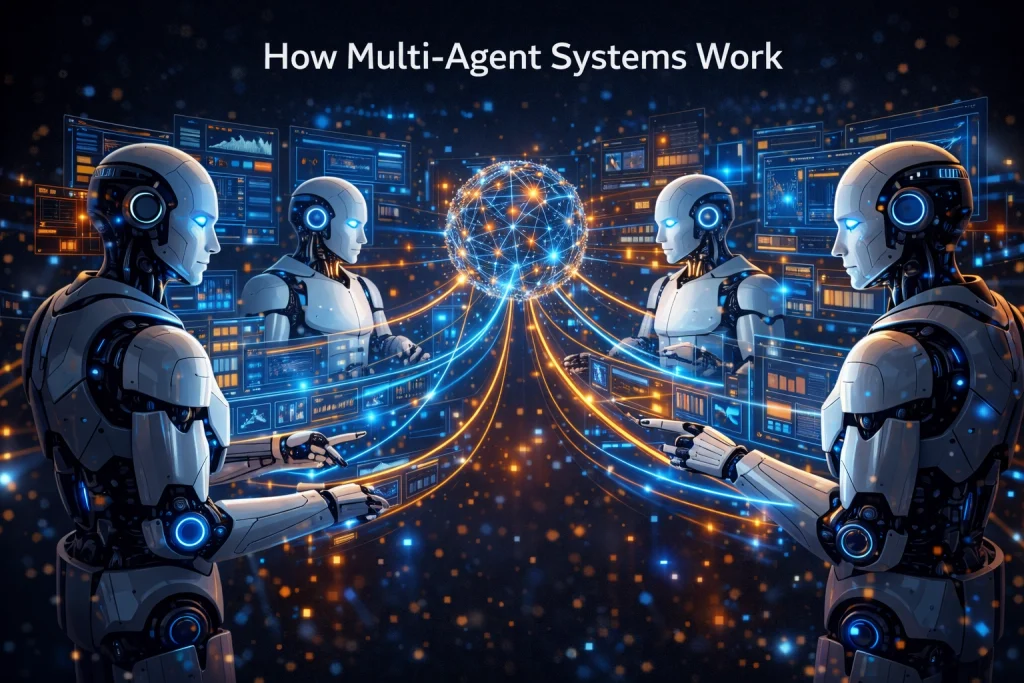
Some AI systems work alone while others depend on multiple agents that are working together in parallel, dividing tasks, sharing information, and producing results that no single agent could achieve on its own.
If you are trying to understand the main difference between single-agent vs multi-agent systems, the confusion is understandable.
Most explanations either oversimplify to the point of uselessness or jump straight into technical depth that assumes you already know the fundamentals.
This guide will help you understand the concept clearly. You will get a clear breakdown of how each system works, where they differ, what they are each good at, and crucially, when choosing the wrong one will cost you.
Quick Answer
A single-agent system uses one AI agent to work alone to complete a task, while a multi-agent system consists of multiple agents interacting or collaborating. Single-agent systems are simpler and easier to control, whereas multi-agent systems handle more complex, distributed, and dynamic problems that a single agent cannot efficiently manage alone.
Single-Agent vs Multi-Agent
Single-Agent and Multi-Agent Systems: Key Differences
The difference between these approaches is not just about the number of agents involved, but it goes deeper than just that:
How decisions are made?
How the system responds to its environment?
What happens when the problem becomes more complex?”
These are the key differences between single and multi-agent systems. It is a fundamentally different philosophy about how problems should be solved.
Single-Agent and Multi-Agent Systems Key Differences
1) One Agent vs Multiple Agents
A single-agent system assigns all responsibility to one agent for the entire execution. That one agent:
Perceives its environment
Reasons for what to do
Acts according to the nature of the input.
There is no dependence, no handoff, no consultation with other agents; everything is independent.
Multi-agent: The scenario is different in a multi-agent system, in which the task is distributed among all the agents that are present. Different agents can hold different and specialized roles that work on different aspects of the same problem and produce a combined result that reflects all of their contributions.
Key Insights:
Here is an insight which most article writers skip: the number of agents is not really the defining feature; the division of cognitive tasks is.
2) Independent vs Interactive Behaviour
Single agents behave independently. They do not wait for a decision from another agent. Every decision is self-generated, based entirely on the agent’s own model, memory, and inputs. No other agent influences its reasoning mid-task. Their behaviour is self-contained, or you can say self-oriented.
Multi-agent systems are fundamentally interactive and collaborative in nature by design. Agents in this system observe, respond, and build on each other’s outputs. That interactivity creates something genuinely interesting: emergent behavior, outcomes that no individual agent planned or could have produced alone. This interactivity makes the system powerful.
Here is the main idea: “In a single-agent system, all behaviour originates from one source, but in a multi-agent system, behaviour emerges from the interactions between sources”.
3) Simplicity vs Complexity
Single-agent systems are simpler in design, not as a limitation, but as a feature. One agent, only one set of rules means one decision maker, one failure mode. This simplicity makes it easier to identify what went wrong when something breaks.
Multi-agent systems trade that simplicity for capability. When you introduce multiple agents, then more interactions come in one place, more potential states, and more edge cases. Here, you gain the ability to handle problems that are too large or complex for a single agent. Managing that complexity well is one of the hardest problems in multi-agent system design, and it is where most implementations fall in practice.
How Single-Agent Systems Work
A single-agent system is self-contained in nature, which follows a clean, contained loop:
Perceive, Reason, Act.
Everything happens within one agent, from start to finish.
Then it either stops or repeats the cycle based on the problem complexity.
How Single-Agent Systems Work
Operating Independently
The defining characteristic of a single-agent system is independence and lone solving problem techniques. The agent does not need to consult, communicate with, or wait for any other agent’s decision for help. This type of agent has its own perception mechanism, its own reasoning process, and its own way of action when facing the problem.
This independent nature makes it prominent. Suppose when the task has clear inputs and outputs, and when the environment does not change in such ways that require multiple simultaneous responses, then a single agent is often the most efficient and best solution for it.
Decision-Making in Isolation
Isolation means alone or separately, an AI agent is working in isolation because there is only one agent, and all decisions are made internally or alone. The agent takes data as input, processes it by applying its logic or model, and specifies a decision, without any external agent involvement.
This characteristic makes a single-agent decision predictable and traceable. If something goes wrong, you know exactly where to look and how to solve. There is no question of which agent made a particular call or how two agents’ decisions might have interacted.
Practically, this is one of the most underrated advantages of single-agent systems, that “they are auditable”.
When a Single Agent Is Enough
One important point to note that “not every problem needs multiple agents”. A single agent is often the right choice when:
The task has a clear beginning and end
The problem can be solved sequentially, in one step at a time
The environment is stable and predictable
Speed and simplicity are higher priorities than scale
Debugging and transparency matter more than raw capability
These are all the examples where a single agent performs well.
How Multi-Agent Systems Work
Multi-agent systems involve multiple AI agents that exist within the same environment and interact, whether by cooperating toward a shared goal, dividing a task between them, or operating in parallel on different aspects of the same problem.
How Multi-Agent Systems Work
Multiple Agents in One Environment
In a multi-agent system, each agent has its own perspective and role in the shared environment. One agent may be responsible for monitoring the inputs, another may be generating responses, while a third may be evaluating quality or flagging errors. But they all exist within the same system, where each has a distinct and defined function.
This division of responsibilities makes the multi-agent systems more capable of handling tasks that cannot be dealt with by a single agent.
Basic Interaction Between Agents
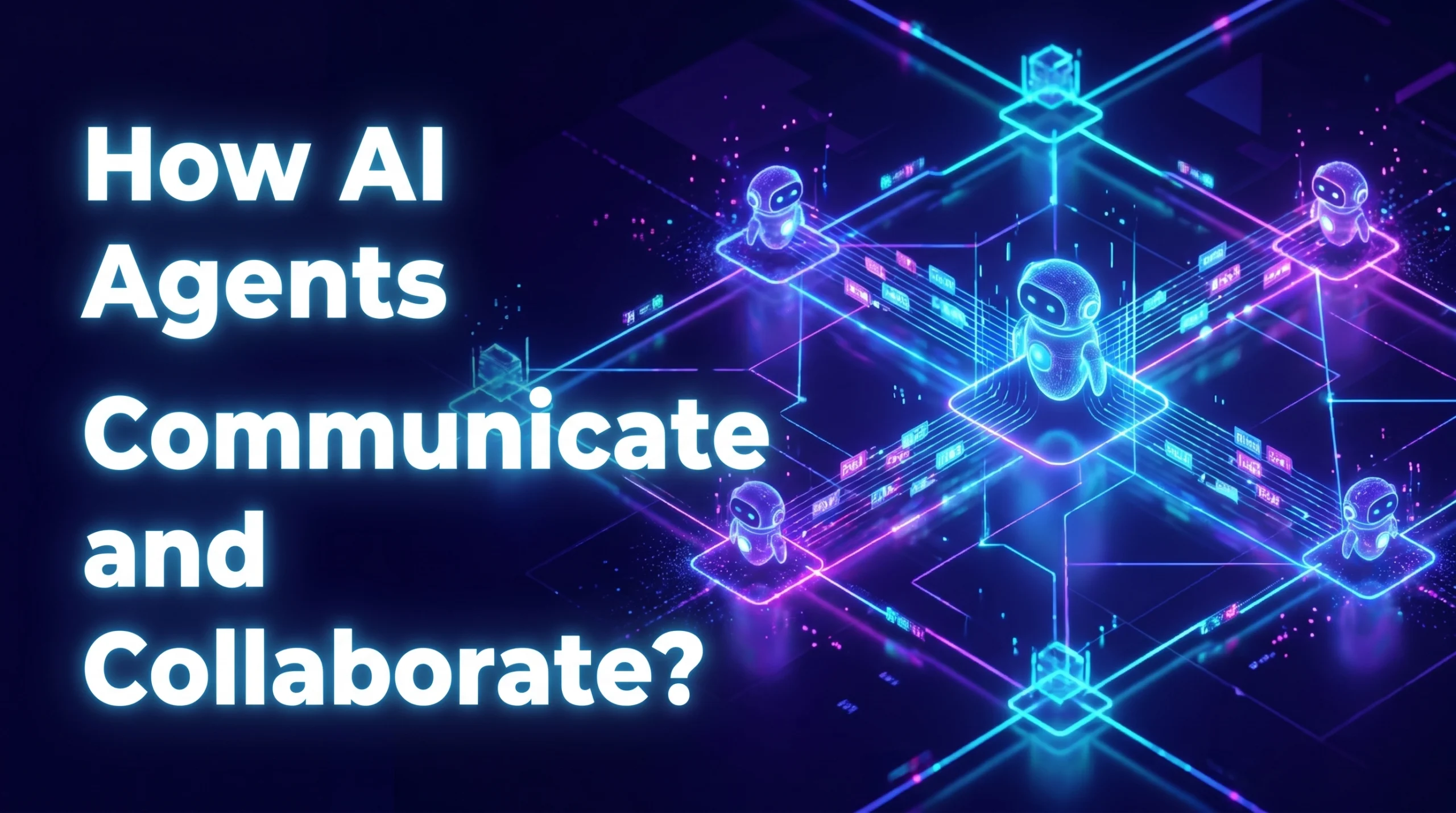
Agents in a multi-agent system do not operate in complete isolation from each other. At some level, they interact.
That interaction might be as simple as one agent passing its output to another agent as input or when there is any task that are not defined to the agent they will interact for the purpose to find for which agent the task is associated and the task should send to that agent or it might involve agents sharing a common data store that all of them read from and write to etc.
The nature of the interaction in the system varies widely. Some systems have agents which cooperate closely, acting and working as a team. Others have agents which operate more independently, only loosely connected through shared outputs.
What matters in the multi-agent system is only the behaviour which is not produced by any single agent alone but it depends on the system’s nature that how the agents interact in the system.
Handling Complex Tasks
When a task is too large, too dynamic, or too complex for a single agent to handle easily, then distributing it across multiple specialized agents can dramatically improve the results of handling and dealing with it efficiently. This is where multi-agent systems shine and are useful.
Consider a complex research task in which some activities involve gathering data, analysing it, fact-checking conclusions, and formatting a final report. All these steps are genuinely different from the others. A single agent doing all of them sequentially might produce mediocre results at each stage but a multi-agent system where each agent specializes in one of those steps can produce significantly better output for overall activities.
Note: Multi-agent systems do not automatically produce better outcomes just because there are more agents. Most importantly, note that “A poorly designed multi-agent system will often perform worse than a well-tuned single agent”. The gains are real, but they depend entirely on how clearly the task is divided and how cleanly the agents interact.
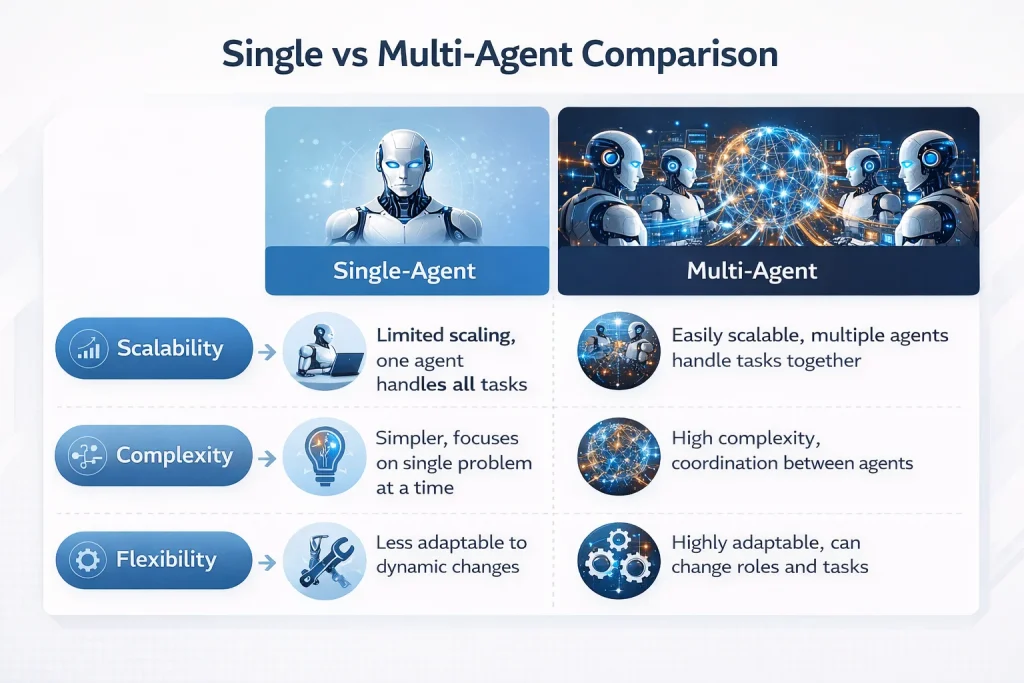
Key Differences: Single-Agent vs Multi-Agent Systems (Side-by-Side Comparison)
Dimension
Single-Agent
Multi-Agent
Agent count
One
Two or more
Decision model
Centralized
Distributed
Scalability
Ceiling-bound
Horizontally scalable
Complexity
Low
High
Flexibility
Limited
High
Failure tracing
Straightforward
Complex
Best fit
Bounded, sequential tasks
Complex, parallel, or dynamic tasks
Setup cost
Low
Higher
Single-Agent vs Multi-Agent Systems (Side-by-Side Comparison)
Scalability
Single-Agent Scalability: A single-agent system has limits and performs poorly when the task becomes complicated. As tasks become bigger or more complex, one agent can struggle to handle them efficiently, even if you improve it with better tools or give it more power for problem-solving. Eventually, it cannot handle everything, which means that it cannot scale well for the complex tasks.
Multi-Agent Scalability: A multi-agent system works better when the task or problem becomes more complicated, because it has the ability to scale according to the needs of the problem’s complexity. You can simply add more agents to share the work instead of overloading one.
Example: Imagine one customer service chatbot is trying to answer thousands of questions at once, it will slow down or may be possible to become crash. With multiple chatbots sharing the load, the system can handle many users at the same time.
Complexity
A single-agent system is simple in nature because there is only one agent which making decisions, so it is easier to build, manage, and fix. A multi-agent system is more complex in nature because many agents interact in this system, which can make it harder to control and manage.
Example: A single thermostat which performs controlling activity to control your whole house is simple. A smart home with many devices, thermostats, lights, and cameras, which requires careful coordination to work smoothly.
Flexibility
Multi-agent systems are more flexible because different agents can handle multiple and different tasks, and you can just update or add new agents without changing the whole system. Single-agent systems are less flexible because if something changes, you often need to retrain or heavily modify the single agent which is a complicated process.
Example: In a warehouse, different robots can be specialized in specific tasks, one picks items, another moves pallets, and another scans inventory, and so on. Adding a new type of robot in the system which does not affect the others or the system but it improves the efficiency in a multi-agent system. On the other side, a single robot doing all the tasks would need a major upgrade to handle new duties, which is difficult for a single agent.
Problem-Solving Ability
Single agents are good for simple problems, while multi-agent systems are better for complex problems because multiple agents can work simultaneously, solving different parts faster and more effectively, and provide a result as a whole.
Example:
In a kitchen, one chef can cook a simple meal easily. But preparing a large banquet with multiple dishes at once is faster and more efficient with a team of chefs, each working on different recipes.
Real-World Examples of Each System
It is one thing to understand these systems in theory, but real examples make them easier and friendlier to understand.
Single-Agent Example
Imagine a basic AI assistant which answers to customer questions. A person asks something, the AI reads it, looks for the answer, and replies. Simply that is it.
There is only one input, one process, and one output. The AI does not need help from others or split the task among others. This works well because the task is simple and clear for the agent or for the system.
Other examples are:
A spam filter checks each email
A tool that reads text and detects emotions
A simple system that suggests products based on what you liked before
Multi-Agent Example
Now imagine a system with several AIs working together.
One finds news online
Another summarises it
A third writes a draft
A fourth checks it for accuracy and tone
Each AI does a different job according to its specialisation. If one AI tried to do everything, the result would not be as good or the best according to the user’s expectations. Multiple agents are working together, which gives a better final result.
Other examples include:
Delivery systems where different AIs manage stock, routes, and demand
Financial trading systems
Complex simulations
Advantages and Limitations of Single-Agent Systems and Multi-Agent Systems
Benefits of Single-Agent Systems
Simplicity: It is easier to design, build, and maintain because it is based on a single agent
Predictability: The behaviour is consistent and easier to trace in this type of system
Lower overhead: There is no need for coordination costs or inter-agent conflicts
Faster setup: This system is quicker to get running for straightforward tasks means for simple tasks
Easier debugging: When something breaks, you know exactly where to look and how to solve it because the steps are limited
Limitations of Single-Agent Systems
Limited capacity: One agent can only handle a certain amount of work or complexity.
Bottleneck risk: If that one agent fails, the entire system fails
Poor scalability: As tasks get more complex, the Performance degrades due to the complexity of problems
Less flexibility: To handle new tasks, you often have to redesign or rewrite the whole system because it cannot adopt the new functions.
Benefits of Multi-Agent Systems
Handles complexity: Work is distributed among different agents, so it is easier to manage big tasks.
Scalability: You can add more agents as demands grow
Parallelism: Multiple agents can work simultaneously, so it reduces the time to completion
Resilience: If one agent fails, others can still keep things running
Specialization: Each agent can be optimized for its specific role to know what to do.
Limitations of Multi-Agent Systems
Higher complexity: More agents mean the system is not easy to manage.
Coordination challenges: Agents must work together properly, which takes extra effort.
Harder to debug: It is difficult to find where something went wrong because multiple agents are working.
More resources needed: Multiple agents use more memory and computing power because they have separate memories.
Overkill for simple tasks: For easy problems, this system is unnecessary and too complex.
When to Use Single-Agent vs Multi-Agent Systems
This is the most practical question, and every one skip this guide too quickly. Here is a clear framework.
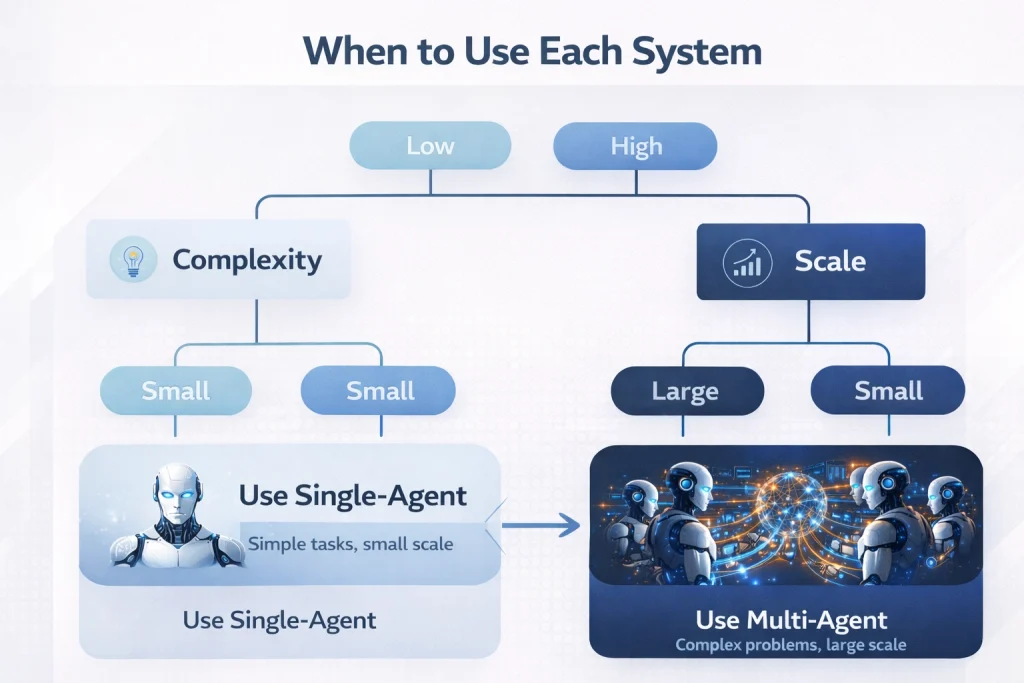
When to Use Single-Agent vs Multi-Agent Systems
Use Single-Agent When…
The task is well-defined and bounded. If you can describe exactly the task that what the agent needs to do with it from start to finish, then a single agent is probably sufficient.
Sequential processing is enough. When one step reliably follows from another without needing parallel processing, you do not need multiple agents.
Speed of setup matters. If you need a system that performs something quickly with minimal infrastructure, a single agent is the best choice to start as a starting point.
Transparency and auditability are priorities. Single agents are easier to monitor and explain.
The task does not require specialization. If one generalist agent can handle all aspects of the problem competently, there is no reason to introduce more agents.
Use Multi-Agent When…
The task is too large or complex for one agent. When the scope of the complexity exceeds what a single agent can handle well, then distributing the work is the logical answer, which requires a multi-agent system.
Different parts of the task require different expertise. The specialization of each agent for one task of multiple agents produces better results when the task has genuinely distinct components.
Parallel processing would speed things up. If multiple subtasks can run simultaneously, keep running them in parallel with different agents to save significant time.
Resilience matters. In production environments where uptime matters, distributing work across multiple agents means no single failure point can take down the whole system.
The problem is dynamic. When conditions change rapidly and continuously, and there are different aspects that need to be handled and monitored simultaneously, multiple agents provide better coverage to them.
Practically, many teams start with a single-agent system and then migrate to a multi-agent architecture as their needs grow and expand. That is a perfectly reasonable path, which you do not need to build for maximum complexity on day one.
Frequently Asked Questions about single-agent and multi-agent systems
1. What is the difference between single-agent and multi-agent systems?
A single-agent system uses one AI agent to independently handle a task, while a multi-agent system uses two or more agents that interact or collaborate to handle a complex task. The main difference between these two in the decision-making abilities: in single-agent systems, everything is decided by a single system, while in multi-agent systems the task is distributed among multiple agents.
2. What is a multi-agent system in simple terms?
A multi-agent system is a setup where multiple AI agents work within the same environment, each handling a different part of a problem. Instead of one agent performing everything alone, the work is divided across multiple agents, who are specialized in a specific role.
3. Are multi-agent systems better than single-agent systems?
Not universally that multi-agent systems are better than single-agent systems categorically because multi-agent systems are better suited to complex, large-scale, or dynamic problems, while Single-agent systems are better for simple, bounded tasks where clarity and speed matter most. The right choice depends entirely on what you are trying to accomplish.
4. When should I use a single-agent system?
Use a single-agent system when your task is clearly defined, to the point, and can be handled sequentially, which does not require specialization, and does not need to scale rapidly. If you can describe what the agent needs to do from input to output in a straight way, then a single agent is the right tool for this.
5. Do multi-agent systems require coordination?
Yes, at some level, multi-agent systems require coordination. Multiple agents do not automatically work together, but they need some proper mechanism for interacting, whether that is passing outputs between them, reading from a shared data source, or following a structured process. All of these should be discussed in a proper way in the initial. The nature of that coordination can range from very simple to highly sophisticated, depending on the system’s design.
6. Can a single-agent system become multi-agent?
Yes, and this is a common evolution path, actually. Many systems start as a single-agent and grow into multi-agent architectures as requirements expand. The transition usually happens when a single agent starts struggling with the volume or complexity of work, or when different parts of the task would benefit from specialized handling.
7. Why are multi-agent systems more complex?
As the number of agents increases, the system becomes more complex. Each new agent adds different behaviours and potential points of failure. You must also consider how these agents share information, resolve conflicts, and what happens if one agent does not perform well. These issues do not occur in a single-agent system.
Conclusion
The choice between single-agent and multi-agent systems is not really a technical decision, but it is a problem-matching decision.
Single-agent systems are independent, predictable, and easy to control. They are the right tool when the task is bounded, sequential, and does not demand the kind of specialization that multiple agents can provide. Multi-agent systems are collaborative, flexible, and capable in nature of handling complexity that would defeat any single agent, but also they carry real costs in design, debugging, and infrastructure.
The most common mistake is not choosing the wrong architecture from the start. Actually, it is refusing to evolve. Start with the simplest system that could work, understand where it breaks down, and let that understanding guide the decision to scale.
Choose based on the shape of your problem, not the sophistication of the solution.
👉 Next, learn how AI agent orchestration works step-by-step, because once multiple agents are involved, the question of how they are coordinated and managed becomes the most important design decision you will make.