The top 5 career paths in Big Data and Data Science are Data Analyst, Data Scientist, Data Engineer, Machine Learning Engineer, and Business Intelligence Developer. Where each role serves a different function and activities in the data ecosystem, for instance, “from analysing data to building AI systems,” which allows you to choose based on your skills, career goals, and technical expertise.
Definition
Big Data and Data Science careers involve working with the large datasets to extract meaningful insights, to build predictive models, and to create such type of systems which support data-driven decisions.
Key Takeaways
Different roles require different levels of technical skills
A Data Analyst is best for beginners; an ML Engineer is the most advanced
The demand for these roles is very high across such type of industries like finance, healthcare, and tech
Choosing the right career in the data ecosystem completely depends on your interests and long-term goals
Why Data Science Careers are In-Demand?
👉 Data Science Careers are In-Demand because companies completely rely on data to and need data to make smarter decisions from them and stay competitive in this modern era.
Tech and Digital Organizations are generating massive amounts of data daily, each and every second. If there are no skilled professionals available to deal with this data, so this data is useless for the organizations until a professional is present to deal with it.
Actually, data professionals have the ability to turn the raw data into the meaningful and easily understandable insights, predictions, and automated systems. These are the main capabilities which make them valuable and demanding persons across industries like e-commerce, banking, healthcare, and marketing.
What Is Driving the Growth of Big Data Careers?
The following three forces are basically accelerating the demand for data professionals in the data ecosystem:
Cloud computing, which is very popular nowadays and made a large-scale data storage and processing which is affordable for companies of all sizes, not just only tech giants. The best opportunity for all types of organizations to store massive amounts of data
AI and machine learning moved from research labs into everyday business operations such as fraud detection, recommendations, and churn prediction
Regulatory and compliance pressure forced organizations to treat data as a governed, auditable asset, creating demand for engineers and analysts who ensure quality and traceability in this modern era to deal with it efficiently
How Do Data Roles Differ Across Industries?
The table shows different Data Roles across various industries:
Industry
Primary Data Use Case
Healthcare
Patient outcome prediction, clinical trial analysis, medical imaging
What Skills Make Data Professionals Valuable in 2026?
This table shows those skills which make a data professional valuable in 2026:
Skill Category
Examples
Technical
Python, SQL, cloud platforms (AWS, GCP, Azure)
Analytical
Statistics, experiment design, data modelling
Business
Communication, stakeholder management, and domain knowledge
The most valuable professionals come from the combination of all three above skills. Technical depth alone is no longer enough, but also the ability to translate data into decisions is what creates real organizational impact”.
What are the top 5 Career Paths in Big Data and Data Science?
👉 The top 5 Career Paths in Big Data and Data Science are Data Analyst, Data Scientist, Data Engineer, Machine Learning Engineer, and BI Developer.
top 5 Career Paths in Big Data and Data Science
These roles and skills develop and form a complete data ecosystem, which is now in demand. Among from these, some skills focus on analysing data, others on building systems, and some on deploying AI solutions, all of which are beneficial for the unstructured data to make it structured an in efficient manner. To understand the differences among these roles will basically help you to choose a best career path which matches your strengths and interests.
1. What Does a Data Analyst Do?
A data analyst collects data, cleans it, and interprets it to help the business teams to understand about “what happened and why it happens?” They deal with their own dashboards, reports, and ad hoc investigations, which guide day-by-day decisions. Actually they are the translators for organizations between raw data and business action, and the most accessible entry point in the field.
For a step-by-step learning path into this role, see our complete Data Analyst Roadmap.
What Skills Are Required for Data Analysts?
These are the important skills which are required for a Data Analyst, which are given below:
SQL: which is essential and non-negotiable for the storage area
Business communication and stakeholder presentation
Skills Are Required for Data Analysts
What Tools Do Data Analysts Use Daily?
Data Analysts use these mentioned tools daily when he/she deals with the data:
Category
Tools
Querying
SQL, PostgreSQL, Snowflake, MySQL
Visualization
Tableau, Power BI, Looker Studio
Analysis
Python (Pandas), Excel, Google Sheets
Product / Web Analytics
Google Analytics, Mixpanel
What is the Career Progression for Data Analysts?
The Career Progression for Data Analysts is:
Junior Analyst to Mid-Level Analyst to Senior Analyst to Data Scientist / BI Lead / Product Analytics Manager
The Analysts who develop Python and statistics skills commonly transition into data science. Those who build strong business communication and visualization ownership move toward BI leadership or product management.
2. What Does a Data Scientist Do?
A data scientist goes beyond for describing “what happened to predicting what will happen and also, in some cases, prescribing what a business should do about it”. They apply statistical modelling, machine learning, and programming to complex problems that reporting alone cannot solve these issues, which are present or will come into existence. The role lies at the intersection of mathematics, programming, and business strategy.
How Is a Data Scientist Different from a Data Analyst?
The following table will point out the main difference between a Data Scientist and a Data Analyst:
Dimension
Data Analyst
Data Scientist
Core Question
What happened? Why?
What will happen? What should we do?
Primary Output
Reports, dashboards
Predictive models, AI systems
Math Depth
Basic statistics
Linear algebra, probability, ML theory
Time Horizon
Daily / weekly cycles
Weeks to months per project
Tools
SQL, Tableau, Excel
Python, Scikit-learn, PyTorch, Spark
What Technical Skills Are Essential for Data Scientists?
These are the main technical Skills which are necessary for a data scientist, which are given below:
Python: NumPy, Pandas, Scikit-learn, PyTorch or TensorFlow
Machine learning: classification, clustering, deep learning, model evaluation
SQL, Git, cloud platforms, and basic model deployment awareness
What Are Typical Career Growth Opportunities?
Typical Career Growth Opportunities for a Data Scientist:
Junior Data Scientist to Senior Data Scientist to Staff / Principal DS or ML Engineering or Head of Data Science
Also important to note that the specialization in NLP, in computer vision, or causal inference significantly increases market value at the senior level.
3. What Does a Data Engineer Do?
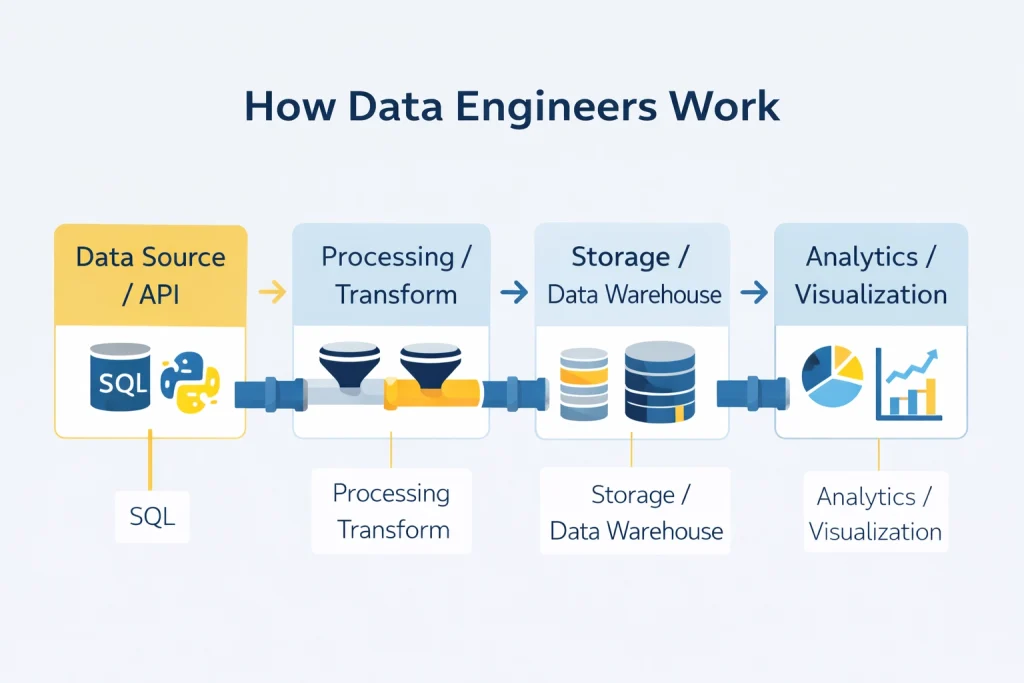
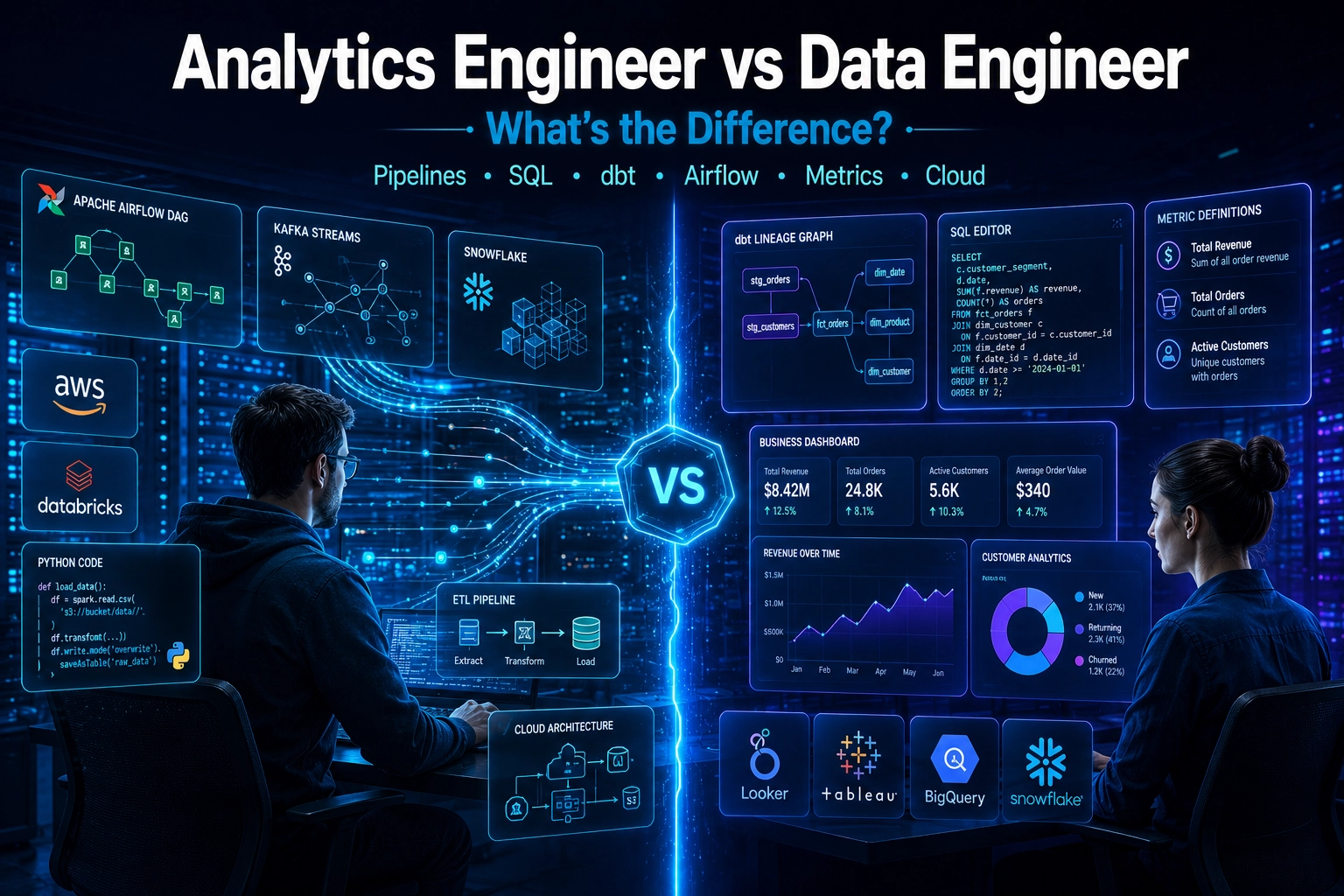
A data engineer actually focuses on the designing, building, and maintaining such type of infrastructure which collects, stores, transforms, and delivers data reliably at scale. They connect data to the business strategy to make sure about the right people that they get accurate information when they need it. They also create and keep clear definitions consistent.
For a complete breakdown of the data engineer skill set and learning path, see our Data Engineer Roadmap.
Why Are Data Engineers Critical in Big Data Systems?
Data Engineers are Critical in Big Data Systems because Data quality is the single biggest threat to analytics value. Basically, Data engineers develop and build pipelines to catch errors, handle failures, and maintain data consistency as information moves between form one system to another, and also often processing millions of events per hour across dozens of sources. Real-time streaming architectures (for fraud detection, live dashboards) represent the fastest-growing area within the role.
What Technologies Do Data Engineers Work With?
The table shows those technologies with which Data Engineers Work:
Building a portfolio pipeline project such as: ingest a public dataset, transform it, and expose it in a queryable format. Pair this with the cloud certification like AWS Data Analytics Specialty or Google Professional Data Engineer, for the validate skills credibly. Basically software engineers transitioning need to add data tooling; analysts transitioning need to strengthen software engineering rigor.
4. What Does a Machine Learning Engineer Do?
An Machine Learning engineer actually takes models which are built by data scientists and deploys them into production systems which serve real users at scale. This role is the combination of software engineering discipline with the ML fluency, which specifically focused on reliability, latency, monitoring, and continuous improvement of live AI systems. It is the highest-demand, highest-paying role in the data ecosystem.
Docker and Kubernetes for the containerization and orchestration
Cloud ML platforms: AWS SageMaker, Google Vertex AI, Azure Machine Learning
Model optimization: quantization, pruning, distillation for production performance
What Is the Difference Between ML Engineer and a Data Scientist?
The main Difference Between ML Engineer and Data Scientist is shown in the table:
Dimension
Data Scientist
ML Engineer
Focus
Build and validate models
Deploy and operate models in production
Key Concern
Accuracy, bias, statistical soundness
Latency, throughput, reliability, scalability
Primary Deliverable
Trained model + documentation
Production ML system serving live users
Core Tools
Jupyter, Scikit-learn, PyTorch
Docker, Kubernetes, serving frameworks, MLflow
5. What Does a Business Intelligence Analyst Do?
A BI analyst basically builds the reporting infrastructure for the organizations, such as dashboards, KPIs, and data products, which gives decision-makers a clear, reliable view of business performance. They connect data with the business strategy, and ensuring that the right people receive an accurate information at the right time. Additionally, they establish and maintain consistent definitions for metrics across the organization.
How Do BI Analysts Support Decision-Making?
BI Analysts Support Decision-Making in the following ways: BI analysts reduce time-to-insight for the leaders, to enforce consistent metric definitions across departments, and to handle the ad hoc investigations and answer questions like “Was the promotion effective or not?” or “Is the sales decline regional or widespread?” quickly and accurately. The best and most authentic BI analysts shape what questions get asked, not just how they get answered.
What Tools Are Common in BI Roles?
Here are the Common tools that are used in BI Roles:
Category
Tools
Dashboard
Tableau, Power BI, Looker (Google)
Querying & Transformation
SQL, dbt
Ad Hoc Analysis
Excel, Google Sheets, Python
Data Sources
Snowflake, BigQuery, Salesforce, CRM platforms
What Career Path Leads in BI Leadership Roles?
Career Path that Leads in BI Leadership Roles:
BI Analyst to Senior BI Analyst to BI Lead / Analytics Manager to Head of Analytics to Chief Data Officer
Domain specialization are important in any field, such as finance, product, supply chain, and customer experience, significantly because it accelerates the path to the leadership and increases compensation at every stage.
How Do These Data Science Roles Connect to Each Other?
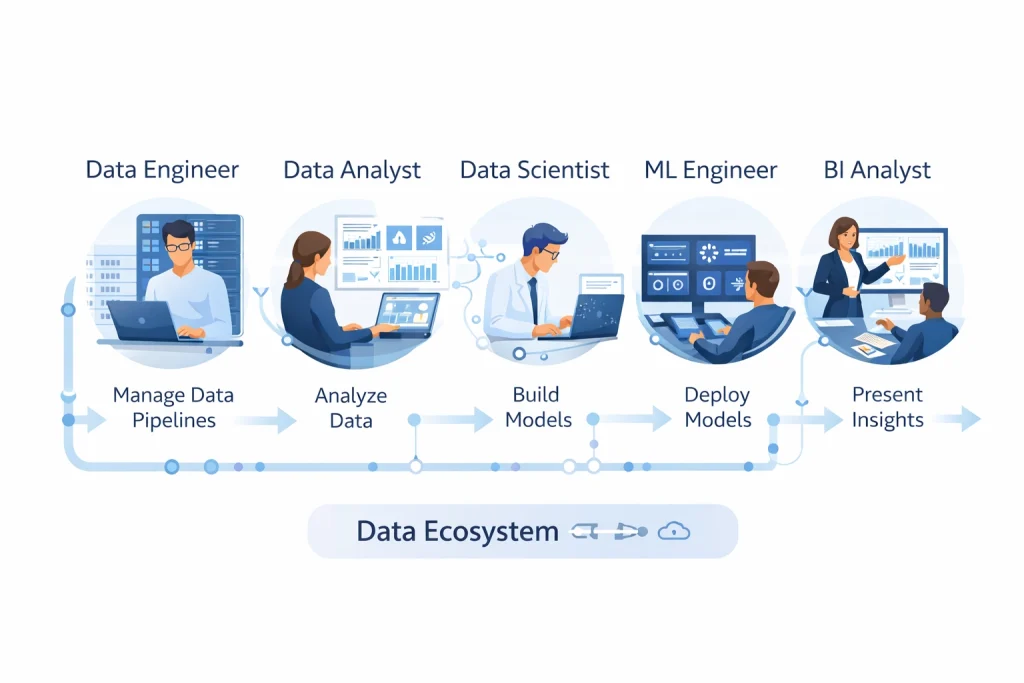
These five roles from data ecosystem form an interconnected ecosystem in which Data engineers build the foundation while Analysts and BI professionals use the foundation and surface insights from it. Data scientists build predictive systems on the top of these. ML engineers put those systems into production way. Each data role creates value for the others and breakdowns in one affect everyone downstream.
Data Science Roles Connection
What Is the Typical Career Transition Between Roles?
Transition
What You Need to Build
Analyst → Data Scientist
Statistics depth, ML fundamentals, stronger Python
Analyst → BI Analyst
Visualization ownership, metric definition, business reporting
Data Scientist → ML Engineer
Systems engineering, deployment frameworks, MLOps practices
Can You Switch Between Data Science Career Paths Easily?
You can Switch Between Data Science Career Paths from one career to the other by the following procedures easily:
Adjacent transitions (Analyst ↔ BI Analyst, Data Scientist ↔ ML Engineer) are achievable in 6–12 months of deliberate upskilling.
Cross-quadrant transitions (BI Analyst → ML Engineer) require building entirely new skill sets and it can take 12–24 months of structured effort alongside current work.
Which Roles Require the Most Technical Depth?
The roles which require most technical skills are represented in the greatest and smaller symbol which denote that the highest and large-scale technicality:
ML Engineer > Data Engineer > Data Scientist > BI Analyst > Data Analyst
Comparison Table: Which Data Career Is Right for You?
Role
Difficulty
Coding Level
Focus Area
Best For
Data Analyst
Easy
Low
Insights
Beginners
Data Scientist
Hard
High
Prediction
Problem solvers
Data Engineer
Hard
High
Systems
Tech-focused
ML Engineer
Very Hard
Very High
AI Deployment
Advanced learners
BI Developer
Medium
Medium
Visualization
Business-focused
What Is the “Data Career Growth Matrix”?
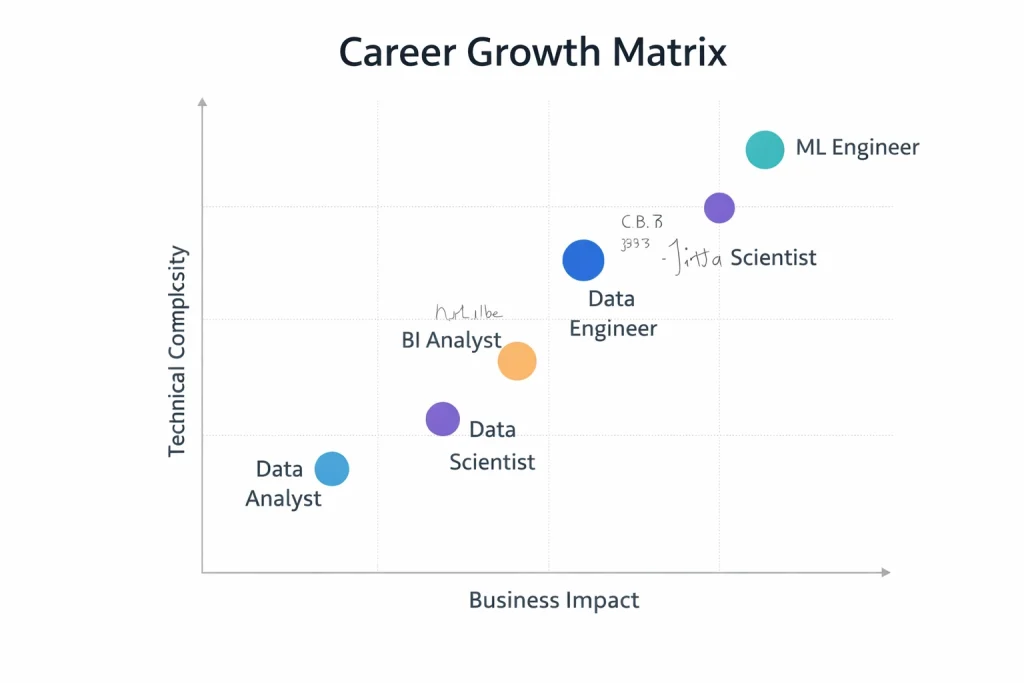
The Data Career Growth Matrix exactly maps and represent all five roles across two axes to clarify where each sits and what it takes to move between them.
Axis 1: Technical Complexity (Low → High): depth of programming, math, and systems knowledge required
Axis 2: Business Impact (Low → High): how directly the role influences business decisions and outcomes
How Does the Matrix Map Skills vs Career Progression?
Role
Technical Complexity
Business Impact
Primary Value
Data Analyst
Low
High
Daily business decisions
BI Analyst
Medium
High
Executive visibility, consistent metrics
Data Scientist
High
High
Predictive and prescriptive systems
Data Engineer
High
Medium
Infrastructure that enables everyone else
ML Engineer
Very High
High
Production AI at scale
Where Do the 5 Career Paths Fit in the Matrix?
Data Analyst: Closest to the business, most accessible technically; the best entry point for most people
BI Analyst: stronger technical demands than pure analysis, very high organizational visibility
Data Scientist: high technical ceiling, high business impact; the highest-prestige quadrant
Data Engineer: technically demanding, indirect impact; the invisible backbone of every data team
ML Engineer: highest technical demands, production AI impact; increasingly the highest-paid role
How Can You Use This Matrix to Plan Your Career Path?
Find out your current position on both axes, then identify your target position. The gap tells you exactly what should be prioritize to reach you’re the desired position easily. If you can see the it is notable that moving right on the technical axis requires deeper programming, ML, or systems skills while Moving up on the business axis requires domain knowledge, communication ability, and stakeholder exposure. Both movements can happen in parallel but it need the right approach.
How Do These Data Careers Work in Real Life?
You will understand about These Data Careers Which Work in the Real-Life problems like:
Example 1: How Does an E-Commerce Company Use a Data Analyst?
A data analyst in the marketing team which tracks campaign performance, updates weekly Power BI dashboards, and investigates the conversion rate drops. The analysis of the data analyst directly shapes budget decisions, which campaigns get more spend, which customer segments get targeted, every single week.
Example 2: How a Streaming Platform Uses a Data Scientist?
A data scientist can build a churn prediction model which wisely identifies at-risk subscribers before they cancel and triggers the targeted retention campaigns. The model influences outreach to the hundreds of thousands of users monthly and has a measurable impact on the platform’s monthly with the revenue retention rate.
Example 3: How a Fintech Company Uses a Machine Learning Engineer?
An ML engineer deploys a real-time fraud detection model which can processes thousands of payment transactions per second with sub-100-millisecond latency at fast rate. They create automated retraining pipelines which enable the model to adapt as fraud patterns to evolve, where accuracy, speed, and reliability directly impact on the financial outcomes.
How Can You Choose the Right Data Science Career Path for You?
Here a few questions which clarify to Choose the Right Data Science Career Path for yourself:
What Factors Should You Consider Before Choosing a Role?
Do you prefer talking to the business stakeholders or building technical systems?
How comfortable you are in the origins of mathematics, statistics, and mathematical theory?
Do you enjoy the infrastructure and reliability problems, or analysis and communication?
What is your current baseline like strong in SQL, programming, math, or business domain knowledge?
Which Career Path Fits Beginners vs Advanced Professionals?
Background
Best Starting Role
Complete beginner, no data experience
Data Analyst or BI Analyst
Quantitative background (math, stats, economics)
Data Scientist
Software engineering background
Data Engineer or ML Engineer
Experienced analyst seeking advancement
Data Scientist or BI Lead
Academic researcher (quantitative field)
Data Scientist
What Is the Fastest Way to Start a Career in Data Science?
The Fastest Way to Start a Career in Data Science:
Pick one role as a primary role.
Learn its three to five main and core skills of it to understand the main funda of it.
At least build two portfolio projects for the real-world experiences.
Apply consistently and frequently.
Most beginners take too broad an approach, learning a little of everything rather than developing real depth in anything.
The market rewards focused, demonstrable competence.
Combine structured learning with portfolio work and genuine professional networking, and the path to a first role becomes significantly shorter.
How to Start Career in Data Science?
Step-by-step solution To Start a Career in Data Science, here is a Step-by-Step procedure which are given below:
Step 1: Learn Basics
Start with Excel and SQL to understand data handling.
Step 2: Learn Programming
Move to Python for data analysis and automation.
Step 3: Build Projects
Work on real-world datasets to gain practical experience.
Step 4: Choose Specialization
Decide whether you want to become an Analyst, Scientist, or Engineer.
Step 5: Build Portfolio
Showcase your work on GitHub or personal websites.
Step 6: Apply for Jobs
Target internships or entry-level roles to gain experience.
Common Mistakes to Avoid
There are some mistakes that can do every beginners but should be aware of these to not make it:
Learning too many tools without mastering basics
Skipping real-world projects
Not choosing a clear career path at early stage
Ignoring SQL and data fundamentals
Future of Big Data and Data Science Careers
👉 The future of Big Data and Data Science Careers is completely shifting towards the AI-driven and automated systems which will make a revolution in the data ecosystem.
Key Trends
Rise of real-time analytics
Growth of AI and automation
Demand for cloud-based data solutions
Emergence of hybrid roles (Data + AI + Engineering)
Analytics engineering as a distinct role, professionals who apply software engineering discipline to the SQL transformation layer are now hired under the specific title of analytics engineer, sitting between data engineering and analysis. See our complete guide to analytics engineer vs data engineer
Strategic Insight
Professionals who combine multiple skills such as data engineering + machine learning will completely dominate the job in the market.
Frequently Asked Questions About Data Science Careers
What is the best career path in the field of data science?
The best career path in the field of data science completely depends on your strengths and interest. Analytical, and communication-oriented people going in the analyst and BI roles. Those which have strong backgrounds in the field of mathematics and programming are considered and well suited for data science or ML engineering roles on the basis of experience. There is no universally best way to find out the best path but only the best fit depends on your specific profile, background, and long-term goals.
Is a data science consider as a high-paying career role or field?
Data science is a high-paying career role in today era due to strong demand and limited supply in the industry. ML engineers and senior data scientists have the highest compensation, followed by data engineers and experienced BI analysts. The Salaries of these professionals are varying by location, industry, and specialization, but the field as a whole remains one of the most financially rewarding in tech.
Can I switch from data analyst to data scientist?
Switching from data analyst to data scientist is one of the most common transitions in the field of data ecosystem. But you will need to build a statistical depth, machine learning fundamentals, and stronger Python fluency to switch. Most of the analysts make this movement possible in the duration of 12–18 months of deliberate upskilling combined with the self-directed portfolio project work, and then transition into the junior data science roles.
Which one data career is best in the data science field for beginners?
The best data career for beginners in the data science is Data Analyst or BI Analyst roles which is the most accessible entry points in this filed. Both require SQL as the primary technical skill which is learnable in a few months, and both build the business understanding and communication skills which remain valuable across any future data role.
Is there need a degree to start a data science career?
Absolutely not, there is no need a degree to start a data science career because Analyst and BI roles are regularly filled by people who entered through just after joining of the bootcamps, certifications, and self-directed projects. For a data scientist and ML engineer roles at larger organizations, a quantitative degree is often preferred, but important point is “a strong portfolio demonstrating real capability can substitute for it”, particularly at startups and growth-stage companies.
Conclusion
Big Data and Data Science offer some of the most beneficial and future-proof career opportunities today and in the future. If you want to start your career as a Data Analyst or aim to become a Machine Learning Engineer, the success key for this is to build strong fundamentals and gain hands-on experience on different data projects. Important to be note that each role has its own path, but all are contributing to a data-driven world.
Start from small, stay consistent, and choose a specialization which matches your strengths. With the right approach, you can build a successful and high-paying career in this rapidly growing field in today era and in the future also.