Open the finance dashboard also open the marketing dashboard. Now pull the “active customers” metric from both dashboards. If you’ve worked with data professionals or in a data team for more than six months, you already know that what happens: the numbers don’t match. It is not dramatically case, the dramatically would be easier to catch. They’re off by four percent, or twelve percent, or they agree on Mondays and diverge by Thursday. Nobody knows that which one is the right case. So teams stop trusting either.
That’s the organizational failure mode, for this purpose analytics engineering was specifically created to solve. And it’s why the analytics engineer vs data engineer distinction matters a lot, not just as a career question, but as an explanation of why modern data teams are structured the way they are.
This article covers “why the role split happened, what each role actually does day-to-day, where they overlap in smaller teams, how the career paths and salaries compare, and a direct framework for deciding which direction fits you”.
Table of Contents
Quick Answer
A data engineer is a professional to builds and maintains the pipelines and infrastructure that move raw data from source systems into a warehouse or lakehouse. While the other hands An analytics engineer takes that raw data and transforms it into clean, tested, documented models that analysts and business teams can trust. The data engineer makes data available. The analytics engineer makes data usable.
Analytics Engineer vs Data Engineer: What’s the Difference
1. Why Analytics Engineering Exists
The standard answer, “the role emerged around 2018”, is accurate but useless unless you understand what created the opening for it.
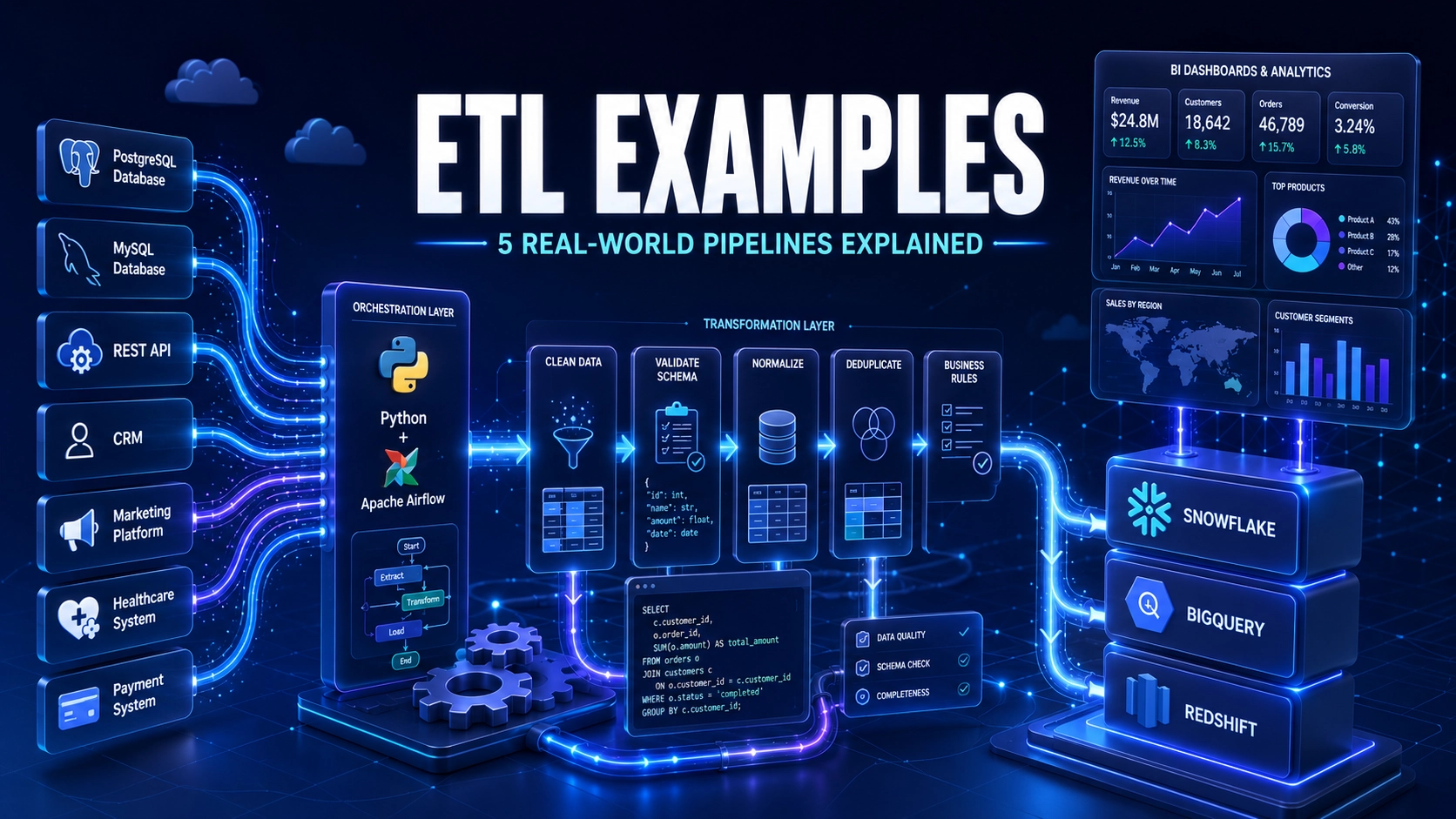
Cloud data warehouses changed the transformation equation. When BigQuery, Snowflake, and Redshift became powerful enough to handle heavy transformation workloads natively, the industry shifted from ETL (transform before loading) to ELT (load first, transform inside the warehouse). That shift had an unintended consequence:
The transformation step moved to a layer nobody clearly owned.
Data engineers focused on the ingestion side:
Getting data in reliably, managing pipelines, keeping infrastructure running.
Business analysts focused on the consumption side:
Answering business questions, building dashboards, running ad-hoc queries.
The transformation logic in between, the work of turning raw tables into trustworthy, consistently defined business metrics, fell into a gap.
What filled that gap was not good. Analysts wrote SQL transformations without any software engineering discipline: no version control, no automated tests, no documentation, no module reuse. Engineers occasionally wrote transformation logic without adequate business context, producing technically correct outputs that answered the wrong questions. Each team built their own version of “revenue” or “active user,” and those definitions quietly diverged over time.
dbt Labs and the Locally Optimistic communitynamed the role that addressed this in 2018: the analytics engineer. Someone who applies software engineering practices such as version control in Git, automated testing, modular design, documentation, specifically to the SQL-based transformation layer that connects raw data to business questions.
Here is the key point most introductions miss:
dbt didn’t just support analytics engineering, it created the conditions that made the role coherent. Without a tool that applied engineering discipline to SQL transformation work, “analytics engineering” would just be “analyst who writes cleaner code.”
dbt gave the role a specific, teachable, hireable tool set. That’s why it’s impossible to talk about analytics engineering without starting there, our dbt tutorial for beginners covers the fundamentals if you’re approaching this layer for the first time.
2. Analytics Engineer vs Data Engineer: What Each Role Actually Does
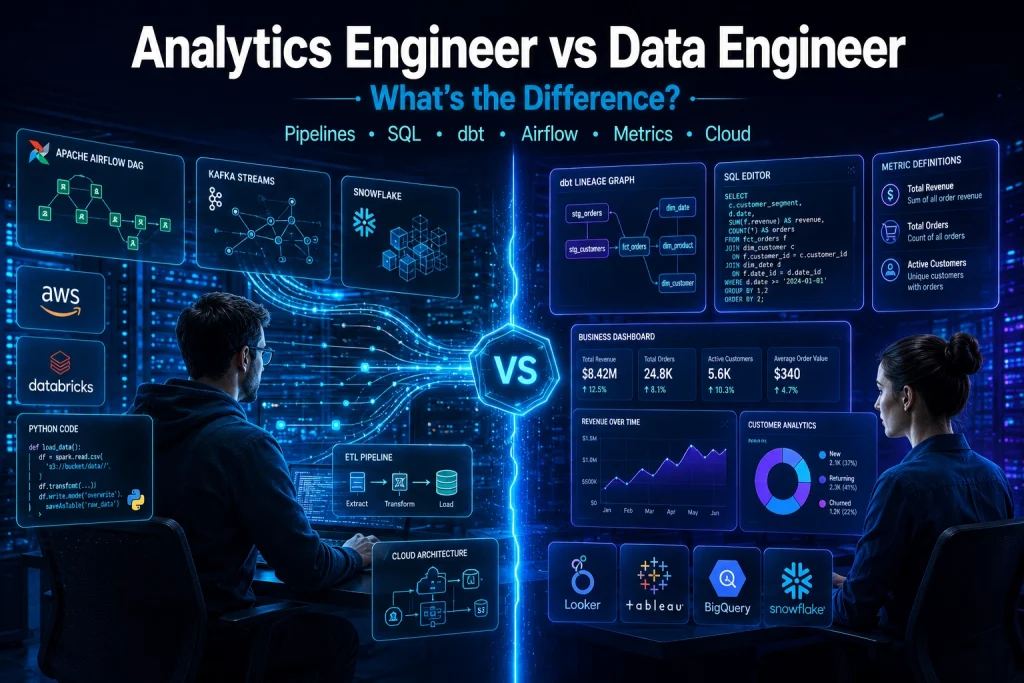
Stop at any data team and ask a data engineer what they did yesterday. You’ll hear: fixed a failing ingestion job, debugged a Kafka consumer that was falling behind, added a new data source to an existing Snowflake pipeline, reviewed an Airflow DAG that was running slow. The problems are infrastructure problems. The instinct is reliability, data needs to arrive on time, complete, and in the right format.
Ask an analytics engineer the same question. You’ll hear: wrote a new dbt model that joins orders to customer dimensions, added a not_null test on a revenue column that was silently passing NULLs downstream, met with the finance team to reconcile why their churn definition differed from the product team’s, reviewed a pull request on a metrics model. The problems are trust and consistency problems. The instinct is usability, data needs to be understood, agreed upon, and reliable enough to make decisions from.
Description
Data Engineer
Analytics Engineer
Primary output
Reliable data pipelines
Trusted data models
Works with
Raw data, infrastructure
Warehouse data, business logic
Core language
Python + SQL
SQL (primary), Python (secondary)
Key tools
Spark, Airflow, Kafka, AWS/GCP/Azure
dbt, Snowflake/BigQuery, Looker, Git
Closest to
Source systems
Business stakeholders
Owns
Data availability
Data usability and trust
Failure mode
Data doesn’t arrive
Data arrives but nobody trusts the numbers
Salary range (US, 2026)
$120K–$170K
$110K–$160K
The failure mode row is worth sitting with:
A data engineering failure is loud: pipelines error out, dashboards go blank, alerts fire.
An analytics engineering failure is quiet: dashboards keep loading, numbers keep updating, and the organization keeps making decisions on metric definitions that nobody ever agreed on.
Quiet failures are harder to catch and often more damaging.
3. The Trust Gap: The Problem Analytics Engineering Actually Solves
Name it directly: the trust gap is what happens when multiple teams build their own transformation logic independently, without coordination, over a period of months or years.
The finance team’s “revenue” excludes refunds and credits, because their accountant defined it that way when they built the first version of the report. The marketing team’s “revenue” includes everything that transacted, because their analyst was optimizing for top-line attribution. Neither definition is wrong in isolation. Together, they’re corrosive, because the moment someone puts both numbers in a slide deck for an executive review, the entire meeting becomes a debate about the numbers rather than a discussion about the business.
The consequence isn’t just friction in one meeting. It’s the slow erosion of trust in data across the organization. Teams that have been burned by mismatched metrics stop relying on dashboards. They build their own spreadsheets. They stop asking the data team for reports because they don’t believe the reports will be trusted anyway. Data becomes a political artifact rather than a shared decision-making tool.
Analytics engineering solves this by creating a single, governed transformation layer where metric definitions are established once, tested automatically, documented visibly, and served to everyone from the same source. One definition of “active customer.” One definition of “revenue.” Built in dbt, tested with unique and not_null checks, documented with business-readable descriptions, and versioned in Git so changes are tracked and reviewed like code.
The testing and documentation features in dbt aren’t just good technical hygiene, they’re the actual mechanism that makes shared metric definitions maintainable at scale. Without automated tests, a metric definition drifts silently. Without documentation, the definition exists only in one person’s head.Both failures reproduce the trust gap that analytics engineering was built to prevent.
4. Where the Roles Overlap, and How to Handle It
In a large organization with a mature data team, the boundary between data engineering and analytics engineering is relatively clean.
Data engineers own the ingestion layer:
Getting data from Salesforce, Postgres, Kafka, and whatever else the business runs on into Snowflake or the lakehouse.
Analytics engineers own the transformation layer:
everything from raw tables to business-ready models, handled in dbt.
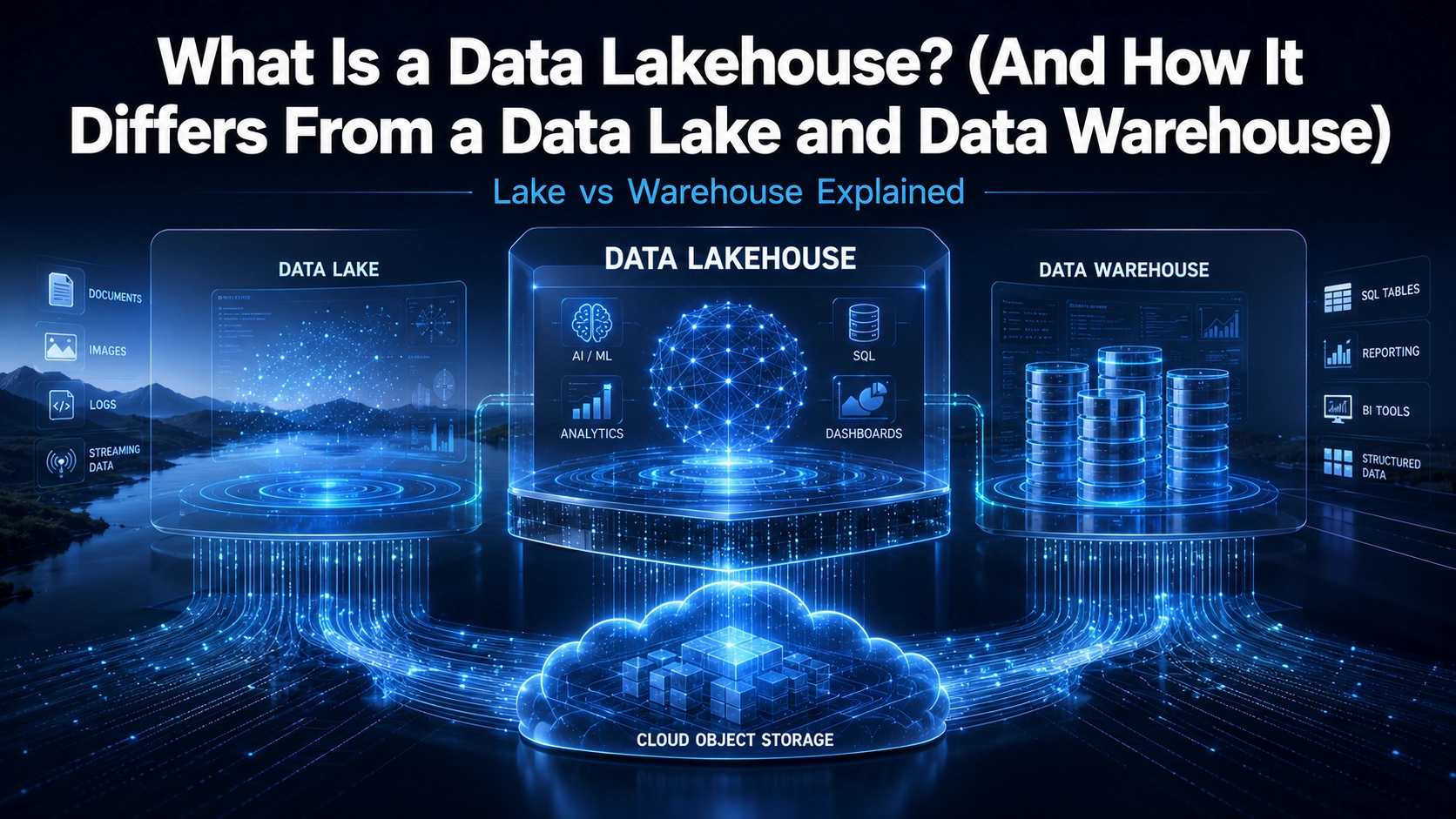
The handoff point is the raw or source layer in the warehouse, what most teams call the Bronze layer if they’re running Medallion Architecture.
In a smaller team, three to five data people, both roles often fall to the same people, or the boundary shifts week to week based on what’s on fire. That’s fine, but it requires a prioritization rule.
The practical rule: get data landing reliably before investing heavily in making it trustworthy. An infrastructure failureblocks everything; nothing downstream works if Airflow isn’t running and data isn’t arriving. A trust failure slows everything; decisions get made more slowly and more poorly, but the system keeps running. Sequence matters. Data engineering work first, analytics engineering investment second.
Here is where it gets interesting: the failure pattern that comes from violating this sequencing. A company hires a strong data engineer and, because the team is small, asks them to own the dbt transformation models as well. The data engineer builds solid pipelines, ingestion is reliable, data arrives on schedule. But when they build dbt models, they think about them as an engineer: does the SQL run correctly, does it produce output, does it handle edge cases. They don’t think about them as a business consistency problem.
Six months in, the project has 200 dbt models. None of them have tests. Documentation is sparse and uneven. There are three different definitions of “paid user” across the model catalog, one for the billing team, one for the product team, one in an old model nobody can trace the origin of. Analysts don’t know which one to trust, so they each pick the one that tells the story they need. The trust gap that analytics engineering was supposed to close has been reproduced in the dbt project itself.
The wrong-role failure runs in the other direction too. An analytics engineer asked to own streaming infrastructure, building and managing Kafka pipelines, handling consumer backpressure, designing partitioning schemes, will get the work done, but slowly and poorly. The instincts don’t fit the problem. It’s not a capability gap; it’s a judgment-and-instinct mismatch that compounds under deadline pressure.
5. Salary and Career Path Comparison
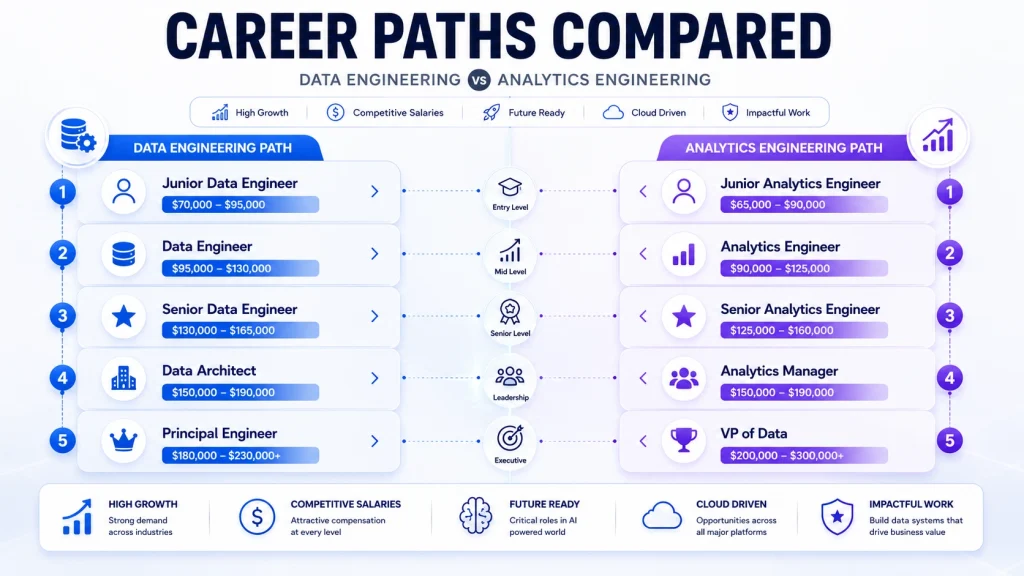
Data engineers in the US earn in the range of $120K–$170K in 2026, with senior and architecture roles pushing toward the top of that range and beyond at larger organizations. Analytics engineers earn slightly less, typically $110K–$160K across US markets. The gap is smaller than it used to be, and it’s narrowing, analytics engineers are significantly undersupplied relative to demand per Primis Talent’s June 2026 analysis, which tightens compensation at the senior end.
Data engineer vs Analytics engineer Salary and Career Path
Career trajectories for both roles are well-established, but they move in different directions.
The data engineering track tends toward systems scale and architecture:
junior data engineer → senior data engineer → data architect → staff or principal engineer → infrastructure leadership.
The problems get more distributed, the systems get more complex, and the technical depth keeps compounding.
The analytics engineering track tends toward business alignment and organizational impact:
junior analytics engineer → senior analytics engineer → analytics engineering manager → head of analytics engineering → VP of data or analytics.
The problems increasingly involve cross-functional coordination, metric governance at an organizational level, and translating between technical capability and business strategy.
One observation that doesn’t get made often enough:
The analytics engineering career path moves engineers closer to business leadership without requiring them to leave technical work behind.
For data engineers who find pure infrastructure work isolating from the business questions they’re ultimately serving, moving toward analytics engineering often resolves that tension.
For analysts who want more engineering credibility and structured discipline, it’s the path that doesn’t require jumping all the way to infrastructure.
The role itself is still underrecognized. Many organizations are hiring analytics engineering work without using the analytics engineer title, they’re hiring “senior SQL developers,” “analytics developers,” or “BI engineers” and asking them to do what analytics engineers do. That fragmentation makes the talent pool harder to search and career paths harder to navigate, but it also means the underlying demand is larger than job posting counts for the specific title suggest.
6. Which Path Should You Choose?
This is the question every comparison article avoids answering directly. Here’s the framework.
If your background is software engineering or backend infrastructure and you want to work with distributed systems, streaming architecture, and cloud-scale data movement, so data engineering is the natural fit. The problems are systems problems: reliability, latency, throughput, fault tolerance. They play to engineering instincts. Our Data Engineer Roadmap covers the full infrastructure skill sequence if you’re building in this direction.
If your background is data analysis, SQL, or business intelligence and you want to apply engineering discipline without moving away from the business layer, so analytics engineering is the natural fit. The problems are trust and consistency problems: metric definitions, data modeling, documentation, testability. dbt is the starting point, and the skills build from there into data modeling patterns, semantic layer design, and cross-functional governance.
If you’re a data engineer who wants more business exposure and stakeholder interaction so analytics engineering is often the natural next move. The transition is fundamentally about shifting from “does the data arrive correctly” to “does the data mean what we think it means.” The engineering discipline carries over; the focus shifts.
If you’re a data analyst who wants to write more structured, testable code and have more engineering credibility so analytics engineering is the most direct path that doesn’t require rebuilding your skills from the ground up. The SQL you already know becomes the foundation; the engineering practices around it are what you add.
If you’re joining a small team where both roles need to be covered, so sequence it correctly. Build data engineering fundamentals first, because broken ingestion blocks everything. Add analytics engineering discipline second. Treat dbt model quality and metric governance as the investment you make once the foundation is solid, not before.
The skills above the automation line in data engineering, architecture, governance, business logic translation, map heavily onto analytics engineering work. If you’ve read about which data engineering skills AI is least likely to replace, you’ll notice the overlap is substantial. That’s not a coincidence.
7. Frequently Asked Questions
What is the difference between a data engineer and an analytics engineer?
A data engineer builds the infrastructure that moves raw data into a warehouse; an analytics engineer transforms that raw data into trusted models. → Data engineers work closest to source systems, managing pipelines, orchestration (Airflow, Prefect), and storage infrastructure (Snowflake, S3, Databricks) → Analytics engineers work closest to business stakeholders, defining metrics in dbt, writing automated tests, and maintaining documentation → The data engineer makes data available; the analytics engineer makes it usable and trustworthy
Is analytics engineering the same as data engineering?
No, they’re distinct roles with different instincts, tool sets, and organizational relationships. → Data engineering focuses on reliability and data movement; analytics engineering focuses on transformation, metric consistency, and trust → The roles emerged from the same field but diverged when the ELT shift created a transformation gap that neither data engineers nor business analysts were filling well → In small teams, one person may cover both, but the skill sets and judgment calls required are genuinely different
What tools does analytics engineer use?
The analytics engineering stack centres on dbt, SQL, and a cloud data warehouse. → dbt is the primary transformation and testing tool, it’s so central to the role that understanding analytics engineering is largely synonymous with understanding dbt → Cloud warehouses (Snowflake, BigQuery, Databricks) are where transformation logic runs and models are materialized → Looker, Tableau, or similar BI tools sit at the serving layer; Git handles version control for all transformation code
Which pays more, data engineer or analytics engineer?
Data engineers earn slightly more on average, but the gap is narrowing. → US data engineer salaries range from $120K–$170K in 2026; analytics engineer salaries range from $110K–$160K → Analytics engineers are significantly undersupplied relative to demand, which is compressing the salary gap at senior levels → Career ceiling depends more on specialization and scope than on the role title — senior analytics engineering leaders can reach compensation parity with senior data engineers in organizations that value the governance layer
How do I become an analytics engineer?
Start with strong SQL skills and dbt, those two form the foundation of the analytics engineering role. → Most analytics engineers come from a data analyst background and add engineering discipline, or from a data engineering background and shift focus toward the transformation and business logic layer → Building a portfolio of dbt projects, with models, tests, and documentation, demonstrates the specific skill set employers look for → Our dbt Tutorial for Beginners covers the practical starting point for anyone approaching analytics engineering for the first time
Do analytics engineers need to know Python?
Python is secondary to SQL in analytics engineering, but it matters at the senior level. → Day-to-day analytics engineering work is predominantly SQL, writing dbt models, defining tests, maintaining documentation → Python becomes relevant for building custom dbt macros, writing data quality checks beyond dbt’s generic tests, and integrating with orchestration tools → Data engineers need Python fluency at the core; analytics engineers need it at the margins, with SQL as the primary competency
What is the analytics engineer role in a small team?
In a small team, one person often covers both data engineering and analytics engineering work. → The practical sequencing rule: prioritize data engineering first (broken ingestion blocks everything), then invest in analytics engineering discipline once data is arriving reliably → The most common failure in small teams is a strong data engineer being asked to own dbt models without analytics engineering instincts, the result is technically functional models that lack tests, documentation, and consistent metric definitions → As teams grow past five or six data people, the roles typically split, that’s when hiring specifically for one or the other becomes worth the clarity
8. Conclusion
The data engineer and analytics engineer roles exist because the same person can’t hold both sets of instincts equally well at scale. One is drawn to systems reliability; the other to business trust. That’s not a skills gap; it’s a difference in where attention naturally goes under pressure.
The best practical next step depends entirely on where you’re starting. If analytics engineering is the direction, the dbt tutorial is the entry point, it’s the tool that defined the role and remains the core of it. If data engineering is the direction, the Data Engineer Roadmap covers the full infrastructure skill sequence in the right order.