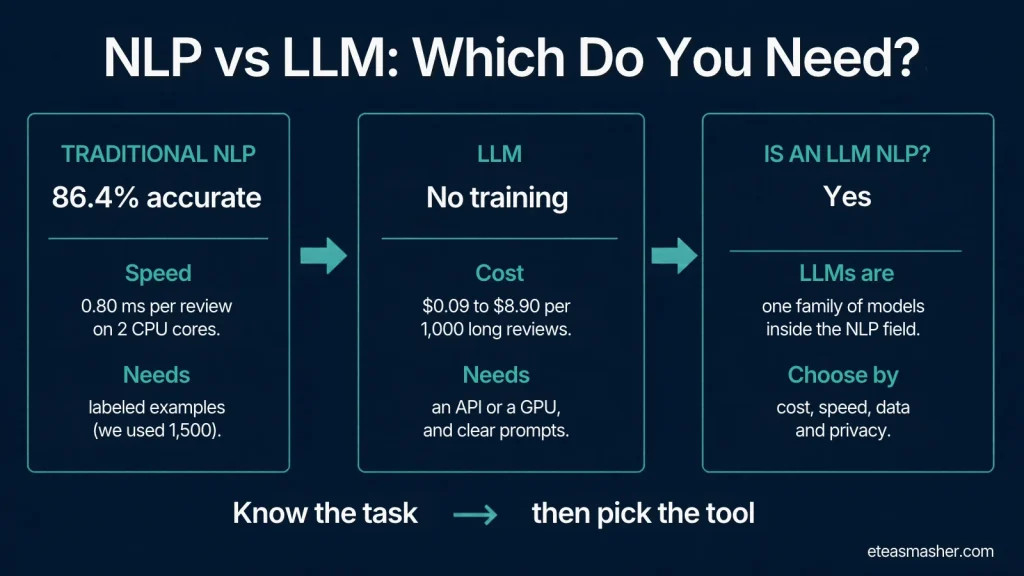
Quick answer: NLP (natural language processing) is the whole field of getting computers to work with human language. An LLM (large language model) is one family of models inside that field: a very large neural network trained to predict the next token, which can do many language tasks from a plain-text prompt. So “NLP vs LLM” is really a choice between a small, task-specific NLP model (such as a spaCy pipeline or a TF-IDF classifier) and a general-purpose LLM. Pick the small model for narrow, high-volume, private or explainable tasks where you have labeled data; pick an LLM when labeled data is scarce, the task is open-ended, or you need to generate text.
Most NLP vs LLM articles stop at a comparison table. This one also runs a small test: we train a traditional NLP classifier on 2,000 movie reviews, run spaCy’s small English pipeline, and count how many LLM tokens the same reviews would use, then turn that into an estimated API cost. No LLM could run in our test environment, so we show no made-up LLM answers; we report what we measured and cite published studies for the rest.
Table of Contents
Is an LLM part of NLP?
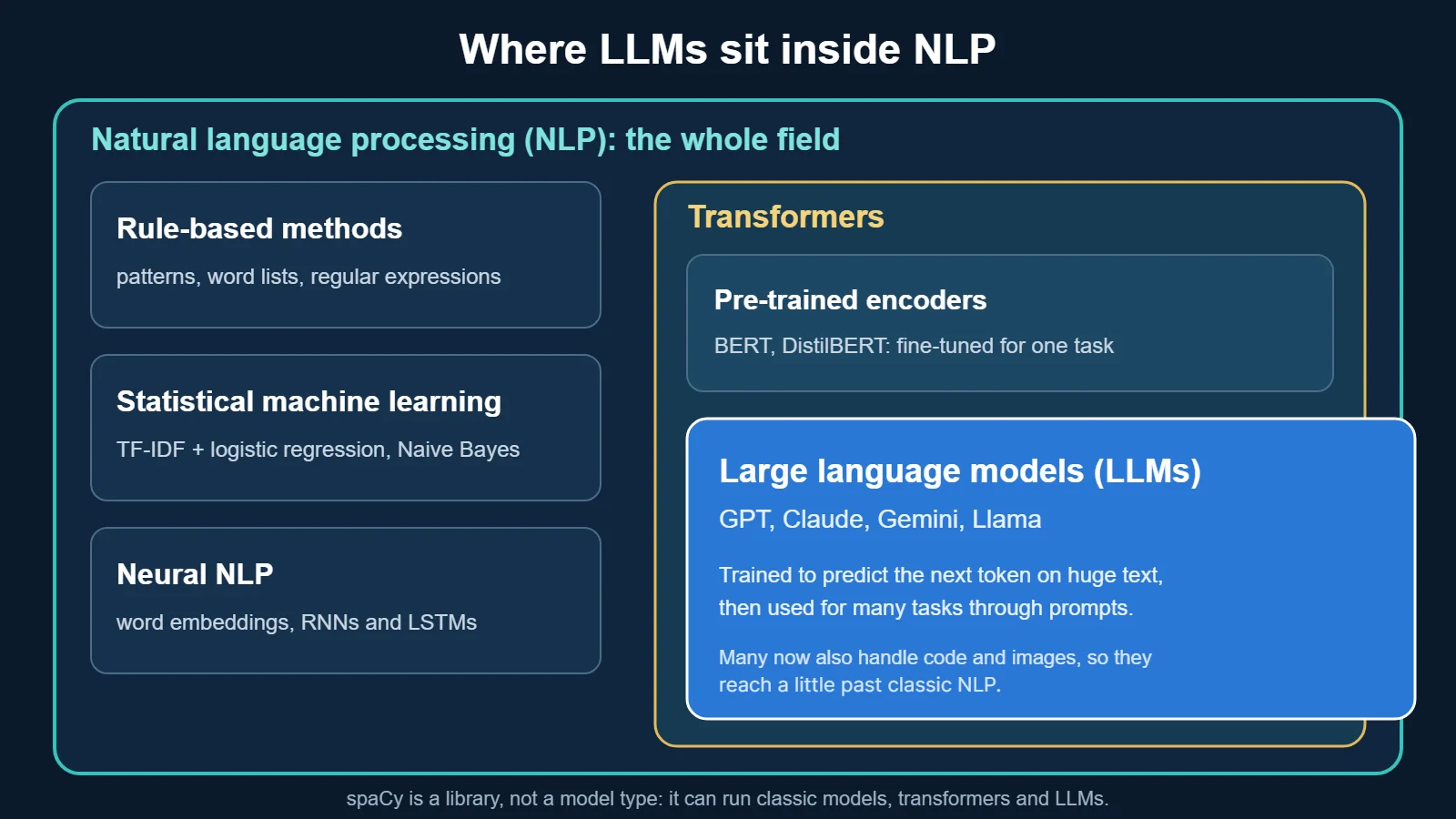
Yes. NLP is the field; an LLM is one kind of model used in it, the way an aeroplane is one kind of transport. NLP has gone through several waves, and each wave added tools without deleting the old ones:
Rules: hand-written patterns and word lists.
Statistical machine learning: Naive Bayes, logistic regression and similar models trained on labeled examples.
Neural networks: word embeddings and recurrent networks that learn their own features.
Pre-trained transformers: BERT-style models fine-tuned for one task.
Large language models: much bigger transformers such as GPT, Claude, Gemini and Llama that do many tasks from instructions alone.
LLMs are one family of models inside NLP, not a separate field.
The standard textbook for the field, Jurafsky and Martin’s Speech and Language Processing (3rd edition draft, August 2026 release), covers logistic regression for text classification, named-entity tagging, transformers, post-training and retrieval-augmented generation in one NLP book.
LLMs reach a little beyond NLP, since many also write code or read images, but their core skill, predicting the next token of text, is a language task. Our guide on how large language models work shows that prediction step by step.
Traditional NLP vs LLM: the main differences
“Traditional NLP” usually means small models built for one job: a sentiment classifier, a named-entity recognizer or a spam filter. Here is how that compares with using an LLM.
Traditional NLP model
LLM
What it is
A small model trained for one task
A huge general model that follows instructions
How you build it
Collect labeled examples, choose features, train
Write a prompt, maybe add a few examples
Typical size
Our TF-IDF classifier was 3.6 MB; spaCy’s small English model took about 15 MB on disk
Billions of parameters; even OpenAI’s smaller open-weight model, gpt-oss-20b, needs about 16 GB of memory
Output
A label, a score, or tagged spans of text
Free text (which you can ask to follow a format)
Where it runs
Any laptop or server CPU
Usually a paid API; larger open-weight models need a GPU or a lot of memory
How you change it
Retrain on new data
Change the prompt, or fine-tune
The biggest difference is the starting point. A traditional model knows nothing until you train it on labeled data. An LLM already knows a lot about language, so it can try a task with zero or a few examples. The GPT-3 paper, Language Models are Few-Shot Learners (2020), showed this, with tasks given as text “without any gradient updates or fine-tuning”.
Our mini test: traditional NLP vs LLM on 2,000 movie reviews
We used the movie review polarity dataset v2.0 from Pang and Lee (2004): 1,000 positive and 1,000 negative film reviews. It is in NLTK’s data collection as movie_reviews (licensed CC BY 4.0), so nltk.download("movie_reviews") fetches it. The reviews come lowercased, with spaces around punctuation, so they look a little different from how people normally type. Because of those spaces, the word counts below split on spaces and count punctuation marks as words; an average review has about 650 real words.
Everything ran on 4 November 2026 on a small cloud machine with 2 CPU cores and 7 GB of RAM, with no GPU. Versions: Python 3.13, scikit-learn 1.9.1, NLTK 3.10.4, spaCy 3.8.18 with the en_core_web_sm 3.8.0 model, and tiktoken 0.14.0. Install them with:
Test 1: A TF-IDF and logistic regression classifier
This is the classic recipe for text classification. TF-IDF turns each review into numbers, giving a high score to words that are common in this review but rare across all reviews. Logistic regression then learns one weight per word or word pair and adds them up to decide “positive” or “negative”.
# step1_tfidf_classifier.py
# Traditional NLP: TF-IDF features + logistic regression on 2,000 movie reviews.
import pickle, time
import numpy as np
import nltk
from nltk.corpus import movie_reviews
from sklearn.feature_extraction.text import TfidfVectorizer
from sklearn.linear_model import LogisticRegression
from sklearn.model_selection import train_test_split, cross_val_score
from sklearn.pipeline import make_pipeline
from sklearn.metrics import accuracy_score

nltk.download("movie_reviews", quiet=True)
texts = [movie_reviews.raw(f) for f in movie_reviews.fileids()]
labels = [movie_reviews.categories(f)[0] for f in movie_reviews.fileids()]   # "pos" or "neg"
print(f"{len(texts)} reviews, average {np.mean([len(t.split()) for t in texts]):.0f} words each")

X_train, X_test, y_train, y_test = train_test_split(
    texts, labels, test_size=0.25, random_state=42, stratify=labels)

def build(C):
    return make_pipeline(
        TfidfVectorizer(ngram_range=(1, 2), min_df=2, sublinear_tf=True),  # words + word pairs
        LogisticRegression(C=C, max_iter=1000))

# Choose the regularization strength with 5-fold cross-validation on the training set only
scores = {C: cross_val_score(build(C), X_train, y_train, cv=5).mean() for C in (1, 10, 100)}
best_C = max(scores, key=scores.get)
print("Cross-validation accuracy by C:", {C: round(float(s), 3) for C, s in scores.items()})

model = build(best_C)
start = time.perf_counter()
model.fit(X_train, y_train)
train_s = time.perf_counter() - start

times = []
for _ in range(5):                        # time prediction 5 times, keep the fastest
    start = time.perf_counter()
    pred = model.predict(X_test)
    times.append(time.perf_counter() - start)
pred_s = min(times)

print(f"Training time:   {train_s:.2f} s on {len(X_train)} reviews (C={best_C})")
print(f"Accuracy:        {accuracy_score(y_test, pred):.3f} on {len(X_test)} test reviews")
print(f"Prediction time: {pred_s * 1000:.0f} ms for {len(X_test)} reviews, best of 5 "
      f"({pred_s / len(X_test) * 1000:.2f} ms per review)")
print(f"Model size:      {len(pickle.dumps(model)) / 1e6:.1f} MB")

# Explainability: the features with the biggest weights decide the prediction
vec, clf = model[0], model[1]
words = vec.get_feature_names_out()
order = np.argsort(clf.coef_[0])          # classes_ are ['neg', 'pos']
print("Most negative:", ", ".join(words[order[:8]]))
print("Most positive:", ", ".join(words[order[-8:]][::-1]))
2000 reviews, average 746 words each
Cross-validation accuracy by C: {1: 0.857, 10: 0.873, 100: 0.879}
Training time:   1.91 s on 1500 reviews (C=100)
Accuracy:        0.864 on 500 test reviews
Prediction time: 401 ms for 500 reviews, best of 5 (0.80 ms per review)
Model size:      3.6 MB
Most negative: bad, worst, boring, script, nothing, plot, should have, the worst
Most positive: great, very, perfect, the best, excellent, he is, well, as the
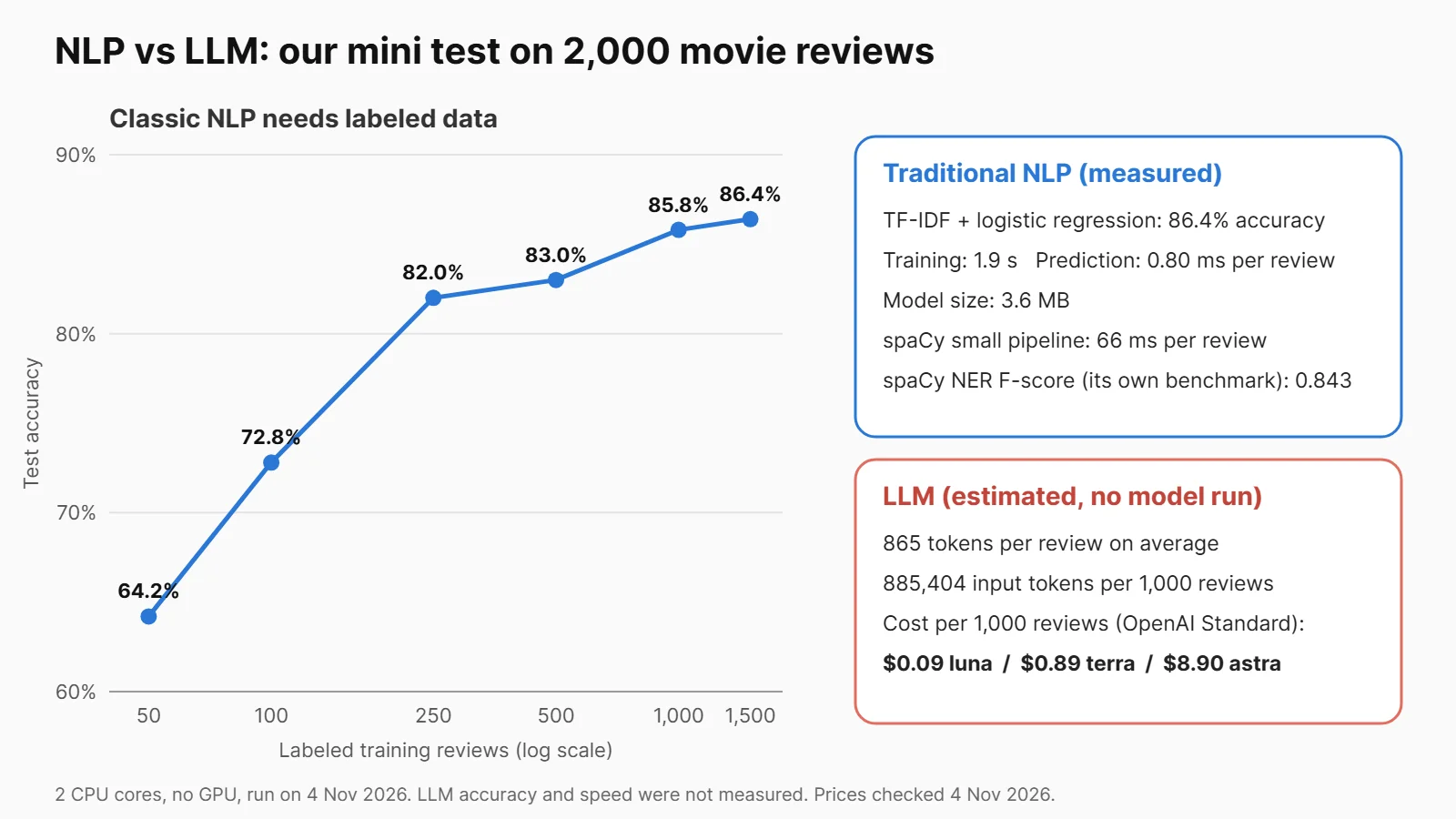
The classifier got 86.4% of the 500 unseen reviews right. It trained in about 2 seconds, labeled each review in under 1 millisecond on two CPU cores, and the whole model is 3.6 MB.
The last two lines show what drives each decision: “bad”, “worst” and “boring” push towards negative, “great”, “perfect” and “excellent” towards positive. You can also spot quirks. “he is” and “as the” are not opinions; they just appeared more often in positive reviews here. A small model learns whatever patterns its data contains, and its weights make those quirks easy to find.
Test 2: How much labeled data does it need?
To see how much labeled data the model needs, we trained it on smaller, balanced slices of the training set and tested each on the same 500 reviews.
# step2_learning_curve.py
# How much labeled data does the traditional model need?
import nltk
from nltk.corpus import movie_reviews
from sklearn.feature_extraction.text import TfidfVectorizer
from sklearn.linear_model import LogisticRegression
from sklearn.model_selection import train_test_split
from sklearn.pipeline import make_pipeline

nltk.download("movie_reviews", quiet=True)
texts = [movie_reviews.raw(f) for f in movie_reviews.fileids()]
labels = [movie_reviews.categories(f)[0] for f in movie_reviews.fileids()]
X_train, X_test, y_train, y_test = train_test_split(
    texts, labels, test_size=0.25, random_state=42, stratify=labels)

for n in (50, 100, 250, 500, 1000, 1500):
    # take the first n training reviews, keeping both classes balanced
    pos = [i for i, y in enumerate(y_train) if y == "pos"][: n // 2]
    neg = [i for i, y in enumerate(y_train) if y == "neg"][: n // 2]
    idx = pos + neg
    model = make_pipeline(
        TfidfVectorizer(ngram_range=(1, 2), min_df=2, sublinear_tf=True),
        LogisticRegression(C=100, max_iter=1000))
    model.fit([X_train[i] for i in idx], [y_train[i] for i in idx])
    print(f"{n:5d} labeled reviews -> test accuracy {model.score(X_test, y_test):.3f}")
   50 labeled reviews -> test accuracy 0.642
  100 labeled reviews -> test accuracy 0.728
  250 labeled reviews -> test accuracy 0.820
  500 labeled reviews -> test accuracy 0.830
 1000 labeled reviews -> test accuracy 0.858
 1500 labeled reviews -> test accuracy 0.864
With 50 labeled reviews, the model was right only 64.2% of the time. It needed about 250 to pass 80%. This is where LLMs have a real advantage. In Sentiment Analysis in the Era of Large Language Models: A Reality Check (Zhang et al., 2023), LLMs “significantly outperform” small models in few-shot settings, where only a handful of labeled examples exist.
Test 3: spaCy for extracting names, places and dates
Often you want to pull facts out of text rather than classify it. spaCy’s small English pipeline does tokenization, part-of-speech tagging, parsing and named-entity recognition (NER) in one call, on your own machine. Run it after Test 1, which downloads the reviews.
# step3_spacy_pipeline.py
# Traditional NLP for extraction: spaCy's small English pipeline, fully on-device.
import time
import spacy
from nltk.corpus import movie_reviews

nlp = spacy.load("en_core_web_sm")
print("Pipeline:", nlp.pipe_names)
print(f"Model version {nlp.meta['version']}, NER F-score reported by spaCy: "
      f"{nlp.meta['performance']['ents_f']:.3f}")

doc = nlp("Ayesha booked a flight from Lahore to Islamabad on 5 December for 18,000 rupees.")
print([(ent.text, ent.label_) for ent in doc.ents])
print([(t.text, t.pos_) for t in doc][:6])

# Speed: run the full pipeline over 500 movie reviews
texts = [movie_reviews.raw(f) for f in movie_reviews.fileids()][:500]
start = time.perf_counter()
docs = list(nlp.pipe(texts, batch_size=50))
full_s = time.perf_counter() - start
n_tokens = sum(len(d) for d in docs)
print(f"Full pipeline: {len(texts)} reviews, {n_tokens:,} tokens in {full_s:.1f} s "
      f"({n_tokens / full_s:,.0f} tokens/s, {full_s / len(texts) * 1000:.0f} ms per review)")

# Tokenizer only (no tagging, parsing or entities)
start = time.perf_counter()
_ = [nlp.tokenizer(t) for t in texts]
tok_s = time.perf_counter() - start
print(f"Tokenizer only: {tok_s:.2f} s for the same {len(texts)} reviews")
Pipeline: ['tok2vec', 'tagger', 'parser', 'attribute_ruler', 'lemmatizer', 'ner']
Model version 3.8.0, NER F-score reported by spaCy: 0.843
[('Lahore', 'GPE'), ('Islamabad', 'GPE'), ('5 December', 'DATE'), ('18,000', 'CARDINAL')]
[('Ayesha', 'PROPN'), ('booked', 'VERB'), ('a', 'DET'), ('flight', 'NOUN'), ('from', 'ADP'), ('Lahore', 'PROPN')]
Full pipeline: 500 reviews, 381,032 tokens in 32.8 s (11,606 tokens/s, 66 ms per review)
Tokenizer only: 0.54 s for the same 500 reviews
It found both cities (GPE means a country, city or state) and the date, and tagged “Ayesha” as a proper noun. But it missed two things a person would get right: it did not label “Ayesha” as a PERSON, and it labeled “18,000” as a plain number instead of “18,000 rupees” as MONEY. The model’s own reported NER F-score is 0.843: on spaCy’s English evaluation data, it finds about 84% of the entities, and about 84% of the entities it labels are correct. One sentence is not a full test, but it shows the kind of mistake a small model makes on text unlike its training data. The usual fix is to train it further on your own labeled examples.
The full pipeline took about 66 ms per long review; the tokenizer alone took about 1 ms, so the trained components (tagging, parsing, NER) take most of the time.
Test 4: Same text, two kinds of tokenizer
Classic NLP tokenizers split text into words and punctuation using rules. LLMs use a learned byte-pair encoding (BPE) tokenizer that breaks any text, even a typo or an unfamiliar script, into pieces from a fixed vocabulary. We used OpenAI’s open-source tiktoken library and its o200k_base tokenizer, which tiktoken links to the GPT-4o, GPT-4.1 and GPT-5 models.
# step4_tokens_and_cost.py
# Same text, two kinds of tokenizer: classic word tokenizers vs an LLM's BPE tokenizer.
import numpy as np
import nltk
import spacy
import tiktoken
from nltk.corpus import movie_reviews
from nltk.tokenize import word_tokenize

nltk.download("punkt_tab", quiet=True)
nlp = spacy.blank("en")                      # spaCy's rule-based English tokenizer only
enc = tiktoken.get_encoding("o200k_base")    # BPE tokenizer of GPT-4o, GPT-4.1 and GPT-5 models

sentence = "The film wasn't bad, it was unbelievably good!"
print("NLTK: ", word_tokenize(sentence))
print("spaCy:", [t.text for t in nlp(sentence)])
print("BPE:  ", [enc.decode([i]) for i in enc.encode(sentence)])
print("BPE on typos:", [enc.decode([i]) for i in enc.encode("Ths moovie was sooo gud lol")])

print("\nToken counts (words / NLTK / spaCy / BPE):")
for s in ["The film wasn't bad, it was unbelievably good!",
          "Ayesha booked a flight from Lahore to Islamabad.",
          "یہ فلم بہت اچھی تھی",                 # Urdu: "This film was very good"
          "Ths moovie was sooo gud lol"]:
    print(f"{len(s.split()):3d} {len(word_tokenize(s)):3d} {len(nlp(s)):3d} "
          f"{len(enc.encode(s)):3d}  {s}")

# Same meaning in English and Urdu, older vs newer OpenAI tokenizer
old = tiktoken.get_encoding("cl100k_base")   # GPT-4 and GPT-3.5 Turbo era
for s in ["This film was very good", "یہ فلم بہت اچھی تھی"]:
    print(f"cl100k_base: {len(old.encode(s)):2d}  o200k_base: {len(enc.encode(s)):2d}  {s}")

# Whole dataset: how many LLM tokens would 2,000 reviews cost?
texts = [movie_reviews.raw(f) for f in movie_reviews.fileids()]
prompt = ("Classify the sentiment of this movie review as positive or negative. "
          "Reply with one word.\n\nReview:\n")
review_tokens = np.array([len(enc.encode(t)) for t in texts])
words = np.array([len(t.split()) for t in texts])
prompt_tokens = len(enc.encode(prompt))
print(f"\nAverage review: {words.mean():.0f} words -> {review_tokens.mean():.0f} BPE tokens "
      f"({review_tokens.mean() / words.mean():.2f} tokens per word)")
print(f"Instruction adds {prompt_tokens} tokens; the answer is "
      f"{len(enc.encode('positive'))} token")

# OpenAI API, Standard tier, USD per 1M tokens (pricing page checked 2026-11-04)
prices = {"gpt-6-luna": (0.10, 0.50), "gpt-6.1-terra": (1.00, 5.00), "gpt-6-astra": (10.00, 50.00)}
in_tok = (review_tokens.mean() + prompt_tokens) * 1000
out_tok = 1 * 1000
print(f"\nPer 1,000 reviews: {in_tok:,.0f} input tokens + {out_tok:,} output tokens")
for name, (p_in, p_out) in prices.items():
    cost = in_tok / 1e6 * p_in + out_tok / 1e6 * p_out
    print(f"  {name:14s} ${cost:.2f}")
NLTK:  ['The', 'film', 'was', "n't", 'bad', ',', 'it', 'was', 'unbelievably', 'good', '!']
spaCy: ['The', 'film', 'was', "n't", 'bad', ',', 'it', 'was', 'unbelievably', 'good', '!']
BPE:   ['The', ' film', " wasn't", ' bad', ',', ' it', ' was', ' unbelievably', ' good', '!']
BPE on typos: ['Th', 's', ' mo', 'ovie', ' was', ' sooo', ' gud', ' lol']

Token counts (words / NLTK / spaCy / BPE):
  8  11  11  10  The film wasn't bad, it was unbelievably good!
  8   9   9  10  Ayesha booked a flight from Lahore to Islamabad.
  5   5   5   6  یہ فلم بہت اچھی تھی
  6   6   6   8  Ths moovie was sooo gud lol
cl100k_base:  5  o200k_base:  5  This film was very good
cl100k_base: 20  o200k_base:  6  یہ فلم بہت اچھی تھی

Average review: 746 words -> 865 BPE tokens (1.16 tokens per word)
Instruction adds 20 tokens; the answer is 1 token

Per 1,000 reviews: 885,404 input tokens + 1,000 output tokens
  gpt-6-luna     $0.09
  gpt-6.1-terra  $0.89
  gpt-6-astra    $8.90
A few things stand out:
Classic tokenizers follow grammar rules. NLTK and spaCy split “wasn’t” into “was” and “n’t”, which helps a model notice the “not”. BPE keeps ” wasn’t” as one learned token, with its leading space.
BPE never meets an unknown word. The typo “moovie” became ” mo” + “ovie”. A word-based model trained on clean text has never seen “moovie”; an LLM can still work from the pieces.
Tokenizers have improved for Urdu, at least in this example. The Urdu sentence took 20 tokens with the older cl100k_base but only 6 with o200k_base, close to the 5 of the English version. Petrov et al. (2023) found that the same text can need up to 15 times more tokens in some languages, so count tokens in the language you will actually use.
What it would cost to send these reviews to an LLM
No LLM could run in our environment, so we could not measure LLM accuracy or speed, but we could measure input size exactly. An average review was 865 tokens, plus 20 for our instruction, so 1,000 reviews come to about 885,000 input tokens and 1,000 output tokens (one-word answers).
Using OpenAI’s API pricing page (Standard tier, checked on 4 November 2026), that is about $0.09 per 1,000 reviews with gpt-6-luna, $0.89 with gpt-6.1-terra and $8.90 with gpt-6-astra. Three cautions apply. First, tiktoken does not yet list the GPT-6 models, so we used o200k_base as a stand-in; real GPT-6 token counts may differ. Second, chat requests can add a few formatting tokens per message. Third, if a model “thinks” before answering, OpenAI’s reasoning guide says those hidden reasoning tokens are billed as output tokens, which can multiply the output cost.
The TF-IDF model labeled 500 reviews in 0.4 seconds on a small CPU, with no per-request fee. For a few thousand texts the LLM bill is small either way; at a million texts a day, the same estimate comes to about $90 to $8,900 a day.
Our test: the classic model is fast and cheap but needs labeled data; LLM cost is estimated from real token counts.
What the published research says about accuracy
For LLM accuracy we rely on published comparisons. Both studies are from 2023 and LLMs have improved since, so treat them as a guide to the pattern, not current numbers.
In the Zhang et al. study, LLMs did well on simple sentiment tasks but lagged behind small fine-tuned models on harder ones that need structured sentiment information.
The pattern: a model trained on plenty of labeled data for one narrow task is hard to beat on that task, while an LLM wins on flexibility and when labels are scarce.
When to use NLP vs LLM: the decision table
This table pulls our measurements and the sources together.
Factor
Traditional NLP model
LLM
Usually better
Cost at high volume
No per-request fee; runs on a CPU
Billed per token; about $0.09 to $8.90 per 1,000 long reviews in our estimate
Traditional NLP
Speed
0.8 ms per review (TF-IDF), 66 ms (full spaCy pipeline) in our test
Network call plus token-by-token generation; not measured here
Traditional NLP
Labeled data needed
Hundreds to thousands of examples (we needed about 250 for 80%)
Zero or a few examples in the prompt (Brown et al.)
LLM
Accuracy on one narrow task with good training data
Strong; best fine-tuned models still lead (Ziems et al.)
Often good, but below the best fine-tuned models in 2023 studies
Traditional NLP or fine-tuned model
Open-ended tasks (summaries, answers, writing)
Not possible with a classifier
Built for it
LLM
Explainability
Linear models’ feature weights show why (see Test 1)
API sends text to a provider; a capable local open-weight model such as gpt-oss-20b needs about 16 GB of memory; smaller ones fit in less but are weaker
Traditional NLP
Messy text, typos, many languages
Struggles with words it never saw
Subword tokens handle typos and many scripts (Test 4)
The task is narrow and well defined, such as spam detection or routing tickets.
You have, or can create, a few hundred labeled examples.
You process large volumes, need millisecond answers or must keep costs flat.
The data must stay on your own machines.
You need to explain decisions to a customer or a regulator.
Choose an LLM when
You have little or no labeled data and need results quickly.
The task is open-ended: summarizing, answering questions, drafting, translating.
Inputs are messy, mixed-language or keep changing.
Volume is modest, so per-token cost is acceptable.
You can check outputs, because an LLM can give confident wrong answers.
The middle ground: use both
In real projects, the answer is often “both, in the right places”. Three patterns are common.
1. Fine-tune a small transformer. Between TF-IDF and a giant LLM sit small pre-trained transformers such as BERT and DistilBERT, which you fine-tune on your labeled data. The DistilBERT paper reports a model 40% smaller and 60% faster than BERT that keeps 97% of its language understanding.
2. Prototype with an LLM, then replace it. spaCy’s own documentation for spacy-llm suggests this path. It says: “Supervised learning is much worse than LLM prompting for prototyping, but for many tasks it’s much better for production.” It adds that efficiency, reliability and control are all better with supervised learning, and that accuracy is generally higher too. A practical workflow: let an LLM label a few hundred examples, have a person check them, and train a small model on them.
3. Let the small model go first. A cheap classifier handles easy, confident cases and only uncertain texts go to the LLM. Similarly, in retrieval-augmented generation, classic methods such as keyword search often find the documents and the LLM writes the answer from them. Choosing what goes into the LLM’s prompt is the core of context engineering.
spaCy vs LLM: which should you learn?
“spaCy vs LLM” compares two different kinds of thing. spaCy is a Python library for building NLP pipelines; an LLM is a type of model. They are not rivals: spaCy can call an LLM as one pipeline step through spacy-llm, and many LLM apps use spaCy-style tools to clean text or find entities around the LLM step.
For a career, learn both. The classic toolbox (tokenization, TF-IDF, logistic regression, accuracy and F-score, spaCy) teaches you to measure whether any language system works, including an LLM-based one. The LLM layer (prompting, retrieval, evaluating generated text, cost control) is where much of the current demand is. Our list of high-paying AI skills covers LLM-side skills such as prompt engineering and RAG systems in more detail.
Frequently asked questions
Is an LLM part of NLP?
Yes. NLP is the field of making computers understand and produce human language, and LLMs are one family of models within it. Standard NLP textbooks, such as Jurafsky and Martin’s Speech and Language Processing, cover LLMs alongside classic methods like logistic regression and named-entity recognition.
Is NLP still worth learning now that LLMs exist?
Yes. Classic NLP skills are still used wherever cost, speed, privacy or explainability matter, and they teach you how to evaluate any language system. In our test, a 3.6 MB model trained in about 2 seconds reached 86.4% accuracy on movie reviews and labeled each one in under 1 millisecond.
Is ChatGPT NLP?
ChatGPT is an application of NLP. It is a chat product built on large language models, which belong to the field of natural language processing. It handles many NLP tasks, such as summarizing, translating and answering questions, from a single prompt.
Can I use spaCy and an LLM together?
Yes. The spacy-llm package adds an LLM component to a spaCy pipeline, so you can mix prompted steps with trained ones. A common plan is to start with the LLM for a quick prototype and later replace some steps with trained spaCy components for speed and control.
Which is cheaper, traditional NLP or an LLM?
At high volume, traditional NLP is usually far cheaper because it runs on an ordinary CPU with no per-request fee. In our estimate, sending 1,000 long movie reviews to an OpenAI model would cost about $0.09 to $8.90 depending on the model, while the small classifier labeled 500 reviews in 0.4 seconds. For small volumes, the LLM cost is often low enough not to matter.
Key points
NLP is the field; an LLM is one family of models inside it, so “NLP vs LLM” really means “small task-specific model vs large general model”.
In our test, a TF-IDF and logistic regression classifier reached 86.4% accuracy, trained in about 2 seconds and labeled each review in under 1 ms, but needed about 250 labeled examples to pass 80%.
spaCy’s small pipeline extracted cities and a date on a CPU, but missed a person’s name and a money amount, which is why small models often need training on your own data.
LLM tokenizers handle typos and other scripts well; 1,000 long reviews came to about 885,000 tokens (counted with o200k_base), or $0.09 to $8.90 at current OpenAI prices.
Use traditional NLP for narrow, high-volume, private or explainable tasks; use an LLM for open-ended work or when labeled data is scarce; combine them when you can.