You’ve experienced this before that even if you haven’t named it. An AI agent successfully handles a complicated and complex request brilliantly, finds the right information, makes a smart decision, and completes the task neatly and provide in a well-efficient manner. Then, the next day you return with a follow-up, and it’s like speaking to a stranger again. It doesn’t remember yesterday or recognize that you’ve spoken before or discuss anything with it.
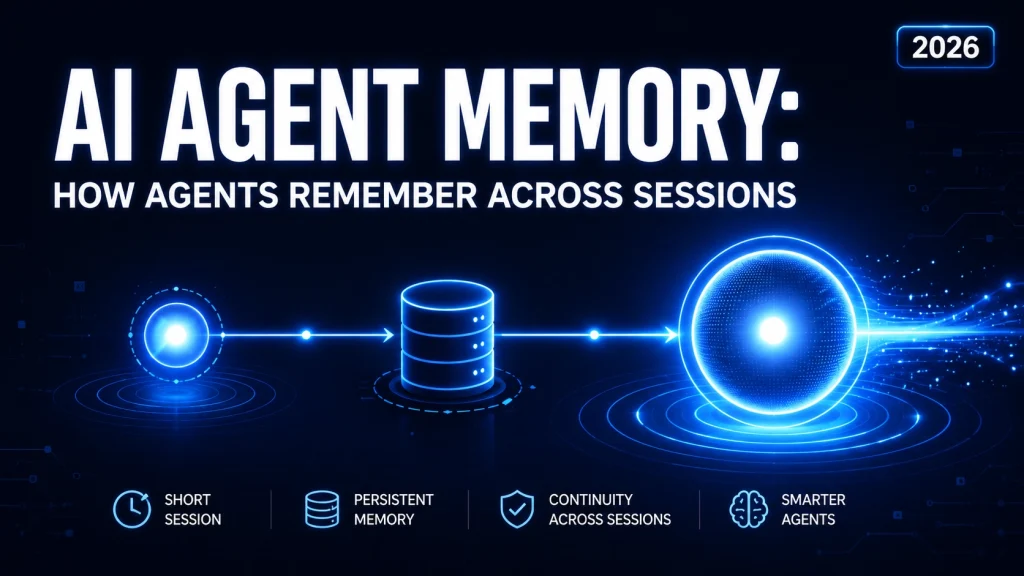
The reason AI agent memory is important is due to the gap between being able to perform tasks in a single session and struggling to remember in multiple sessions.
This article explains that how memory works in the AI models, also we will discuss the main difference between short-term and long-term memory. It also discusses the differences among the tools which are named for 2026, where memory quietly breaks in real-world production, and how to determine and decide what your agent truly needs. This way, you can avoid setting up unnecessary infrastructure.
Table of Contents
AI Agent Memory: How Agents Remember Across Sessions
Quick Answer
AI agent memory is a specified storage layer that helps an agent to retain information across sessions instead of starting fresh every conversation It has two types of memory: short-term memory for the current conversation and long-term memory for facts that can be stored and recalled over days or months, often using a special database. Without this memory, the agent forgets user preferences, asks the same questions again, and loses context once the chat ends.
Why Do AI Agents Forget Everything by Default?
Here’s the part that trips people up:
A language model doesn’t have memory in any persistent sense. It has a context window, the text visible to it during a single inference call, and once that conversation ends, the window closes. Nothing carries over unless something outside the model explicitly saved it and feeds it back in later.
A common assumption is that a bigger context window solves this. It doesn’t. A million-token context window just gives the model more room to work with inside one session, it says nothing about what happens when that session ends and a new one starts cold.
Picture a support agent that spends twenty minutes resolving a billing dispute, tracking down the right invoice, confirming a refund. The user comes back tomorrow to ask about the refund status. Unless that resolution was written to a memory store somewhere, the agent has no idea the conversation ever happened.
Short-Term vs Long-Term Memory: The Distinction That Actually Matters
You’ll see a pile of competing terminology in this space:
Working memory
Episodic memory
Semantic memory
Procedural memory
Buffer memory
Knowledge-graph memory.
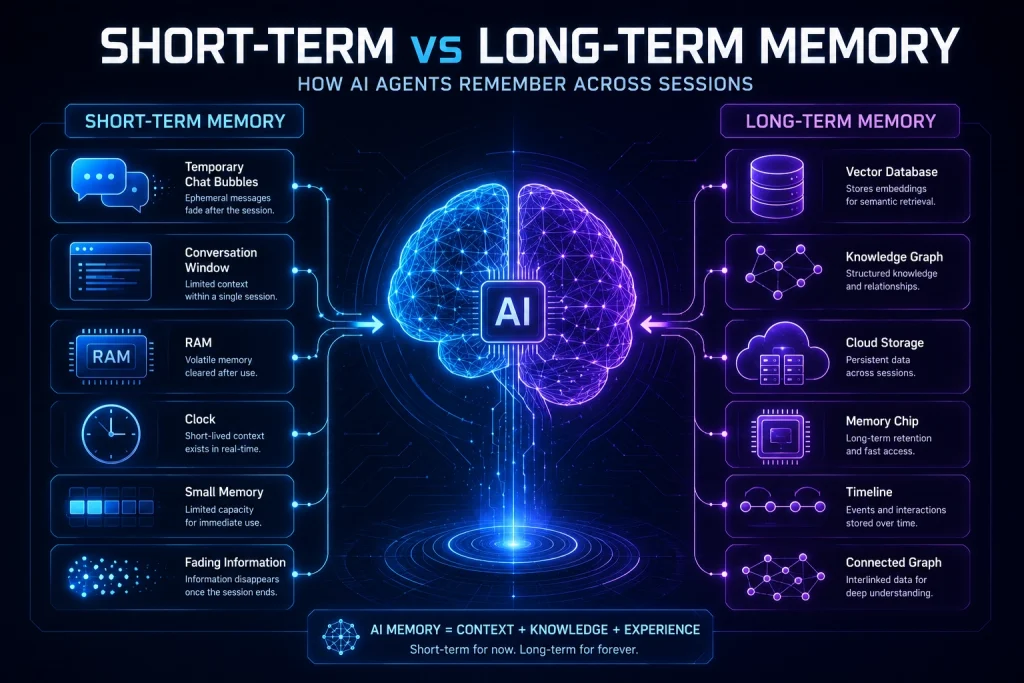
Short-Term vs Long-Term Memory
Different teams use different words for overlapping ideas, and it creates more confusion than it resolves.
Strip it back to the split that actually matters:
Short-term versus long-term. Everything else, episodic, semantic, graph-based, is a more specific flavor of long-term memory.
Get the short-term/long-term split right first, and the rest becomes much easier to reason about.
Here’s a production insight that doesn’t get said enough:
Most teams reach for long-term memory infrastructure before they’ve gotten short-term memory right. Buffer memory, just managing what’s in the current conversation well and covers a surprising amount of ground on its own. Add long-term storage only once you’ve actually hit its limits, not because a blog post told you to.
How AI Agent Memory Actually Works
The mechanics are less mysterious than the marketing around them suggests. It’s a loop, and it runs the same way every time:
During a conversation, the system extracts facts worth keeping, a stated preference, a decision made, a task left unresolved.
Those facts get written to a vector or graph database, indexed by user ID, session ID, and agent ID so they can be found again later.
When a new session starts, the agent queries that store for anything relevant to the current request.
Whatever gets retrieved is injected back into the context window before the model generates its response.
The whole cycle: extract, store, retrieve, inject and repeats every session, indefinitely.
The quality of step one is usually what separates a memory system that feels genuinely useful from one that feels noisy. Extract too aggressively and you store junk; extract too conservatively and you lose the thing that mattered.
Memory vs RAG: A Distinction Worth Getting Right
People conflate these constantly, and the mix-up causes real architecture mistakes. RAG (retrieval-augmented generation) pulls external knowledge into a prompt at the moment of inference. It’s stateless: a RAG system has zero awareness of who you are or what happened in your last conversation.
Memory is different. It’s about continuity:
Capturing your preferences, the decisions an agent already made on your behalf, the things that already failed once so the agent doesn’t try them again.
The cleanest way to hold the distinction:
RAG answers “what does the world know.”
Memory answers “what does this agent know about you.”
If you’re building context engineering into your system, this distinction is foundational, it’s worth reading alongside a deeper look at how context engineering frames the full information environment an agent operates in.
Time-aware reasoning, tracking how facts change over time
Before reaching for any of these, check what your existing framework already gives you. LangGraph ships checkpointers and cross-thread stores that handle a lot of this natively. CrewAI uses a three-tier memory model combining ChromaDB, SQLite, and entity memory. LlamaIndex has its own memory blocks. If you’re already deep in one of these, our comparison of LangGraph, CrewAI, and AutoGen covers how each handles state, start there before adding a separate memory vendor.
None of these tools has a clear “winner” position, and treating this as a horse race misses the point. Mem0 is the fastest to bolt on. Cognee and Graphiti earn their complexity when relationships between facts matter more than the facts themselves. Pick based on what your architecture actually needs, not whichever tool’s launch post you read most recently.
The market itself reflects how fast this space is moving, AI agent memory infrastructure is projected to grow from roughly $6.27 billion in 2026 to $28.45 billion by 2030. That’s a lot of vendors building in a space that’s still figuring out its own best practices.
Where AI Agent Memory Breaks in Production
This is the part vendor pages tend to skip, and it’s the part you actually need to plan for.
1) Session bleed:
This happens when memory written for one user surfaces in another user’s session, because the memory store wasn’t properly scoped by user ID, org ID, or session ID. It’s not a model hallucination. It’s a scoping bug, usually one that started as a shortcut during a prototype and never got fixed before the system hit real users. At small scale it’s invisible. At scale, it’s a serious incident.
2) Memory staleness:
A fact gets stored, a user’s preferred shipping address, the status of a project, and it’s accurate the day it’s written. Three weeks later it’s wrong, and nothing in the system knows that. The agent retrieves the stale fact with full confidence and acts on it anyway. Be clear-eyed about this one: nobody has fully solved it in 2026. Expiration policies and confidence decay help, but this remains a genuinely open problem, not a solved one with a clean library import.
3) Flat retrieval without relationships:
Basic vector search finds chunks that are semantically similar to your query, it has no concept of how those facts connect to each other. If a user’s preference depends on a decision made three conversations ago, plain vector retrieval won’t surface that chain. This is exactly the gap that graph-based tools like Cognee and Graphiti exist to close.
Which Memory Setup Does Your Agent Actually Need?
The honest answer is: probably less than you think. Run through these four situations and find yours.
1) Simple chatbot, no need to recognize returning users: stick with short-term memory, framework-native, no extra infrastructure. Adding a vector database here is solving a problem you don’t have.
2) Customer-facing agent that should recognize returning users: lightweight long-term memory fits, and Mem0 or Zep are reasonable starting points without heavy setup overhead.
3) Multi-agent system where agents need shared, relationship-aware memory: this is where graph-based memory earns its complexity. Cognee or Graphiti make sense once multiple agents need to reason over how facts connect, not just what the facts are.
4) Research or experimental agent needing fine-grained state control: Letta gives you that level of control, at the cost of more setup than you’d want for a production customer-facing system.
Here’s the limitation worth stating plainly, not softening:
Adding long-term memory infrastructure adds real engineering and compliance overhead.
Scoping rules, data lifecycle policies, export and deletion rights under privacy regulation, none of that is optional once you’re storing user data persistently.
For most early-stage projects, getting short-term memory genuinely right is the correct call, not a placeholder until you “graduate” to long-term storage.
If MCP is part of your stack for connecting agents to external tools, it’s worth understanding how that protocol relates to memory management as a complementary layer, not a substitute for it.
FAQ
What is AI agent memory?
AI agent memory is a specified storage layer that helps an agent to retain information across sessions instead of starting fresh every conversation It has two types of memory: short-term memory for the current conversation and long-term memory for facts that can be stored and recalled over days or months, often using a special database. Without this memory, the agent forgets user preferences, asks the same questions again, and loses context once the chat ends.
What is the difference between short-term and long-term AI memory?
Short-term memory exists only within the current conversation and disappears once the session ends. Long-term memory is written to a vector or graph database and persists across sessions, days, or months. Short-term memory handles things like “what did you just say two messages ago.” Long-term memory handles “what did you tell me last week.”
What is the difference between AI agent memory and RAG?
RAG retrieves external knowledge from documents or databases at the moment of a query, it’s stateless and has no concept of who’s asking. Memory is specifically about continuity for one user or agent: preferences, past decisions, prior failures, carried forward over time. RAG answers what the world knows; memory answers what the agent knows about you.
Does ChatGPT have persistent memory across sessions?
Yes, ChatGPT includes a memory feature that can retain certain facts and preferences across separate conversations when enabled. It works similarly to the long-term memory systems described in this guide: facts get extracted, stored, and selectively retrieved in future sessions rather than the model remembering everything by default.
Is Mem0 better than building memory myself?
For most teams, yes, Mem0 handles extraction, storage, and retrieval out of the box, which is meaningfully faster than building that pipeline from scratch. Building it yourself makes sense if you need tight control over scoping, retention policies, or storage location for compliance reasons that an off-the-shelf tool doesn’t support.
What causes AI agents to mix up memory between different users?
This is typically a scoping bug, not a model failure, it happens when memory entries aren’t properly tagged and filtered by user ID, organization ID, or session ID before being retrieved. Early-stage systems often skip strict scoping as a shortcut, and it surfaces as a real incident once the system has more than a handful of concurrent users.
Do I need a vector database for AI agent memory?
Not necessarily. If your agent only needs to track the current conversation, framework-native short-term memory (like LangGraph checkpointers or LangChain buffer memory) is sufficient with no extra infrastructure. A vector or graph database becomes necessary once you need facts to persist and be searchable across sessions.
What to Do Next
Memory architecture is a data architecture decision, not a prompt-engineering one. No model upgrade recovers context that was never persisted in the first place, that’s an infrastructure problem, not a capability problem.
Get short-term memory right before you reach for long-term infrastructure, and treat memory scoping as a security decision from day one. It’s far cheaper to design correctly upfront than to patch after a session-bleed incident in production.