Overview of the AI Agents Communicate and Collaborate
AI agents do not work in isolation, but they operate as part of a system, and that is a point where things become truly interesting.
When multiple agents begin exchanging information and dividing complex tasks, a fundamental change occurs. Simple automation evolves into something closer to collective intelligence, where multiple agents work together like a coordinated team.
To understand this in a better way, we need to answer some important questions:
How do AI agents actually communicate?
How do they collaborate without interference with each other’s work?
What breaks down when the design is not right?”
This guide answers these questions clearly and explains them completely with deep knowledge and practical insights that most articles skip.
How AI Agents Communicate and Collaborate (Multi-Agent Systems Guide 2026)
Quick Answer
AI agents communicate with each other by exchanging data, messages, or signals through defined and fixed protocols in a shared environment. They collaborate with each other by coordinating tasks, sharing context, and adopting their actions based on each other’s outputs, which enables them to work as a team in an efficient manner towards a common goal.
Important: To fully understand this, we first need to explore the core concepts behind AI agent communication and collaboration.
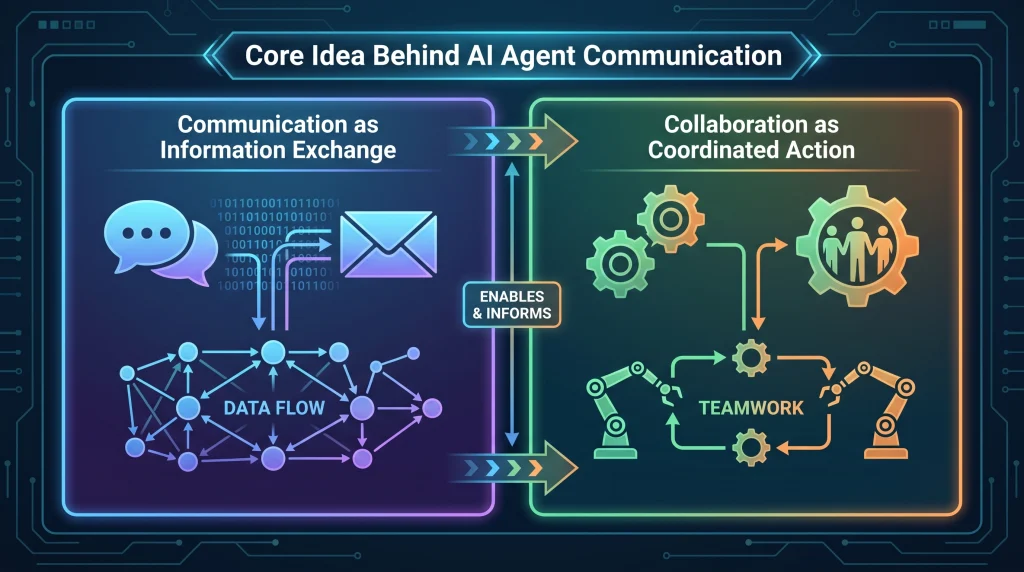
The Core Idea Behind AI Agent Communication
Before exploring methods and protocols, it is important to understand what communication and collaboration actually mean in the context of AI agents.
Communication in multi-agent systems is more complex than simply “agents talking to each other.” It involves structured information exchange that directly influences decision-making and actions.
Core Idea Behind AI Agent Communication
AI Agent Communication: Communication as Information Exchange
Definition: AI agent communication is the structured exchange of meaningful information between autonomous agents, which influences their decisions or actions.
Explanation: In a multi-agent system, communication happens when one agent:
Sends a message
Shares a result
Signals a status
Another agent then:
Receives the information
Interprets it
Adjusts its behaviour accordingly
Even a small exchange of information is considered communication if it changes what an agent does next.
Role of Modern AI (LLMs): Most modern agents are powered by:
Large language models (LLMs),
Machine learning systems trained on huge amounts of data
These technologies allow agents to:
Understand context
Interpret meaning
Generate human-like language
As a result, this means that many agents often communicate with each other in natural human language, which makes their interactions more flexible and reliable.
Key idea: Communication is only meaningful if both agents interpret the message consistently. Even if two agents exchange perfectly formatted messages, collaboration can fail if they interpret those messages differently.
This means that alignment in interpretation is just as important as message format.
AI Agent Collaboration as Coordinated Action
Definition: AI agent collaboration is the coordinated execution of tasks by multiple agents who share information, context, and feedback to achieve a common goal.
Explanation: Collaboration takes communication one step further. It is not just about sharing information, but it is also about adjusting actions based on what other agents are doing.
Think of a multi-agent system as a skilful human team, where:
Each member has expertise in their respective domain.
Each agent perceives the parts of the environment which others cannot see.
Each shares knowledge about that unique point to give benefit to the whole group.
By sharing this knowledge, agents collectively solve problems that no single agent could handle alone.
Why Collaboration Matters Each agent observes parts of the environment that others cannot see. By sharing this information:
The system gains a broader understanding
Decisions become more accurate
Overall performance improves
This is what transforms isolated agents into a system-level intelligence.
Requirements for Effective Collaboration: For Effective collaboration to work properly, three key elements are required:
Timing: agents need to act in the right sequence or in parallel without colliding with others. Poor timing can lead to duplicate work or system errors.
Context: Each agent must have enough background information to understand the task and to make informed decisions. Without context, agents may repeat work and make incorrect assumptions.
Response logic: agents need clear rules that define how to react to incoming information, when to act or when to wait. Without proper response logic, coordination becomes unpredictable.
Key insights:
When you get all these three rights, the agentic system becomes more than the sum of its parts. If there is one miss, the coordination breaks down in such a way that are hard to detect.
Final Takeaway:
What is the core idea behind AI agent systems? The effectiveness of a multi-agent system depends not just on communication only, but on how well agents coordinate actions using shared context, timing, and decision rules.
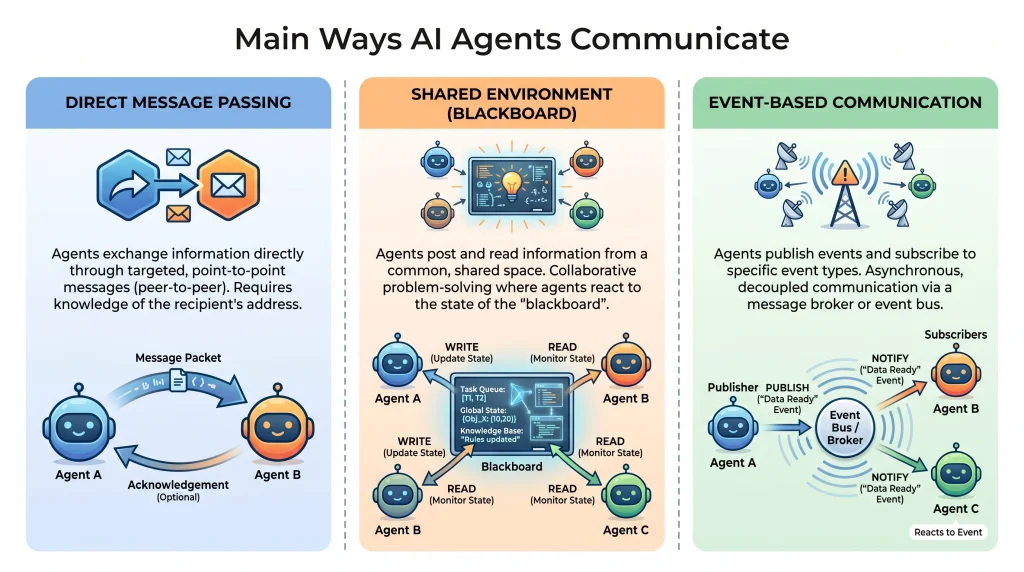
There are three primary communication models that are used in multi-agent systems. Each model is designed for different scenarios, and understanding their trade-offs is essential for designing efficient systems.
Main Ways AI Agents Communicate
1) Direct Message Passing 2) Shared Environment (Blackboard Model) 3) Event-Based Communication
1) Direct Message Passing:
What is direct message passing in AI agents?
Definition:
Direct Message Passing is a communication model in AI systems, where one agent sends a structured message directly to another agent.
Explanation
In this model:
One agent sends a message directly to another agent
The communication is structured, explicit, and in a traceable format
Both sender and receiver are clearly identified
Schema: Communication Flow
Agent A → Message/Signal → Channel (Protocol/Environment) → Agent B → Action Update
Key Protocols:
Two protocols govern how this works in real-world practice:
KQML (Knowledge Query and Manipulation Language), which was developed by DARPA in the 1990s, was one of the earliest frameworks for agent-to-agent communication.
FIPA-ACL (Foundation for Intelligent Physical Agents – Agent Communication Language), an improved standard that focuses on semantic clarity and structured interaction.
Important Insights:
These protocols do not just send data; they also show intent, such as:
Informing
Requesting,
Proposing,
Negotiating.
This distinction is very important in complex workflows because it makes the communication more meaningful.
Advantages and disadvantages
Advantage
Disadvantage
Clear communication
Tight coupling between agents
Easy debugging
Poor scalability in large systems
Structured flow
Dependency on availability
Key Insight:
Direct message passing works best in controlled environments, but becomes difficult to manage in large-scale systems due to tight coupling.
2) Shared Environment (Blackboard Model)
What is the blackboard model in AI agents?
Definition:
The blackboard model is a communication system where agents interact through a shared memory space instead of direct messaging.
Explanation:
In this model:
Agents do not communicate directly
Instead, they read and write to a shared environment
This shared space is called a blackboard or shared memory
Working flow:
Agent A → Writes Output → Shared Blackboard → Agent B Reads → Continues Task
How It Works
Agent A completes a task
It writes results to the shared space
Agent B monitors the shared space
When relevant data appears, Agent B processes it
The workflow continues without direct communication
Key Advantage
This model allows loose coupling, meaning:
Agents do not depend directly on each other
New agents can be added easily
System becomes more flexible
Main Challenge
The biggest issue is data conflict:
Multiple agents may try to write at the same time
This can lead to corrupted or inconsistent data
Solutions
To handle this, systems use:
Locking mechanisms
Version control
Synchronization rules
Advantages and Disadvantages
Advantages
Disadvantages
Highly flexible
Data conflicts possible
Easy to scale
Requires synchronization
Modular system design
More architectural complexity
Key Insight
The blackboard model is ideal for complex reasoning systems, but requires careful handling of shared data consistency.
3) Event-Based Communication
What is event-based communication in AI agents?
Definition:
Event-based communication is a system where agents respond to events or triggers instead of direct messages.
Explanation:
In this model:
Agents do not wait for messages
Instead, they react when an event occurs
Events act as triggers for action
Examples of Events
Data uploaded
Threshold exceeded
Error detected
System update occurred
How It Works
When an event occurs:
Relevant agents are notified
Only subscribed agents react
Agents execute their assigned tasks
Key Benefits
Highly scalable
Efficient resource usage
Real-time responsiveness
Modular architecture
Key Risks: Event Storms
A single event can trigger multiple agents, which may:
Generate more events
Create uncontrolled cascading effects
Risk Control Techniques
To prevent system overload:
Throttling mechanisms
Priority rules
Event filtering systems
Advantages and Disadvantages
Advantages
Disadvantages
Real-time processing
Risk of event cascades
Highly scalable
Hard to debug
Efficient system usage
Complex control logic
Key Insight
Event-based systems are best suited for real-time and dynamic environments, but require strong control mechanisms to prevent cascading failures.
COMPARISON: COMMUNICATION MODELS
Model
Structure
Best use case
Weakness
Direct Message Passing
Point-to-point
Controlled workflows
Poor Scalability
Shared Blackboard
Central memory
Complex reasoning systems
Data conflicts
Event-Based
Trigger based
Real-time systems
Event cascades
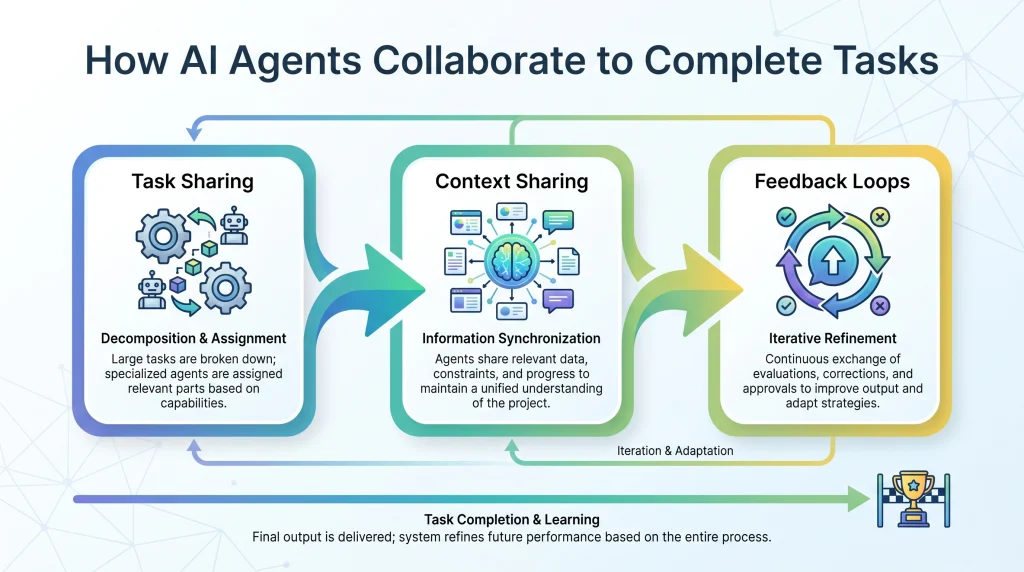
How AI Agents Collaborate to Complete Tasks
How AI Agents Collaborate to Complete Tasks
Communication vs Collaboration (Core Idea)
Communication is the channel, but collaboration is what flows through it.
Definition Context sharing is the process of passing not just outputs, but also background information which explains how and why a result was produced.
Explanation:
When Agent A sends results to Agent B, it also includes:
Reasoning behind the output
Constraints used
Problems encountered
Decision history
Without Context
If context is missing:
Agent B may misunderstand the results
Work may be repeated unnecessarily
System consistency breaks down
With Context
When context is included:
Continuity is maintained across workflows
Agents make better decisions
The system becomes more reliable
System Design Note
Context is usually stored as:
Structured metadata
Lightweight shared memory
Learning Effect
Agents can also:
Learn from past interactions
Improve future decisions
Adapt across workflows
Key Insight
Context sharing is what enables long-term coherence in multi-agent systems.
3) Feedback Loops
What is a feedback loop in AI agents?
Definition: A feedback loop is a process where agents re-evaluate and correct earlier outputs based on new information from other agents.
Explanation:
In multi-agent systems:
Work is not always linear
Downstream agents may detect errors
These errors are sent back upstream for correction
Example Flow
Agent A generates output
Agent B detects an issue
Feedback is sent back to Agent A
Agent A revises output
System converges to the correct result
Benefit
Feedback loops allow systems to:
Self-correct
Improve accuracy
Reduce human intervention
Risk: Infinite Loops
A major issue is:
Continuous reprocessing
No final convergence
Solution
To prevent this:
Limit retry attempts
Add exit conditions
Example: “Stop after 3 retries”
Key Insight
Feedback loops make systems adaptive, but require strict control rules to prevent instability.
SUMMARY of Core Collaboration Principle
AI agent collaboration works through three layers:
Task Sharing → divides work
Context Sharing → preserves understanding
Feedback Loops → improves accuracy
Final Insight
A multi-agent system becomes powerful not because of individual agents, but because of how effectively they:
Divide work
Share understanding
Correct mistakes
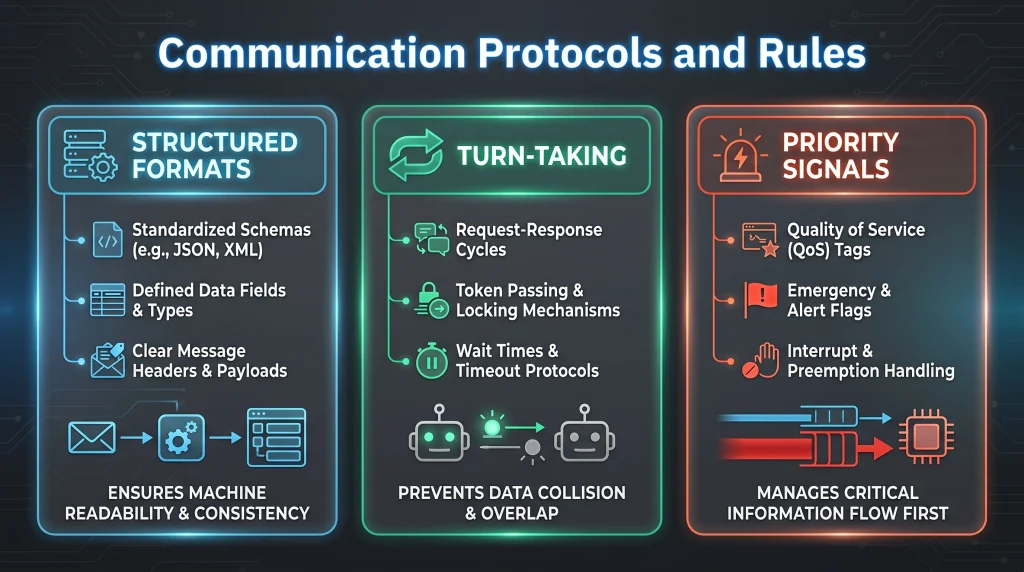
Communication Protocols and Rules (Simplified)
AI Agents do not communicate freely without structure; they follow defined rules which make communication reliable, predictable, and scalable.
Communication Protocols and Rules (Simplified)
1) Structured Communication Formats 2) Turn-Taking and Coordination Rules 3) Priority and Decision Signals
1) Structured Communication Formats
What are structured communication formats in AI agents?
Definition: Structured communication formats are predefined message templates that define how agents exchange information.
Explanation: Messages between agents follow defined formats, which include fields like:
Sender ID
Message type
Data Size
Timestamp
Priority level
These formats can be predefined by human programmers, or they can be emergent, arising organically from agent-to-agent interaction over time.
Why It Matters These formats ensure:
No ambiguity in communication
Easy interpretation by all agents
Compatibility across systems
Key Insight
Structured formats ensure that agents do not “guess,” meaning that they directly interpret it from the format.
2) Turn-Taking and Coordination Rules
What is the turn-taking rules in AI agents?
Definition: Turn-taking rules control when and how agents act to avoid conflicts in the shared environments.
Explanation:
In some systems:
Agents act one at a time (turn-based execution)
In others:
Agents run in parallel
But use locks for shared resources
Key Idea
This design prevents:
Conflicting actions
Data corruption
System instability
Important Insight
Choosing the wrong coordination model is one of the most common causes of hidden system errors in multi-agent systems.
3) Priority and Decision Signals
What are priority signals in AI agents?
Definition: Priority signals determine which messages or tasks an agent should handle first.
Explanation
Not all messages are equal. So here we use terminologies which are give below:
Priority signals
Decision signals
Priority signals
Priority signals help agents:
Decide what to process first
Handle multiple inputs efficiently
Decision Signals
Decision signals go further:
They instruct agents whether to follow or override another agent’s output
Key Insight
These signals prevent:
Conflicting decisions
Chaos in multi-agent coordination
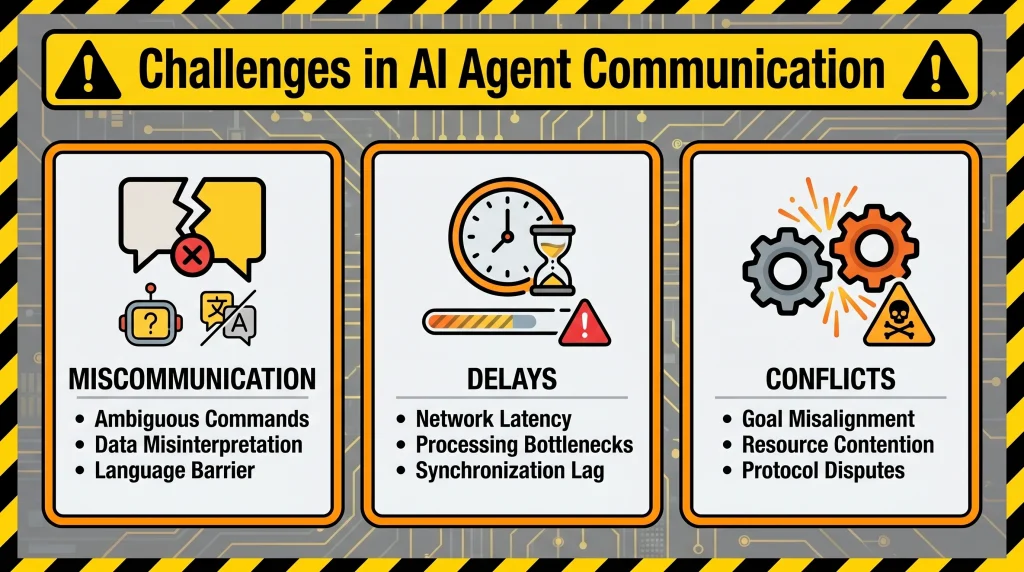
Challenges in AI Agent Communication and Collaboration
Understanding failure cases is just as important as understanding how things work when they go right.
Challenges in AI Agent Communication
1) Miscommunication Between Agents 2) Delays and Synchronisation Issues 3) Conflicting Decisions
1) Miscommunication Between Agents
Even when messages are technically correct, agents may still misinterpret them. Without standardised messaging frameworks, agents across different platforms struggle to interpret each other’s messages correctly.
A real-world example:
In smart cities, traffic management systems and autonomous vehicles might use different communication protocols entirely, which prevents seamless data sharing even when both systems are functioning perfectly.
This creates incompatibility, even if both systems work correctly
Key Problem
The issue is not capability; it is a lack of standardisation.
2) Delays and Synchronisation Issues
AI systems often require real-time communication, but:
Network latency
Processing delays
System load
can slow down responses.
Real Example
In self-driving cars:
AI agents must instantly process data from cameras, sensors, and GPS.
Any object action delay in data exchange can result in poor navigation decisions with serious consequences.
Key Insight
Robust systems are designed assuming delays will always exist.
3) Conflicting Decisions
Two agents, when each one acts on its own logic, can reach conclusions that contradict each other.
Solutions
To resolve the ambiguity, there are two main approaches:
1. Hierarchy Model
One agent has higher authority
Its decision overrides others
2. Consensus Model
Agents negotiate
They reach an agreement collectively
Real Example:
In financial markets, for instance, thousands of AI trading bots communicate and react to market changes simultaneously.
If too many bots act on conflicting signals at once, the result is not just inefficiency, but it can be systemic instability.
Key Insight
Without proper conflict resolution, multi-agent systems can become unstable.
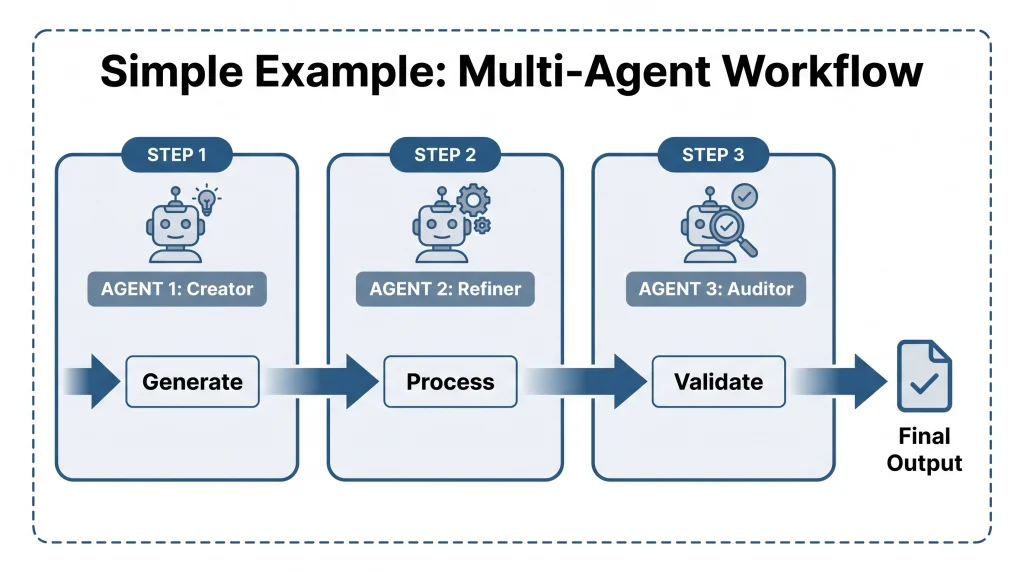
Scenario: Multi-Step Content Research Task Execution
Here is a clean, realistic example. Three agents are handling a content research task:
Agent 1: The Researcher searches available data sources, collects relevant information, and writes raw findings to a shared blackboard environment.
Agent 2: The Analyst monitors the blackboard, picks up the raw findings when ready, processes them, identifies key patterns, and posts a structured summary, also communicating in natural language that Agent 3 can interpret directly.
Agent 3: The Validator reviews the structured summary against accuracy criteria. If something does not pass, it sends a feedback signal upstream to Agent 2, requesting a revision. If everything checks out, it produces the final output.
Communication Models used:
Three communication models work simultaneously, which:
Shared environment (Blackboard)
Natural Language Communication
A feedback loop.
Key Insight:
No single agent knows the full picture, but together they complete something which no one could handle alone. The key takeaway: Connections between agents matter more than individual agents.
Frequently Asked Questions of AI Agent Communication and Collaboration
How do AI agents communicate with each other?
AI agents communicate with each other by exchanging messages, data, or signals through:
Direct Communication Channels Shared environments Event-based triggers.
Most modern agents use LLMs, so they often communicate in natural human language.
What is collaboration in AI agents?
Collaboration is the process where multiple agents coordinate their actions such as: Sharing tasks Exchange context Provide feedback to achieve a shared goal that no single agent could complete alone.
Do AI agents need a central controller to communicate?
Not always. Some systems can be: 1) Centralised control where a single controller manages agents. 2) The decentralised controller communicates directly.
The right choice depends on the system’s complexity and coordination needs.
What are common communication methods in AI systems?
The three primary communication methods in AI systems are: Direct message passing, Shared environments (blackboard model), and event-based communication.
Why is communication important in multi-agent systems?
Communication important in multi-agent systems because: Ensures the coordination, Reduces conflicts, and Improves efficiency. Without it, agents duplicate work, miss handoffs, or produce inconsistent results.
Can AI agents misunderstand each other?
Yes, and mostly, it can happen more than expected. Misunderstanding occurs due to: Ambiguous messages Different interpretation models Lack of standard format
Is communication the same as orchestration?
No. Communication = how agents exchange information Orchestration = how the system controls agent behaviour
Conclusion
AI agents become truly powerful when communication and collaboration are designed from the beginning, not added later.
The real insight is not just that agents can send messages. It is:
The quality of those messages,
The structure of the shared environment,
The protocols governing interaction, and
The security of those channels
All of these determine whether a multi-agent system actually succeeds or fails in ways that are invisible until it is too late.
As more agents become capable of communicating across complex agentic workflows, we are moving toward the entire ecosystems of agents where agents are working together in autonomous coordination.
Understanding how AI agents communicate and collaborate is the main foundation for designing AI agent systems that are: