The architecture problem which forced the Data Lakehouse into the existence. Your business analysts need structured, fast, reliable data to run dashboards and reports properly. Your data scientists and AI pipelines need raw and unstructured data such as logs, documents, images, sensor readings for the purpose to train models.
For years, the standard answer was that to run two separate systems:
A data warehouse for BI
A data lake for ML.
Two ingestion pipelines. Two storage costs. Two governance headaches. And the longer you run them in parallel, the further they drift out of sync. So, the data lakehouse is the architectural response for that problem.
This guide will cover the three-way distinction clearly for you:
Names the real failure patterns (not the sanitized version)
Explains the actual mechanism that makes a Lakehouse work
Gives you a decision framework based on what your team actually does, not what’s trending.
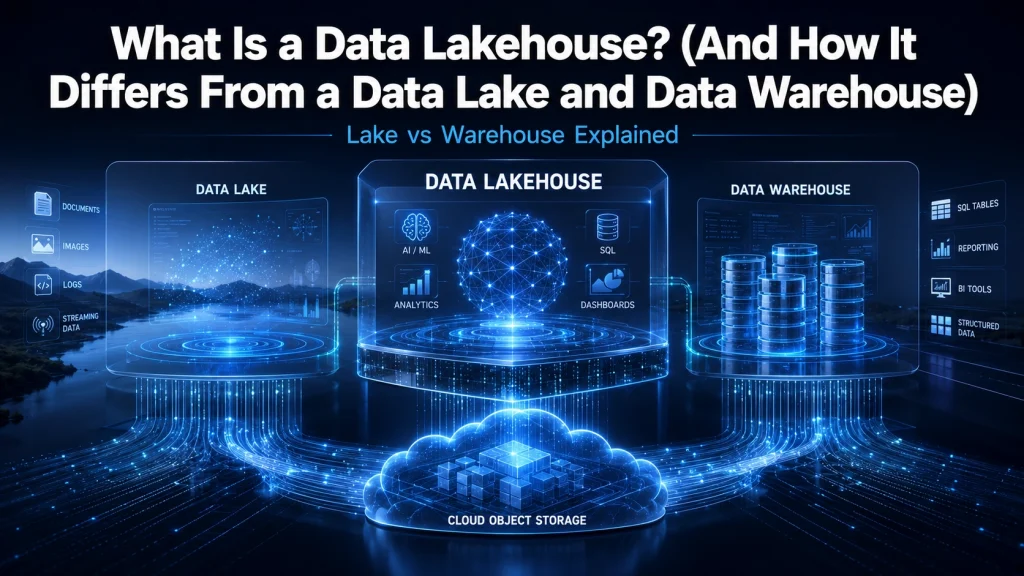
What Is a Data Lakehouse Lake vs Warehouse Explained
Table of Contents
Quick Answer
A data Lakehouse is a new and modern data architecture which combines the low-cost, flexible storage of a data lake with the reliability, governance, and query performance of a data warehouse with in a single system.
It stores all data types (structured, unstructured, semi-structured) in open formats on cloud object storage, then adds a metadata layer which enables ACID transactions, schema enforcement, and fast SQL analytics directly on that storage.
1. The Problem Two Systems Creates
Running a warehouse and a lake in parallel sounds reasonable until you’ve lived with it for eighteen months. The same data gets ingested twice, transformed twice, and stored twice, at meaningfully different costs. When the two systems disagree on a number, which one is right? Usually nobody knows without digging.
The engineering overhead is real, but the trust problem is worse. When analysts and data scientists work from different copies of the same underlying data, decisions get made on different facts. That’s the slow organizational failure mode that nobody puts in a post-mortem.
The Data Lakehouse exists to collapse those two systems into one architecture that serves both consumers, without sacrificing that what either group actually needs.
2. The Three Architectures Explained Simply
1) Data Warehouse
A data warehouse stores structured and pre-processed data in a relational schema which is optimized for fast SQL queries and BI reporting. Data has to be structured and cleaned before it enters, which refers the term “schema-on-write”. The tradeoff is that schema-on-write buys you query speed and reliability, but means anything that doesn’t fit the predefined structure gets excluded.
Storage and compute are tightly coupled in traditional warehouse architectures, which makes scaling expensive. And the real ceiling: warehouses can’t hold the unstructured data such as: raw text, images, audio, log files, that AI and ML workloads need. Snowflake, BigQuery, and Amazon Redshift are the dominant examples.
2) Data Lake
A data lake stores everything raw either it may be structured, semi-structured, unstructured, at low cost in the cloud object storage. AWS S3, Azure Data Lake Storage, and Google Cloud Storage are where most lakes live. Schema is applied only when data is queried (schema-on-read), which means you can land data fast without designing its structure upfront.
Here’s where the real failure pattern lives. Teams optimize for moving fast under deadline pressure, and the governance work:
naming conventions, ownership policies, retention rules, data labelling where gets skipped.
The lake fills up with files nobody trusts, tables nobody remembers creating, and data nobody can find. This is the “data swamp,” and its root cause isn’t a technical misconfiguration.
It’s a governance inversion:
The architecture makes it easy to land data and hard to manage it, so under pressure, management loses every time.
3) Data Lakehouse
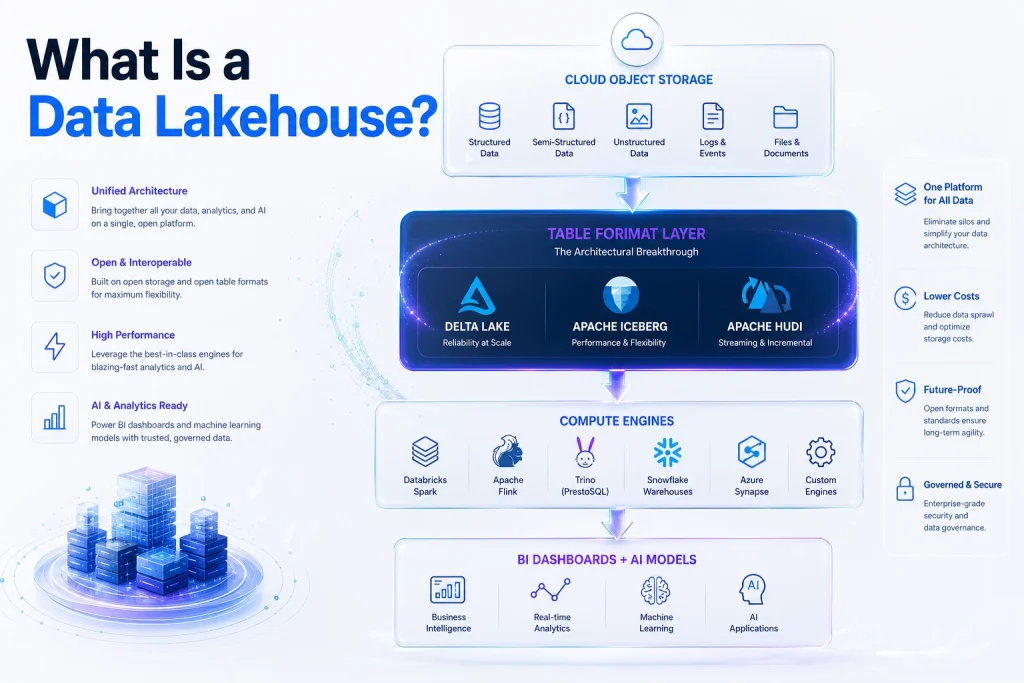
A Data Lakehouse stores all data types in open formats on cloud object storage, like a lake, but adds a metadata and table format layer on top of that storage. That layer is what changes everything.
Databricks coined the term and popularized the architecture; Apache Iceberg, Delta Lake, and Apache Hudi are the three table formats that actually implement it.
The result:
A system that can serve a SQL analytics query and a Spark-based ML training job against the same underlying data, simultaneously, without conflict.
What Is a Data Lakehouse
3. Head-to-Head Comparison: Data lake vs Data warehouse vs Data Lakehouse
Description
Data Warehouse
Data Lake
Data Lakehouse
Data types
Structured only
All types
All types
Schema approach
Schema-on-write
Schema-on-read
Both (flexible)
Storage cost
High
Low
Low (open formats)
ACID transactions
Yes
No (native)
Yes (via table format layer)
Query performance
Fast (SQL)
Slow without tuning
Fast (SQL + ML)
AI/ML workloads
Limited
Strong
Strong
Governance
Strong
Weak
Strong (when configured)
Best for
BI and reporting
Data science, raw storage
Both simultaneously
Named examples
Snowflake, BigQuery, Redshift
S3, ADLS, GCS
Databricks, Apache Iceberg on S3
The governance row deserves a footnote. A lakehouse enables strong governance; it does not enforce it. That distinction matters, and Section 7 addresses it directly.
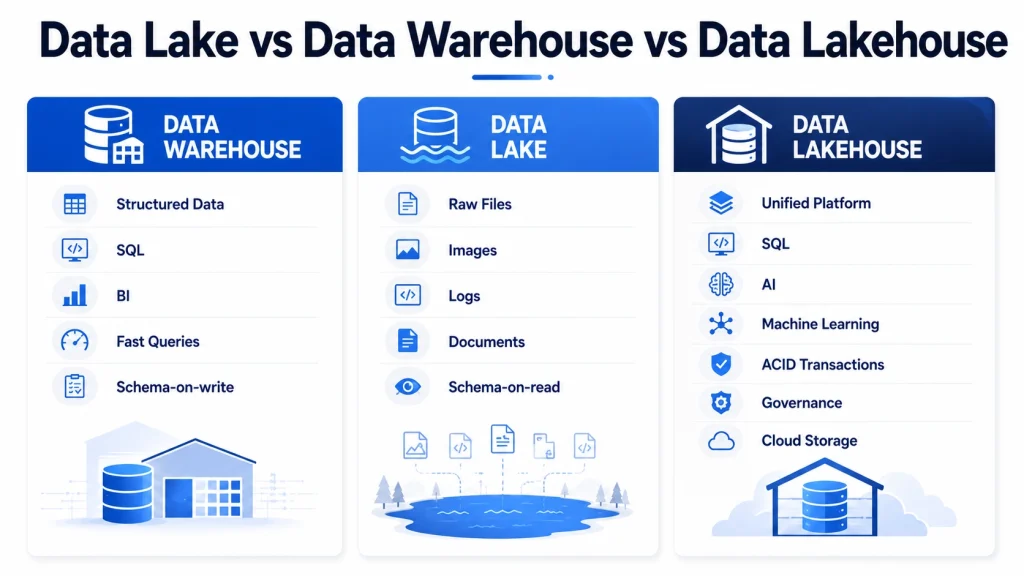
Data lake vs Data warehouse vs Data Lakehouse
4. Why the Lakehouse Isn’t Just “Lake + Warehouse Features”
This is the part where most introductions get wrong, and it’s the most important thing to understand clearly. You cannot produce a lakehouse by pointing a SQL query engine at an S3 bucket. Without the table format layer, you have an expensive, ungoverned lake with a fancier query tool on top of it.
Apache Iceberg(originally built at Netflix now the most widely adopted open format), or Apache Hudi (originally built at Uber), is the actual mechanism.
It sits between your compute engine and your raw object storage and does several specific things that object storage alone cannot do.
It tracks which files belong to which tables. It writes and commits changes atomically, meaning a write either completes fully or doesn’t happen at all, there’s no partial state. It handles schema evolution, so when a column gets added or renamed, existing data doesn’t break. And it enables time-travel queries, letting you query a table as it existed at any point in the past.
Here’s a concrete example of why ACID matters:
Two data engineers run conflicting writes to the same table simultaneously: one is appending new rows, one is deleting stale records.
On a plain data lake without ACID guarantees, one operation corrupts the other.
With a table format layer, the lakehouse handles the conflict cleanly.
That’s not a minor feature, it’s the difference between a storage system you can trust and one you can’t.
5. How the Lakehouse Connects to AI Workloads in 2026
The business case for consolidating onto a single architecture has sharpened considerably. Monte Carlo Data’s January 2026 survey found 81% of IT leaders reporting C-suite mandates to reduce or hold cloud costs, which running parallel warehouse and lake infrastructure is increasingly difficult to justify at budget time.
The AI side is the stronger forcing function. AI agents, large language models, and ML pipelines need raw, unstructured data:
Document text, server logs, images, audio transcripts.
Traditional warehouses simply cannot hold this data. Every organization building serious AI capability hits the architectural ceiling of a warehouse-only stack and has to decide what to do about it.
Over 50% of organizations now implement lakehouse patterns, and the market is projected to grow from $14 billion to over $112 billion by 2035. Those numbers reflect a real shift in where engineering investment is going, not just marketing momentum.
In practice, the transformation logic that runs on top of a lakehouse is usually dbt, which brings the Medallion Architecture pattern that most teams use to structure the data inside the lakehouse.
If you’re building this layer and haven’t looked at how dbt handles lakehouse transformation, that’s worth doing before you design your layer structure.
6. The Medallion Architecture: How Data Actually Flows Inside a Lakehouse
The Medallion Architecture is the three-layer pattern most teams use to structure data inside a lakehouse. It’s not a formal standard, it’s an organizational pattern that’s become close to universal because it solves a real problem cleanly.
1) Bronze layer:
Bronze layer is where raw data lands exactly as ingested. No transformation, no cleaning, no standardization. Maximum fidelity, full history.
If a source system sends you malformed JSON, it lands in Bronze as malformed JSON, you deal with it later, but you never lose what actually arrived.
2) Silver layer:
Silver layer is where the cleaning happens. Deduplication, validation, type casting, null handling, the Silver layer produces data that’s trustworthy and granular but not yet aggregated into business metrics.
This is the layer ML engineers often work from when training models that need row-level detail.
3) Gold layer:
Gold layer is what analysts and dashboards query. Aggregated, business-ready, purpose-built for specific use cases.
A Gold table might be daily revenue by region, something no one needs at Bronze granularity, but everyone needs reliably fast.
The tools that feed each layer reflect the broader data engineering stack. AWS Glue and Azure Data Factoryhandle ingestion to Bronze, both ingest into lakehouses as a primary use case, and the architectural fit between those tools and the Bronze layer is worth understanding if you’re choosing between them.
The Silver-to-Gold transformation is where dbt does its work, using SQL models to build up the analytical layer from cleaned source data.
7. The Honest Limitation: What the Lakehouse Does Not Solve
A poorly planned lakehouse doesn’t split the difference between a data swamp and a data warehouse. It compounds both failure modes simultaneously. The Bronze layer fills up with ungoverned files, the exact data swamp problem, now surrounded by more expensive infrastructure.
The governance problem does not disappear because you chose lakehouse architecture. Metadata management, ownership assignment, retention policies, and data cataloging are investments the architecture enables but does not enforce. A lakehouse gives you the tools to govern data well. It does not stop your team from skipping them under deadline pressure.
Operationally, the lakehouse ecosystem is still maturing. The patterns and tooling around data warehouses have thirty-plus years of production hardening behind them. Lakehouses have years. You will encounter rougher edges, less documentation, and more “it depends” answers than you would with a well-established warehouse stack.
And here’s the decision that’s easy to obscure:
If your team exclusively runs SQL analytics and BI reporting on structured data, with no ML or AI workloads and none planned, a well-managed data warehouse is simpler, cheaper, and more reliable than a lakehouse you don’t actually need.
Databricks invented the term “data lakehouse” and would prefer you run one. That’s not the same as it being the right call for your organization.
8. Decision Framework: Which Architecture Does Your Team Actually Need?
If your team runs SQL analytics and BI dashboards exclusively, all data is structured, and no ML or AI workloads are on the roadmap: use a data warehouse. Snowflake, BigQuery, or Redshift will be simpler to operate and more reliable than a lakehouse built for needs you don’t have.
If your team does heavy ML or AI work on raw, unstructured data and has no BI requirements: a plain data lake is sufficient and cheaper. Don’t add lakehouse infrastructure for workloads that don’t need it.
If your team needs BI reporting and ML on the same data, or expects AI workloads to emerge in the next 12 to 18 months: a lakehouse is the right architecture. But only if you commit to designing the governance layer, ownership, naming, retention, before you start ingesting data, not after the Bronze layer is already a mess.
If you already have a working warehouse: don’t rip and replace it. Incremental adoption is lower risk: add an Iceberg or Delta Lake layer for new AI and ML workloads while your warehouse continues serving BI. Migrate incrementally as you validate the pattern, not as a single high-stakes cutover.
For teams building the ingestion layer, reviewing how Python ETL tools fit into the Bronze ingest pipeline is a practical starting point before committing to a full architecture design.
9. Frequently Asked Questions
What is a data lakehouse in simple terms?
A data lakehouse stores all types of data cheaply like a data lake, but adds reliability and SQL performance like a data warehouse, in one system. => It uses open file formats (Parquet, ORC) on cloud object storage like S3 rather than proprietary warehouse storage => A table format layer (Delta Lake, Apache Iceberg, or Apache Hudi) adds ACID transactions and schema enforcement on top of that storage => One copy of data serves both SQL analytics and ML training, which removes the need for parallel warehouse and lake systems
Is Databricks a data lakehouse?
Yes, Databricks is the company that coined the term “data lakehouse” and its platform implements the architecture natively using Delta Lake. => Databricks built Delta Lake, the table format layer that enables ACID transactions on cloud object storage => Its Lakehouse Platform combines data engineering, ML, and SQL analytics in one environment => Apache Iceberg and Apache Hudi are open-source alternatives to Delta Lake that run on other platforms, including those outside the Databricks ecosystem
What is the difference between Delta Lake and a data lakehouse?
Delta Lake is one component of a data lakehouse, specifically the table format layer, not the whole architecture. => A data lakehouse is the full architectural pattern: object storage + table format layer + compute engine(s) => Delta Lake is the table format layer created by Databricks that enables ACID transactions, time-travel, and schema enforcement on top of cloud storage => Apache Iceberg and Apache Hudi are alternative table formats that play the same role; choosing one over another is an implementation decision within the lakehouse pattern
Do I need a lakehouse if I already have Snowflake?
Not necessarily, it depends on whether you have AI or ML workloads that Snowflake can’t serve. => Snowflake is a strong data warehouse for structured data and SQL analytics, and if that covers your use cases, adding a lakehouse layer creates complexity without benefit => The forcing function is usually unstructured data: if your ML pipelines need raw text, images, or logs that Snowflake can’t hold efficiently, that’s when a lakehouse architecture becomes worth evaluating => Incremental adoption, keeping Snowflake for BI while adding an Iceberg layer for ML workloads, is lower risk than full migration
What is the Medallion Architecture in a lakehouse?
The Medallion Architecture is a three-layer data organization pattern: Bronze (raw ingested data), Silver (cleaned and validated), Gold (aggregated and analytics-ready).
What is the difference between a data lake and a data lakehouse?
A data lake stores raw data cheaply with no built-in reliability guarantees; a data lakehouse adds ACID transactions, schema enforcement, and SQL performance on top of that same storage. => A plain data lake has no mechanism to prevent conflicting writes from corrupting a table, the lakehouse’s table format layer handles this => Data lakes have no native time-travel capability; lakehouses with Delta Lake or Iceberg can query data as it existed at any past point => The governance tools that prevent a data lake from becoming a data swamp are built into the lakehouse architecture, though they still require deliberate configuration to work
Is Apache Iceberg the same as a data lakehouse?
No, Apache Iceberg is a table format, which is one component of a lakehouse architecture, not the whole thing. => Iceberg originated at Netflix and has become the most widely adopted open table format, supported across Spark, Flink, Trino, BigQuery, and Snowflake => A data lakehouse using Iceberg still needs object storage (S3, GCS, ADLS), a compute engine (Spark, Trino, or a cloud service), and an organizational data structure like the Medallion Architecture => Iceberg, Delta Lake, and Hudi are interchangeable at the table format layer, the choice between them is usually driven by your existing tooling and framework compatibility
10. Conclusion
The question that actually matters is not which architecture is best in the abstract, it’s which one your team can govern. A data warehouse you trust and can navigate beats a data lakehouse you can’t. Choose the lakehouse when the workloads genuinely require it, not because the architecture is newer.
If you’re moving toward lakehouse implementation, start with the Medallion Architecture and get Bronze layer governance right before building toward Gold. The transformation layer, dbt handling Silver-to-Gold, and the ingestion tooling, AWS Glue or Azure Data Factory feeding Bronze, are the natural next pieces to design once the storage layer is solid.