Table of Contents
1. Introduction:
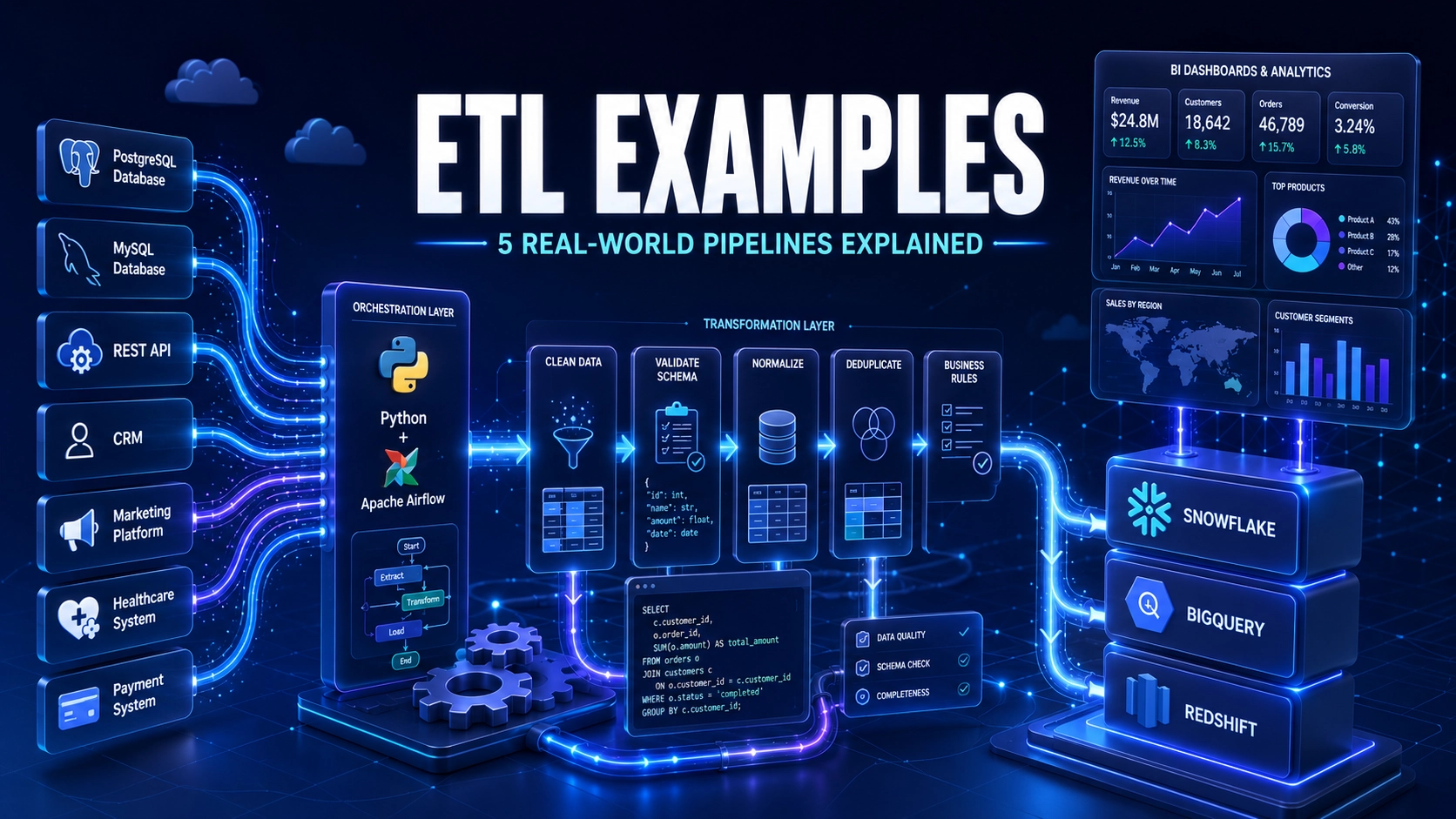
ETL, which stands for Extract, Transform, Load is really important for analytics, Artificial Intelligence and cloud data platforms. The main job of ETL is to take data that is all over the place and clean it up make it standardized and then send it to the systems that actually need it like dashboards and machine learning models so that people can make good decisions based on the data, from ETL. ETL is essential because it helps people make decisions using the cleaned-up data from ETL.
Today, digital and modern companies are drowning and transforming in data, but starving for insight. The way customers behave is seen in SaaS apps money is moving through fintech platforms and logs are coming from cloud infrastructure. The people who do analytics have to take all of this data from SaaS apps, fintech platforms and cloud infrastructure and turn it into decisions that can be made now. This is where ETL is really important for these companies and their data, from SaaS apps, fintech platforms and cloud infrastructure.
Whether you are a startup building your first data pipeline or an enterprise modernizing a legacy warehouse, where understanding ETL is an essential for scalable, compliant, and monetizable data systems.
2. What Is ETL?
A data integration process which:
- Extracts data from multiple sources
- Transforms it into a usable and consistent format
- Loads it into a target system such as a data warehouse or lake
ETL drives essential business operations throughout the various sectors. ETL is an essential tool and step for business intelligence teams to fill dashboards and reports. AI and machine learning engineers utilize ETL pipelines to create training datasets for the best results or outcomes. Cloud analytics platforms rely on ETL for immediate, useful insights. Financial organizations utilize ETL for regulatory compliance and reporting throughout the US, UK, EU, Canada, and Australia.
The ETL guarantees that data is precise, dependable, and ready for the analysis to create the useful and best decisions for the competition with others businesses. In the absence of effective ETL processes, organizations encounter problems with data quality, risks related to compliance, and lost chances for making data-informed decisions.

3. How the ETL Process Works (Step-by-Step)
3.1) Extract – Collecting Raw Data
Extraction involves pulling of data from diverse and vast sources across your digital technology ecosystem. All modern organizations are extracting data from SaaS tools like Salesforce, HubSpot, and Stripe, databases including PostgreSQL, MySQL, and SQL Server, APIs and event streams from payment gateways and webhooks, cloud services like AWS S3 and Google Cloud Storage, and IoT devices generating sensor data, which means those data which is valuable for the present and future.
The extraction phase handles different data formats, like structured tables from relational databases, semi-structured JSON from APIs, and unstructured log files from applications. Extraction can get the information you need at set times, like every hour, every day, or every week. Extraction can also happen in time using change data capture techniques, which is also known as CDC. This way, you can get the data when something changes, which is really useful for keeping things up-to-date.
A fintech digital company where I have worked with the extraction of data, which is based on the transaction data from payment gateways, fraud detection APIs, and banking systems across the US, UK, and EU. Their extraction layer handles different date formats, currency codes, and regulatory requirements specific to each region, critical for maintaining compliance while scaling globally.
3.2) Transform – Cleaning and Standardizing Data
Transformation represents the most critical stage of the ETL pipeline. This is where the raw data becomes a business-ready information through a systematic way which include cleaning, validation, and enrichment.
Common transformation operations include removing duplicate records which create inaccurate results, handling missing values through imputation or exclusion rules, normalizing currency and time zone differences for multinational operations, applying business rules like customer segmentation logic, enriching data by joining customer demographics with transaction history, and aggregating metrics such as monthly revenue by product category all of these are really have a bad impacts on the analytics.
An international SaaS company standardizes and organizes customer data to meet with the GDPR requirements in Europe, PIPEDA regulations in Canada, and privacy laws in Australia. Their transformation layer takes over personally identifiable information (PII), enforces data retention policies, and guarantees continuous data quality across all regional instances.
The majority of ETL failures arise from the poor transformation logic instead of problems with extraction or loading data. Investing and spending time in creating solid data, then transformation rules will lead to better data quality and more accurate analysis later on.
3.3) Load – Storing Data for Analysis
Loading means moving the cleaned and prepared data into the systems which are specially built for the analysis and reporting of the data. These systems can be included in data warehouses (like Snowflake, BigQuery, and Redshift), data lakes (like AWS S3 and Azure Data Lake), and other analytics tools.
There are different ways to load data, but it completely depends on the business needs. A full load of data will replace all the data and is useful for small datasets or when past changes or data do not matter. An incremental load only adds new or updated data to the data tables, which saves time and money for the analyst or data engineers. An update updates existing records and adds new ones, keeping the data current without creating duplicates also.
Once the data is loaded, then it is used to create dashboards for leaders, train machine learning models, generate reports, and help analysts to explore and understand the business needs and requirements also the trend in the business market.
4. ETL vs ELT – What’s the Difference?
The growth of cloud data warehouses has started an important discussion about the old way of doing things with traditional Extract, Load, Transform and the new way with modern ELT (Extract, Load, Transform) approaches. This discussion is not easy to understand for data warehouses. This really, really, interesting debates, for those people who are just starting to learn about cloud data warehouses. This debate will help them, so before going into the details of them, a little bit of discussion is important.
With ETL (Extract, Transform, Load), the data is cleaned and transformed before it is stored. This gives better control over data quality and rules. It is a good choice for the industries like finance and healthcare, where the data must meet to strict standards. Extract, Load, Transform is also helpful when working with the sensitive data which needs to be protected before the storage, when using older systems that expect ready-to-use data, or when applying complex business rules.
With ELT (Extract, Load, Transform), the raw data is loaded first and then transformed inside the data warehouse. This works well with the cloud platforms like Snowflake and BigQuery, which have strong processing power over the others. ELT is great for handling large amounts of data, giving access to data scientists for raw data, and supporting fast and flexible cloud-based setups.
Now, many teams and groups use a mix of both like using ETL for important data controls and ELT for more flexible analysis of data, so both are good based on their needs.
Rule of thumb:
- Choose ETL when data quality, compliance, and control matter
- Choose ELT for high-volume cloud analytics and experimentation
Many modern stacks use a hybrid ETL + ELT approach.
5. Popular ETL Tools in 2026
The Extract, Load, Transform tools landscape is really different now that we are talking about ETL tools. How they have changed over time with the modern data stack movement and cloud adoption.
5.1) Enterprise and Cloud ETL Tools
In this, we are going to discuss those ETL tools which help in the enterprise and Cloud:
- AWS Glue, which provides serverless ETL for AWS systems, which automatically scales resources based on the workload.
- Azure Data Factory which offers an enterprise-grade orchestration with deep integration across Microsoft services.
- Google Cloud Dataflow, which enables a lot of data, can handle scalable batch and streaming data pipelines using Apache Beam.
These platforms are preferred by large enterprises with significant cloud investments and skilled members in their respective ecosystems like Amazon, Google, etc.
5.2) Open-Source and Modern Data Stack
This section will discuss the open-source and modern data stack, which consists of the following:
- Apache Airflow is used by most people to manage their workflows; most companies like Airbnb and Twitter use Apache Airflow to handle and manage complex data pipelines. Apache Airflow is really good at these complex data pipelines.
- Apache Spark is used to handle large-scale data processing across distributed computing clusters.
- dbt which stands for data build tool has revolutionized analytics engineering by bringing software development practices to SQL-based transformations.
Startups and mid-sized companies usually pick these tools because for cost control, flexibility, and avoiding vendor lock-in.
5.3) SaaS ETL Platforms
Now the SaaS ETL platforms tools are the following:
- Fivetran is a tool which help to automate data replication with pre-built connectors for hundreds of sources.
- Stitch, which is owned by Talend, makes it simplified Extract, Load, Transform for common SaaS integrations like Salesforce.
- Matillion is another SaaS Extract, Load, Transform tool which provides cloud-native ETL designed specifically for Snowflake, BigQuery, and Redshift.
These platforms completely accelerate time-to-value for organizations prioritizing speed over customization. They are widely adopted and used across the US, UK, EU, and APAC markets by teams without any specified or specific data engineering resources.
6. Real-World ETL Use Cases (Startup to Enterprise)
To make things clear we need to talk about the uses of ETL in the real world. Let us start with the real-world use cases of ETL.
6.1) AI and Machine Learning
ETL feeds labelled datasets into the machine learning models which is really important for getting predictions. A healthcare AI startup in the US, Canada and the EU uses Extract, Load, Transform to put patient records and lab results and also a clinical record about the patient. They have to follow the rules like HIPAA in the US and similar rules in Canada and the EU.
The machine learning models in the healthcare AI startup use to predict if a patient will have to go to the hospital. The Extract, Load, Transform process has to happen first to make sure the data is good and doesn’t have any biases, and also it makes sure the datasets are clean and labeled so the machine learning models can make predictions about patient readmission risk.
6.2) Fintech and Compliance
Banks and fintech firms use ETL to keep track of things. They need to do this for audits and to make sure people are not laundering money. They also have to report to the government.
A company in London which handles payments uses Extract, Load, Transform to look at millions of transactions in a single every day. The ETL system checks for those patterns that do not seem right, figures out how risky they are, and makes a report for the Financial Conduct Authority and other people who regulate this kind of thing.
6.3) SaaS Product Analytics
The ETL process brings together information about how people use products to help keep customers and figure out prices and make the experience better and easy for them. A company which sells software to businesses is collecting data from the database of their application, tickets from customer, support their billing system and the platform they use for marketing.
The Extract, Load, Transform pipeline creates a picture of each customer, which helps them to see when a customer might stop using their product and when they can sell more to a customer. The ETL process is really important for this company to understand their customers and make decisions, about the ETL process and how it can help them with their customer experience and the ETL process.
6.4) Cloud Cost Optimization
Engineering teams look at logs from their infrastructure to cut down on what they spend on the cloud. A company that streams media made a system to get information from AWS CloudWatch metrics to find out where money is being wasted and then puts the results into dashboards.
The dashboards helped the streaming media company where they could save money. They were able to reduce their cloud bill by 23 percent. The engineering teams use this system to make sure they are not wasting money on the cloud. In short, the company made Extract, Load, Transform pipelines to get the metrics from AWS CloudWatch and use them to reduce their cloud spending.
7. Best Practices for Building Reliable ETL Pipelines
- Validate data at every stage using automated checks for completeness, accuracy, and consistency at any stage. The implementation of schema validation is used to catch or view the source system changes before they break downstream processes.
- Automate error handling and retries with intelligent backoff strategies. Not every failure requires human intervention, transient network issues often resolve themselves.
- Monitor pipeline performance using metrics like processing time, data volume, and error rates. Set up alerts for the anomalies which indicate problems requiring immediate attention.
- Design for scalability and regional compliance from day one. What works for 100,000 records in a single region may fail at 100 million records across multiple jurisdictions with different privacy laws.
- Document transformations clearly so team members understand business logic embedded in your pipelines. Six months from now, you’ll thank yourself for explaining why customer lifetime value is calculated using a specific formula.
Expert insight: Most ETL failures come from the poor transformation logic but not extraction or loading.
8. Frequently Asked Questions
8.1) What is ETL in simple terms?
ETL is a process that takes data from different sources, cleans and organizes it, and stores it in one place for analysis. Think for a while like moving items from multiple messy closets, sorting and folding everything properly, then placing it all in one organized warehouse where you can easily find what you need.
8.2) How does ETL differ from ELT?
ETL transforms data before loading it into the warehouse, while ELT loads raw data first and transforms it later inside the warehouse. ETL provides better governance and works well for regulated industries, whereas ELT leverages cloud computing power for faster processing of large datasets.
8.3) Which ETL tools are best for cloud platforms?
AWS Glue works best for AWS environments, Azure Data Factory excels in Microsoft ecosystems, and Google Cloud Dataflow is ideal for Google Cloud. For cloud-agnostic solutions, consider Fivetran for automated data replication or Apache Airflow for customizable workflow orchestration.
8.4) Should startups use ETL or ELT?
Startups often use ELT for speed and flexibility when building initial analytics capabilities. However, startups in regulated industries like fintech or healthcare should use ETL to ensure data quality and compliance from the beginning, even if it requires more upfront investment.
8.5) How is ETL used in AI and machine learning?
ETL prepares clean, structured datasets which improve model accuracy and reliability for the best results. It handles feature engineering, data labelling, removing biased or inconsistent records, and ensuring training data to meets exactly with the quality standards. Without proper ETL, machine learning models produce unreliable predictions.
8.6) What are common ETL pipeline failures?
Common failures of ETL pipeline include source system schema changes, breaking extraction logic, transformation errors from unexpected data formats, network timeouts during large data transfers, and insufficient error handling, causing pipeline crashes. Implementing comprehensive monitoring and validation checks helps to prevent most issues.
8.7) How much does ETL infrastructure cost?
The costs vary widely based on data volume and tool choice. Open-source solutions like Airflow require engineering time but no licensing fees. SaaS platforms like Fivetran charge based on rows synced, typically starting around $1,000-$2,000 monthly. Cloud-native tools like AWS Glue use pay-per-use pricing based on compute resources consumed.
9. Conclusion
ETL is not something that happens in the background anymore it is a very important tool. These days, we are using a lot of Artificial Intelligence and cloud storage tools and models. So good companies using ETL to get information faster, make better choices, and follow the rules better in many different countries. ETL is really helping these companies to do things right.
When you are working with data science or cloud engineering or something like fintech or SaaS it is really good to have ETL pipelines that are well-designed. This is because it helps with how well things work, and people trust you, and you can make money from data science or cloud engineering or fintech or SaaS.
You should start by knowing what your company wants to achieve. Then you pick the tools that your team’s good at using in that tool. You should always remember that having good data is very important for your company to be better, than others so do not forget about it.
The companies winning with data in 2026 aren’t necessarily those with the most data, they are the ones with the best ETL processes turning that data into action.
For real-world examples of each pipeline pattern in practice, see our guide to ETL pipeline examples.
Quiz: test what you learned