
If you’re building anything with multiple AI agents in 2026, you’ve almost certainly run into these three names. LangGraph, CrewAI, and AutoGen show up at the top of every “best AI agent framework” list, every GitHub trending page, and every developer forum thread about multi-agent systems. But the honest answer to “LangGraph vs CrewAI vs AutoGen” has changed a lot over the past year, and picking the wrong one can cost you weeks of rework.
This guide breaks down that what each framework actually does, where it’s strong, where it falls short, and, most importantly that which one fits your specific project right now.
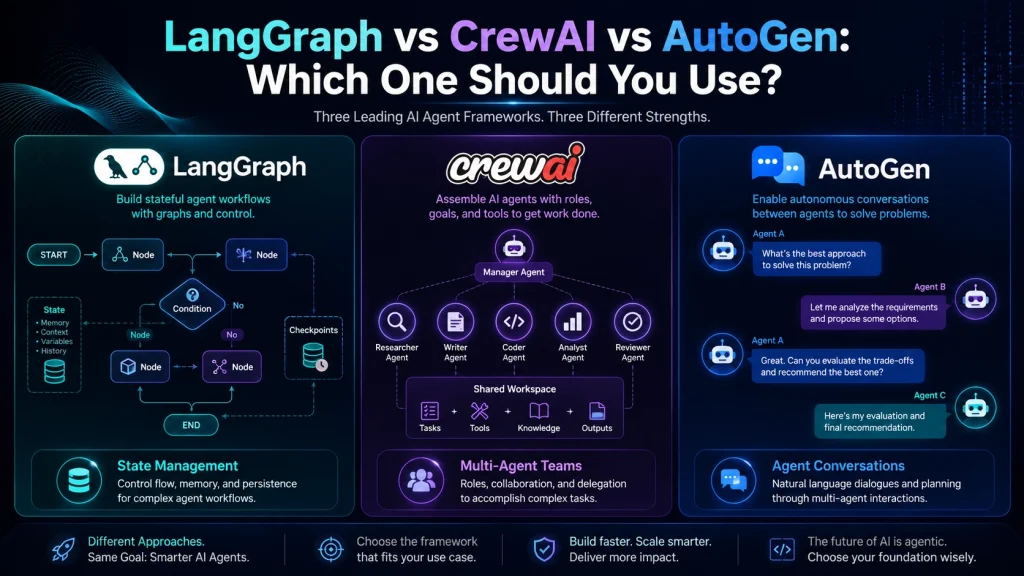
Table of Contents
Quick Answer
LangGraph is the best choice for production systems that need precise state control, checkpointing, and human-in-the-loop approval steps. CrewAI is the best choice for fast, role-based multi-agent prototypes where speed of development matters more than fine-grained control. AutoGen is now in Microsoft’s maintenance mode as of 2026, with new development redirected to Microsoft Agent Framework, so it’s only worth using if you already have an existing AutoGen codebase, not for new projects.
1. Why This Comparison Matters in 2026
A year or two ago, picking an agent framework for work felt like picking a favourite flavour among a pair of favourite flavours; they all roughly competed on the same axis of “let multiple AI agents talk to each other and get things done.” That’s no longer true.
The space has consolidated.
- LangGraph has matured into a genuinely production-grade tool used by large engineering organisations.
- CrewAI has carved out a strong identity as the easiest on-ramp for role-based agent teams.
- And AutoGen, the framework that arguably popularised multi-agent orchestration in the first place, has been formally placed into maintenance mode by Microsoft, with the company steering new users toward its successor, Microsoft Agent Framework.
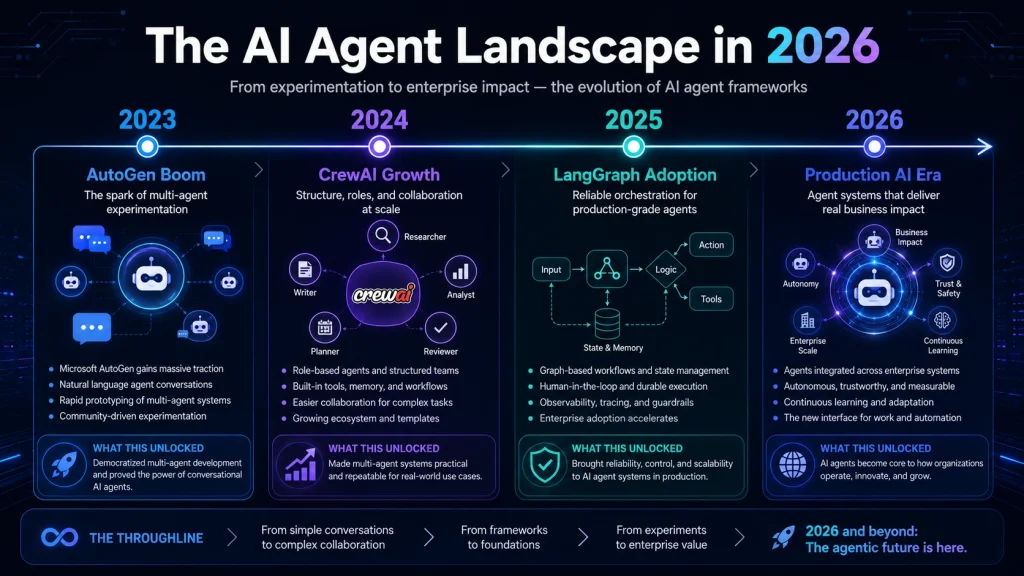
That last shift alone changes the calculus for anyone Googling “LangGraph vs CrewAI vs AutoGen” today. This isn’t a three-way tie anymore. It’s a comparison between two actively evolving frameworks and one that’s effectively frozen for new feature work.
2. Quick Comparison Table
| Framework | Best For | Learning Curve | Production Ready | 2026 Status |
| LangGraph | Stateful, complex production systems | Steepest | Most mature | Active, growing fastest |
| CrewAI | Fast prototyping, role-based teams | Easiest | Solid | Active, fastest community growth |
| AutoGen | Conversational, multi-party agent chat | Medium | Improving but stalled | Maintenance mode — Microsoft shifted focus |
3. What Is LangGraph?
LangGraph, built by the LangChain team, models an AI workflow as a graph. In plain terms: each step your agent takes is a “node,” and the connections between steps, the rules for what happens next are “edges.” Instead of writing a chatbot that just replies and stops, you’re designing a flowchart that an agent moves through, with the ability to loop back, branch based on conditions, or pause entirely.
This graph-based design is what gives LangGraph its core strengths:
- Checkpointing: The framework can save the exact state of a workflow at any point, so a long-running agent can crash, resume, or even be rewound to an earlier step without losing progress.
- Typed state: Developers define exactly what data flows through the system, which cuts down on the unpredictable behavior that loosely structured agent frameworks are prone to.
- Human-in-the-loop: You can build in mandatory pause points where a human has to approve an action before the agent continues, which matters enormously for anything touching money, customer data, or compliance-sensitive decisions.
- Audit trails: Because every state transition is explicit and recorded, you get a built-in paper trail of exactly what the agent did and why.
LangGraph has real production mileage behind it. Klarna has used it to power customer support workflows at large scale, Uber has applied it to automate code migrations and test generation across its developer platform, and LinkedIn has built hiring-related agent systems on top of it. That’s not hypothetical use, these are companies running LangGraph against real traffic and real business outcomes.
The tradeoff is learning curve. LangGraph asks you to think explicitly about state, nodes, and edges from day one. For a simple use case, that can feel like overkill , you’ll write more code than you would in a higher-level framework. But for anything that needs to survive contact with production traffic, that extra structure tends to pay for itself.
4. What Is CrewAI?
CrewAI takes a completely different mental model: instead of a graph, you define a “crew” of agents, and each agent gets a role, a goal, and a backstory, almost like writing a job description. One agent might be the “Researcher,” another the “Writer,” another the “Editor.” They hand work off to each other based on these defined responsibilities.
This role-based approach is CrewAI’s biggest selling point. It maps naturally onto how most people already think about delegating work, which makes it dramatically faster to prototype with than a graph-based tool. If your workflow already breaks down into roles, research, draft, review, approve. CrewAI lets you build that structure in a fraction of the code LangGraph would require.
CrewAI has also become the fastest-growing framework in this space by community adoption, with GitHub star growth that has outpaced both LangGraph and AutoGen over the past year. That momentum reflects real demand: a lot of teams want to ship a working multi-agent prototype in an afternoon, not a sprint.
The downside shows up as projects scale. Developers consistently report that CrewAI’s higher-level abstractions make debugging harder once a workflow grows complex, when something goes wrong three agents deep into a handoff chain, it’s not always obvious why. Logging and visibility into exactly what each agent did and when has also been a recurring pain point compared to LangGraph’s more explicit state tracking. CrewAI gives you less granular control by design, which is exactly what makes it fast to start with and exactly what makes it harder to fine-tune later.
5. What Is AutoGen?
AutoGen, originally a Microsoft Research project, pioneered a conversational model for multi-agent systems: agents are set up as participants in a structured chat, and they “talk” to each other, debating, critiquing, and building on each other’s outputs, until they converge on a solution. This pattern made AutoGen a popular choice for tasks like group debate, consensus-building, and multi-step dialogues where agents needed to challenge and refine each other’s work.
The important 2026 update: Microsoft has placed AutoGen into maintenance mode. That means the framework will continue receiving bug fixes and security patches, but it will not receive new features, and Microsoft’s product momentum has shifted to Microsoft Agent Framework, a newer SDK that merges AutoGen’s multi-agent concepts with Semantic Kernel’s enterprise-grade infrastructure.
This doesn’t mean that AutoGen stopped working. It still runs, it still has an active community maintaining it (including a community-led fork called AG2), and there’s a large body of existing tutorials and example code. But Microsoft’s own guidance is explicit: new users should start with Microsoft Agent Framework, not AutoGen.
So where does that leave AutoGen in a “LangGraph vs CrewAI vs AutoGen” comparison? It’s best understood today as a legacy framework rather than a current contender. If you have an existing, working AutoGen deployment, there’s no urgent need to rip it out — but starting a brand-new 2026 project on a framework in maintenance mode is a real long-term risk, since you’d be building on a foundation that won’t gain new capabilities as the ecosystem evolves.
6. Head-to-Head: Key Differences
Learning Curve
- CrewAI is the easiest to pick up, thanks to its intuitive role-based model, most developers can build a working prototype within a day.
- AutoGen sits in the middle; its conversational pattern is conceptually simple but its async-heavy API requires comfort with asynchronous Python.
- LangGraph has the steepest curve, since it requires understanding graph structures, explicit state management, and how reducers merge state updates.
Control & Flexibility
- LangGraph offers the most control, you define every node, every transition, and every condition explicitly.
- AutoGen sits in the middle, giving you flexible conversational patterns but less structural precision.
- CrewAI offers the least granular control, since its role-based abstraction intentionally hides a lot of the underlying mechanics to keep things simple.
Production Readiness
- LangGraph is the most production-mature of the three, with documented use at companies running it against millions of real interactions.
- CrewAI is solid for production use, particularly for workflows that map cleanly onto roles, though teams report more friction debugging complex multi-step crews at scale.
- AutoGen’s production readiness has effectively stalled — Microsoft itself has acknowledged that conversational multi-agent systems struggled to deliver the governance and observability enterprises need, which directly informed the shift to Microsoft Agent Framework.
Community & Momentum in 2026
- LangGraph and CrewAI are both seeing active growth in adoption, contributions, and tooling.
- AutoGen’s new-user adoption has flattened, with much of its former audience either staying on existing deployments or migrating to Microsoft Agent Framework.
7. Which One Should You Choose? (Decision Framework)
- Choose LangGraph if: You need production-grade reliability, a clear audit trail, mandatory human approval steps, or workflows with complex conditional branching. This is the right call for anything customer-facing at scale, anything regulated, or anything where you need to know exactly what an agent did and why.
- Choose CrewAI if: You want to prototype fast, your workflow naturally splits into roles like researcher, writer, and reviewer, and you’d rather trade some fine-grained control for speed of development. This is the right call for internal tools, content pipelines, and early-stage products where iteration speed matters more than airtight control.
- Choose AutoGen if: You already have a working AutoGen codebase and aren’t ready to migrate yet. Outside of that specific situation, it’s worth skipping AutoGen for new 2026 projects, evaluate Microsoft Agent Framework instead if you want to stay within the Microsoft ecosystem, or choose LangGraph or CrewAI if you don’t.
8. Common Mistakes to Avoid
Don’t choose a framework based on GitHub star counts alone. Stars measure popularity, not fit. The better question is whether your workflow is “graph-shaped” or “role-shaped.” If your process has loops, conditional branches, and points where a human needs to step in and approve something, that’s graph-shaped, LangGraph. If your process is closer to a linear handoff between distinct jobs, that’s role-shaped, CrewAI.
It’s also worth knowing that these tools aren’t mutually exclusive. A growing number of teams use a hybrid pattern: LangGraph for the outer orchestration layer, handling state, checkpoints, and human approval, with CrewAI managing smaller, self-contained “crews” of agents for specific sub-tasks inside that larger graph. This gives you LangGraph’s control at the architecture level without losing CrewAI’s speed for well-defined, role-based chunks of work.
9. FAQ
Is AutoGen still worth learning in 2026?
AutoGen is still worth understanding conceptually, since it introduced patterns like agent-to-agent conversation that influenced the entire field. For new production projects, however, it’s not recommended; Microsoft has moved it to maintenance mode and is directing new users to Microsoft Agent Framework instead. AutoGen remains a reasonable choice only for existing codebases or short-term research and experimentation.
Can I use LangGraph and CrewAI together?
Yes. A common hybrid pattern uses LangGraph to manage the overall workflow, state, and human-in-the-loop checkpoints, while CrewAI handles smaller role-based sub-tasks within that larger structure. This combines LangGraph’s control with CrewAI’s speed for well-scoped pieces of the workflow.
Which framework is easiest for beginners?
CrewAI is generally the easiest framework to start with, because its role-based model (agents with a role, a goal, and a backstory) maps naturally onto how people already think about delegating tasks. Most developers can get a working prototype running within a day, compared to a steeper initial learning curve with LangGraph’s graph-based approach.
Do these frameworks support MCP (Model Context Protocol)?
Support varies and is evolving quickly. Native, built-in MCP support is not yet standard across LangGraph and CrewAI, though community-built integrations exist for connecting these frameworks to MCP servers. This is a fast-moving area, so it’s worth checking each framework’s current documentation before building MCP integration into a production system.
10. Conclusion
There’s no single “best” answer to LangGraph vs CrewAI vs AutoGen; the right choice depends on what your project actually needs.
- If you need control, reliability, and a clear audit trail for production systems, LangGraph is the stronger long-term bet.
- If you need to move fast and your workflow already splits naturally into roles, CrewAI will get you there with far less code.
- And if you’re not already invested in AutoGen, 2026 is the year to look elsewhere for new projects.
As more of these frameworks add native support for protocols like MCP, the practical differences between them will keep shifting, so it’s worth revisiting this comparison periodically rather than treating today’s answer as permanent.