Start your data engineering journey to learn data engineering skills that employers demand in 2026, including Python, Spark, Kafka, SQL, and cloud platforms.
Quick Answer
What skills do you need for data engineering?
The core skills for Data Engineering professionals require “programming, data pipelines, databases, cloud platforms, and big data processing tools”. The most demanded technologies for data engineering professionals include Python, SQL, Apache Spark, Apache Kafka, AWS, Azure, and Google Cloud.
What You’ll Learn
By the end of this article, you’ll better understand that:
- Which programming language appears in the most data engineering job postings and is needed by data engineering professionals to learn
- Where Apache Spark, Kafka, and REST APIs fit in the data engineering pipeline
- Which cloud platform to focus on first, and then second, and so on.
- How to build a prioritized learning path without chasing every tool in the ecosystem
The one-tool-per-layer framework used by working data engineering professionals
This article best for
This guide is best for:
- Who want to change their career into data engineering from software development, analytics, or database administration
- Especially Junior data engineers who want to validate their current skill gaps against job market demand
- Also, for those Mid-level engineers who are evaluating which tools to add to their stack next
Hiring managers are looking for a benchmark of commonly required skills across the field
Key Takeaways
- Python appears in around 70% of data engineering job postings, due to which it is the most important language to learn first for the field of data-related jobs
- Apache Spark is necessary for the data processing layer for batch, streaming, real-time, and in-memory workloads
- REST APIs are the primary mechanism for data collection and pipeline ingestion
- Apache Kafka handles high-volume data buffering between pipeline stages
- SQL remains the foundational storage and querying skill for data engineers
- Tableau and Power BI dominate visualization requirements in job listings
- AWS, GCP, and Azure are the three dominant cloud platforms, so specializing in one first is the best way
- Mastering one strong tool per pipeline category is a realistic and effective career goal, and it is a sign of good data engineers
Table of Contents
1. Introduction
Data Engineering has become one of the hottest and most popular careers in data-related tech right now, which makes sense because data is everywhere and generated in each and every second. Industry specialists often call it the “new oil” because all digital companies depend on data to make decisions for the organizations, to improve product sales, and to understand the customers in a better way.
To work for the organizations, raw data alone is not useful. First, it has to be collected, then cleaned, organized, processed, and stored properly. That is where the job of Data Engineers comes to join the party.
A Data Engineer builds such types of systems that move and manage a large volume of data flow behind the scenes. To perform this job in the best way, you will usually need some skills that work with large databases, big data tools, ETL pipelines, cloud platforms, data warehousing, and programming.
Now here is the tricky part, which is ambiguous for beginners, and that is “there are so many tools out there”.
The question creates in the mind of all learners that really “Do we need to learn all of them? Should we master every platform before applying for jobs?”
The simple answer is “Not at all”.
The real goal is to build strong skills in the main and important areas of Data Engineering and become comfortable with at least one good tool in each category. So, grab a coffee and let’s break down the most in-demand skills in today’s Data Engineering, which are needed in the job market.
2. Why Data Engineering Skills Matter
Data engineering has quickly become one of the most in-demand and fast-growing careers in the digital market based on data-related jobs.
Most of the organizations and companies generate huge amounts of data day-by-day using websites, mobile apps, smart devices, payment systems, and countless other sources that generate data in every step. But when this data is created, it is in raw form, which is not useful for making valuable decisions. To make it useful, first, it has to be gathered, cleaned, organized, stored, and moved properly before anyone can actually use it. That is the tedious work to do, which needs an expert, and we call it the job of a data engineer.
In data-related jobs, such as data scientists and analysts, who focus on finding insights, but essentially, data engineers build the systems that make those insights possible in the first place. For this purpose, they create the pipelines and infrastructure that focus on keeping data flowing smoothly and reliably across an organization.
Without strong data engineering, even the best analytics or machine learning systems fall apart.
That is exactly why all companies are investing heavily in this in-demand role. Businesses need those people who can handle data at a large scale and also make sure that it is accurate, accessible, and ready to use for the business.
The good news is that the path into data engineering is very achievable and traceable when you are eager to learn about it. The skill set to learn may seem tough and vast at first, but you do not need to learn everything at the same time. Naturally, once you understand the core tools and concepts, ultimately the learning becomes much easier and manageable, and also the job market makes it pretty clear which skills are worthy to focus on.

3. Essential Data Engineering Skills
3.1 Needs at least Proficiency in One Programming Language
Absolutely, programming language is a mandatory skill in the field of Data Engineering. Most of the job profiles require that you be comfortable at least with one core programming language because programming languages are required to build the ETL or data pipeline framework through code.
Some of the most commonly used programming languages include:
- SQL for querying and transformation
- Python for pipelines and automation
- Scala for Apache Spark ecosystems
- Java for enterprise-scale distributed systems
- Shell scripting for workflow automation
Where it fits in your pipeline: In the data engineering pipeline, the above programming languages work and are needed at the development layer, the foundation through which all other tools are scripted, orchestrated, and integrated. The one popular language in the field of data is Python, and its dominance comes from its readability, vast library ecosystem, and broad compatibility with cloud platforms, data processing frameworks, and REST APIs.
3.2 Python, which is The Most In-Demand Skill in every field of data
Probably the buzzword of Python! Python! Python! Which means that in every field of data, such as data science, data analysis, machine learning, AI, etc., every field needs Python programming.
And, yes, in many cases nearly 70% of the job profiles need Python as a required skill, followed by SQL, Java, Scala, and other programming skills are also needed, such as R, .Net, Perl, Shell Scripting etc.
Why is Python so popular and dominant? The answer is simple because the 70% figure reflects that it works well for almost everything, such as automation, data processing, scripting, analytics, and pipeline development, and in more modern ways, we can say that its role as the primary language for Apache Spark (via PySpark), data ingestion libraries like dlt, and modern orchestration tools like Prefect. It is easy to learn and has a huge ecosystem of libraries that make data work faster and more smoothly.
3.3 Apache Spark, which leads the Data Processing Layer
Data processing is the manipulation of data, which means that to turn raw data into something useful, which is the need of organizations.
Apache Spark stands out as one of the most widely used among all the tools that are available in today’s era. Because it supports:
- Real-time stream processing
- Batch processing
- In-memory computing
- Large-scale distributed processing
And it does all of these very fast.
Other commonly used tools in this area include:
- AWS Lambda
- Elasticsearch
- MapReduce
- Oozie
- Pig
- AWS EMR.
Where it fits in your pipeline: Apache Spark fits and is set at the processing layer, which is between data ingestion/buffering and data storage. It receives raw data (often via Kafka or REST APIs), then transforms it at scale, and produces output results to the data warehouses, data lakes, or downstream applications. Its Python API (PySpark) makes it a natural companion with Python as the primary development language.
3.4 REST APIs: A Tool for Data Collection
Any data requires analysis and preprocessing. Before data can be analysed, first it needs to be collected using data pipeline techniques.
One of the most common ways that all companies use to pull data into their systems is through REST APIs. These API tools help applications to communicate and exchange data throughout the system smoothly.
Other tools often used for data ingestion include:
- Sqoop
- Apache NiFi
- Azure Data Factory
- Flume
- Hue
Where it fits in your pipeline: REST APIs work on the data collection layer, which is the entry point of any data pipeline. They pull data from external applications, SaaS platforms, web services, and internal microservices into the pipeline for downstream processing. Tools like NiFi and Azure Data Factory extend this capability for enterprise-scale ingestion with GUI-based workflow management.
3.5 Apache Kafka — The Standard for Data Buffering
Modern systems generate massive amounts of data in every second. Sometimes that data needs to pause briefly before moving to the next stage in the pipeline, which is crucial, and this temporary holding process is called data buffering.
Apache Kafka is one of the most popular tools for handling this type of process because it is built for real-time streaming and can process huge volumes of continuously generated data from multiple sources simultaneously.
Other tools used in this area include:
- AWS Kinesis
- Redis Cache
- Google Cloud Pub/Sub
Where it fits in your pipeline: Apache Kafka specifically fits at the data buffering layer, which is between the data collection and the data processing layer. It decouples the producers (data sources) from consumers (processing frameworks like Spark), and enabling high-throughput, fault-tolerant streaming in a pipeline. AWS Kinesis and GCP Pub/Sub serve the same buffering role within their respective cloud ecosystems.
3.6 Data storage still revolves around SQL and NoSQL
Data needs a place to be stored for reporting, analytics, machine learning, or dashboards to generate valuable insights. Companies store data in databases, warehouses, lakes, or distributed systems.
SQL has remained one of the most in-demand skills in the industry for many years. Alongside SQL, companies also look for experience with tools like:
- Hive
- AWS Redshift
- MongoDB
- Amazon S3
- Cassandra
- Google BigQuery
Both SQL and NoSQL technologies play an important role depending on the type of data and scale involved.
Where it fits in your pipeline: The storage layer is where processed data lands for downstream consumption, analytics, reporting, machine learning, and visualization.
- SQL-based warehouses (Redshift, BigQuery, Hive) handle structured, queryable data.
- NoSQL systems (MongoDB, Cassandra, S3) handle high-velocity or schema-flexible data.
- Data engineers typically design and maintain both layers depending on pipeline requirements.
3.7 Data Visualization: The skill of showing data using Tableau and Power BI to leads the Market
Data is only useful if people can understand it easily. To make it easy, we use a mechanism of data visualization. That is why data visualization tools are so valuable, and they turn complex information into meaningful charts, dashboards, and reports that help teams to make better decisions quickly.
Two of the biggest names here are Tableau and Power BI. Other tools companies use include:
- SAP Business Objects
- Qlik
- SPSS
- QuickSight
- MicroStrategy
Where it fits in your pipeline: Visualization tools sit at the consumption layer, which is the final output stage, where processed and stored data is presented in a beautiful format to business users or decision makers. While data engineers don’t always own visualization directly, understanding Tableau and Power BI is valuable for designing data models and warehouse schemas that serve reporting needs effectively.
3.8 Cloud Platforms are now essential for Data Engineering
Today, most Data Engineering work happens on cloud platforms instead of traditional ways, which are held in the premises of systems.
The major platforms companies look for are:
- AWS
- Google Cloud Platform (GCP)
- Microsoft Azure
- Hadoop ecosystems
Each platform offers tools for storage, processing, orchestration, and analytics.
4. How These Skills Fit Together: The 7-Layer Data Engineering Pipeline Framework
Understanding how each skill category connects with the others is as important as knowing the tools themselves. Here is how a complete data engineering pipeline is structured:

| Layer | Role | Top Tools |
| 1. Development | Scripting, automation, and framework integration | Python, Java, Scala |
| 2. Data Collection | Ingesting data from external sources | REST APIs, NiFi, Sqoop, Azure Data Factory |
| 3. Data Buffering | Temporary high-volume storage during transit | Apache Kafka, AWS Kinesis, GCP Pub/Sub |
| 4. Data Processing | Transforming raw data at scale | Apache Spark, MapReduce, AWS Lambda |
| 5. Data Storage | Storing processed data for querying and analysis | SQL (Redshift, BigQuery, Hive), NoSQL (MongoDB, Cassandra, S3) |
| 6. Data Visualization | Surfacing insights to business users | Tableau, Power BI, Qlik, QuickSight |
| 7. Cloud Infrastructure | Hosting and orchestrating the full pipeline | AWS, Google Cloud Platform, Azure |
The practical goal is to master at least one tool per layer, not every tool across all layers.
5. Data Engineering Skills Roadmap: Beginner to Senior
| Stage | Focus Skills | Goal |
| Beginner | Python, SQL basics, Git | Write and run basic ETL scripts |
| Intermediate | Apache Spark (PySpark), REST APIs, one cloud platform | Build end-to-end data pipelines |
| Advanced | Apache Kafka, data warehouse design, distributed systems | Architect scalable, fault-tolerant pipelines |
| Senior | Cloud architecture, pipeline orchestration, performance tuning | Lead data infrastructure strategy |
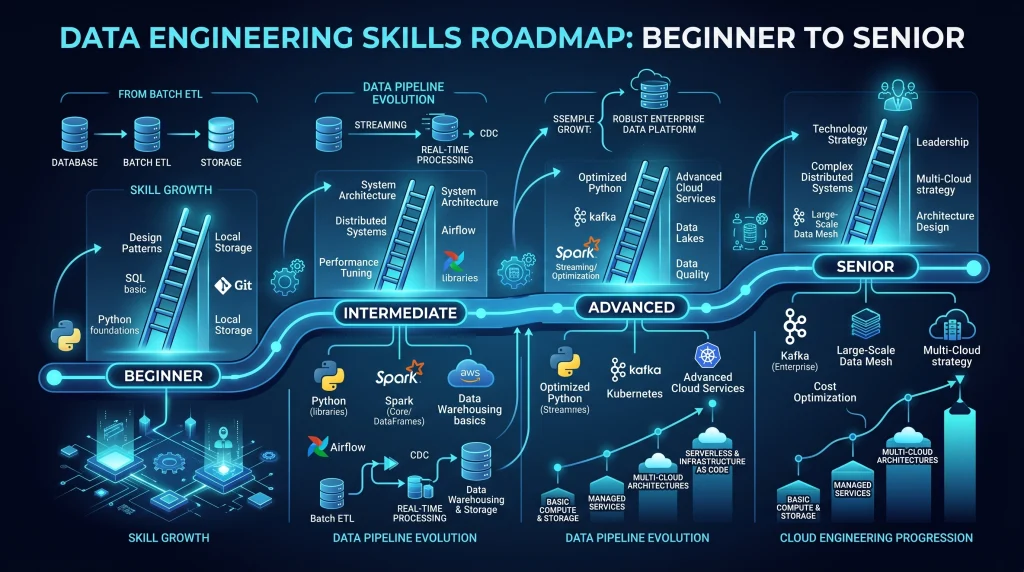
Start at your current level and progress one stage at a time, not all at once. Attempting to learn all layers simultaneously is the most common cause of slow progress in data engineering careers.
6. Common Mistakes to Avoid
- Trying to learn every tool at once
- Skipping SQL fundamentals
- Avoiding cloud platforms due to cost concerns
- Neglecting pipeline architecture understanding
- Focusing on visualization before engineering.
- Not building portfolio projects
The most common mistake that aspiring data engineers make is chasing every new tool instead of going deep on fundamentals. Employers consistently value engineers who can build and maintain reliable pipelines over those who have surface-level exposure to every framework in the ecosystem. Start with Python, SQL, and one cloud platform, then expand systematically into processing and buffering layers.
7. Future Trends in Data Engineering
The data engineering skill landscape is shifting heading into 2026 and beyond:
- AI-Integrated Pipelines Data engineers increasingly need to understand how LLMs and ML models consume pipeline outputs, driving demand for feature store and vector database skills.
- Data Contracts and Schema Management Tools like dbt, SQLMesh, and Pandera are making schema-first development a standard practice in mature data organizations.
- Python-Native Orchestration Prefect and Dagster are gaining ground over Airflow as teams prefer code-first, infrastructure-light orchestration.
- Real-Time Processing Growth Demand for Kafka and stream processing skills is accelerating as more companies move from batch to event-driven architectures.
- Cloud Cost Optimization Data engineers with proficiency in DuckDB, Polars, and serverless patterns are increasingly valued for reducing unnecessary compute spend.
8. Frequently Asked Questions
Q: What is the most important skill for data engineering?
Python is the single and one of the most important skills for data engineering, appearing in approximately 70% of job postings. The main reason behind the popularity of Python is that it is used for ETL scripting, pipeline automation, and integrating with frameworks like Apache Spark. After Python, SQL is the next essential skill for database querying and data warehouse work.
Q: Do I need to know all data engineering tools to get a job?
No, it is not mandatory or compulsory to master every tool in the ecosystem of data engineering. The professional standard is proficiency in at least one tool per pipeline layer, such as Python for development, Apache Spark for processing, Apache Kafka for buffering, and AWS or GCP for cloud infrastructure. Having a deep knowledge in a specific area is more effective than having a little knowledge about many tools.
Q: Is Python enough to become a data engineer?
Python is the best starting point, but it is not sufficient on its own to become a complete data engineer. A complete skill set also requires such as SQL for database work, a processing framework like Apache Spark, familiarity with at least one cloud platform, and an understanding of data pipeline architecture. Python serves as the connective language across all these components. Everything is important in its proper place.
Q: Which cloud platform should a data engineer learn first?
AWS is the most popular choice for data engineering because it offers many services, including EMR, Redshift, Lambda, and S3. GCP is considered the best tool for analytics tasks, featuring tools like BigQuery and Pub/Sub. While Azure works well in those companies that use Microsoft products. Choose a platform based on the types of companies or industries you want to focus on.
Q: What is Apache Kafka used for in data engineering?
Apache Kafka is a distributed data store used for data buffering, which temporarily holds high-volume streaming data as it moves between pipeline stages. It handles data continuously, which is generated by thousands of sources simultaneously, and works and fits between the data collection and processing layers of a pipeline.
Q: What is the difference between SQL and NoSQL for data engineers?
SQL handles structured, tabular data with defined schemas, which is used in warehouses like Redshift, Hive, and BigQuery. NoSQL databases like MongoDB, Cassandra, and Elasticsearch handle unstructured or high-velocity data. Data engineers typically work with both SQL for analytics and reporting layers, NoSQL for raw ingestion, and flexible storage.
Q: How long does it take to become a data engineer?
Most people with some programming experience can be job-ready in 12 to 18 months if they focus on their learning in a very clean and manageable way. They should start with Python, then learn SQL, followed by data pipeline concepts, and then Apache Spark. After that, they should get familiar with cloud platforms and work on portfolio projects. If someone has previous software development or database experience, they can become job-ready faster.
9. Conclusion
Data engineering is one of the fastest-growing technical roles in the job market, and the skill requirements are both clear and achievable. The job market consistently points to a core set of capabilities such as Python for development, Apache Spark for processing, REST APIs for collection, Apache Kafka for buffering, SQL for storage, Tableau or Power BI for visualization, and a cloud platform for infrastructure.
The important point for every learner about the data engineer job market is that you do not need to master everything at once; you need to go deep into at least one tool for each layer of the pipeline. That focus becomes your master is what separates employable data engineers from those still chasing every new framework in the ecosystem.
Use the 7-layer pipeline framework in this article as your main road map, the beginner-to-senior roadmap as your guide, and start building. The most important step is choosing your first tool and going deep.
Learn, get skilled, and boost your career! Good Luck & Happy Data Engineering!
Quiz: test what you learned