## Intro to Open-Source vs Enterprise AI Orchestration
Choosing between the open-source and enterprise AI orchestrations is not just a technical difficulty, it specifically focuses that to shapes your cost structure, deployment speed, and how much engineering pain you absorb in the long term.
Most teams make this decision based on the price or flexibility of orchestration, either in open source or enterprise-based orchestration, but that is a mistake. In practice, the wrong choice does not hurt you on the first day, but it hurts you later, after some time, maybe at month six or 8 or other, because when your system is operating under real load, and your team is firefighting instead of building.
This guide gives you a clear idea about the Open-Source vs Enterprise AI Orchestration:
What each path actually costs,
Where each one breaks down in production, and
A direct decision flow so you know which option fits your situation.
Open-Source vs Enterprise AI Orchestration
## Quick Answer
Open-source AI orchestration is best for those teams that need deep customization and have strong engineering-driven resources to manage infrastructure, while enterprise platforms are better for those organizations that prioritize reliability, compliance, and fast deployment with minimal operational overhead. The right choice depends on your team’s skill level, system scale, technical resources, and long-term cost tolerance.
## Open-Source vs Enterprise AI Orchestration Comparison Table
Factor
Open-Source AI Orchestration
Enterprise AI Orchestration
Upfront Cost
Low (no license)
High (subscription/usage)
Long-Term Cost
High (engineering + maintenance)
Predictable
Scalability
Manual
Auto-managed
Flexibility
Very high
Limited by platform
Deployment Speed
Slower
Faster
Reliability
Team-dependent
SLA-backed
Compliance
Self-managed
Built-in (SOC 2, HIPAA, etc.)
Best For
Startups, experimentation
Enterprises, production systems
## Core Difference: Control vs Convenience (The Real Trade-off)
This is not about which option is “better.” It is about what trade-off your team can actually absorb.
1) Open-Source = Maximum Flexibility, Minimum Abstraction
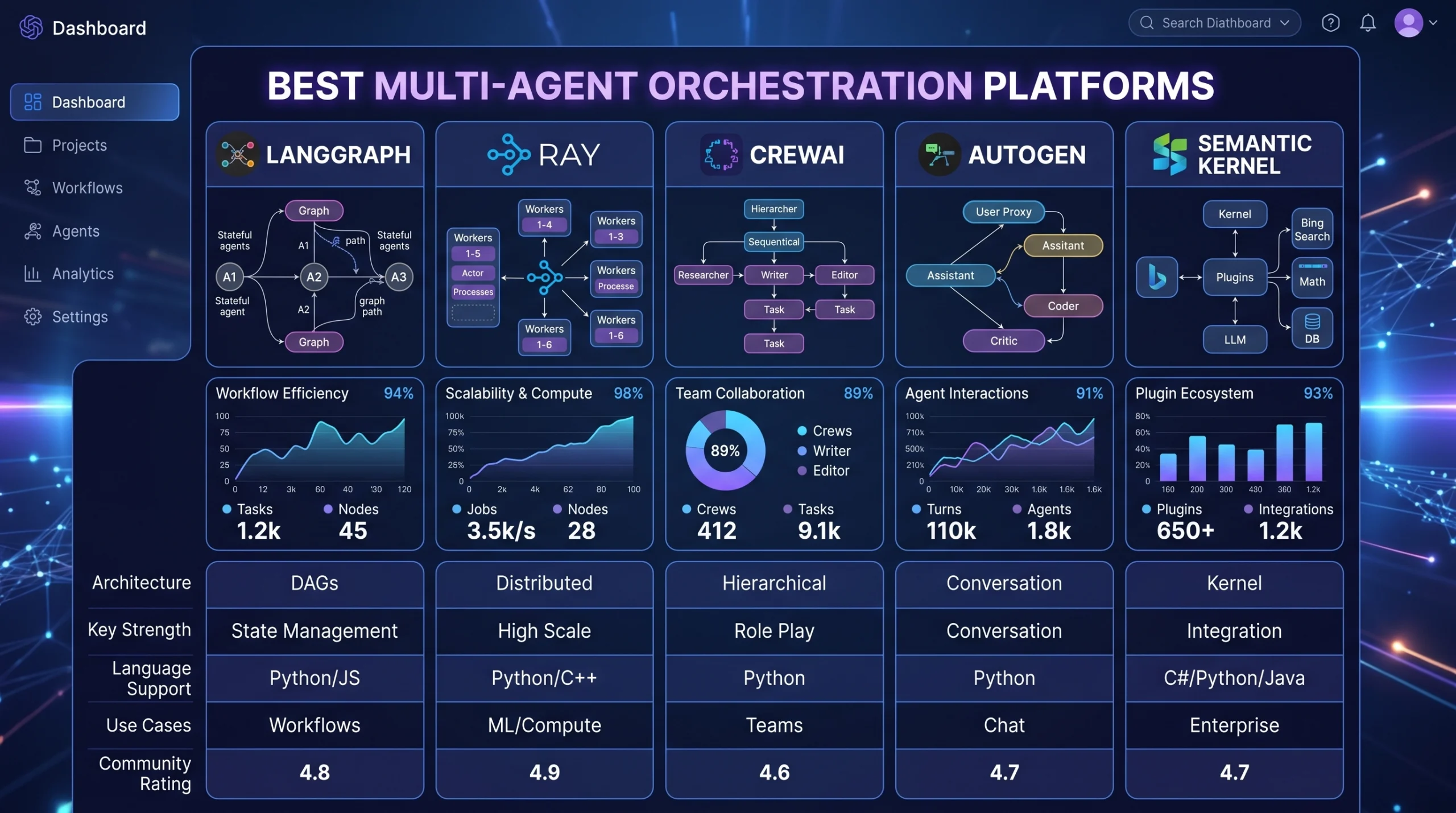
Open-source orchestration tools, such as LangChain, LangGraph, CrewAI, or AutoGen, give you direct access to the underlying system. You control:
Routing logic,
Agent communication,
Memory handling, and
Tool integration at a low level.
What this means is that nothing is hidden from you. You can change anything, which means that you also have to manage everything.
There is no middleware handling retries for you. No managed queue absorbing traffic spikes. No built-in monitoring dashboard. You build or integrate all of it yourself.
2) Enterprise = Managed Systems with Built-In Reliability
The trade-off is that you work within the platform’s design decisions. Customization has limits.
In practice, enterprise tools are faster to deploy but slower to adapt when your use case sits outside their intended boundaries.
3) In Practice, Control Often Increases Complexity
Here is the real issue: control and complexity travel together.
When your team chooses LangGraph for maximum flexibility, they also inherit:
Debugging custom agent graphs,
Managing state persistence,
Handling partial failures manually, and
Writing retry logic from scratch.
A team of two or three engineers working on a prototype can handle this. A team trying to serve 10,000 API calls per day, maintain uptime, and push weekly feature updates often cannot, at least not without significant infrastructure investment.
Key Insight:More control in orchestration systems almost always leads to higher operational complexity, especially under production load.
## Open-Source vs Enterprise AI Orchestration Cost Comparison
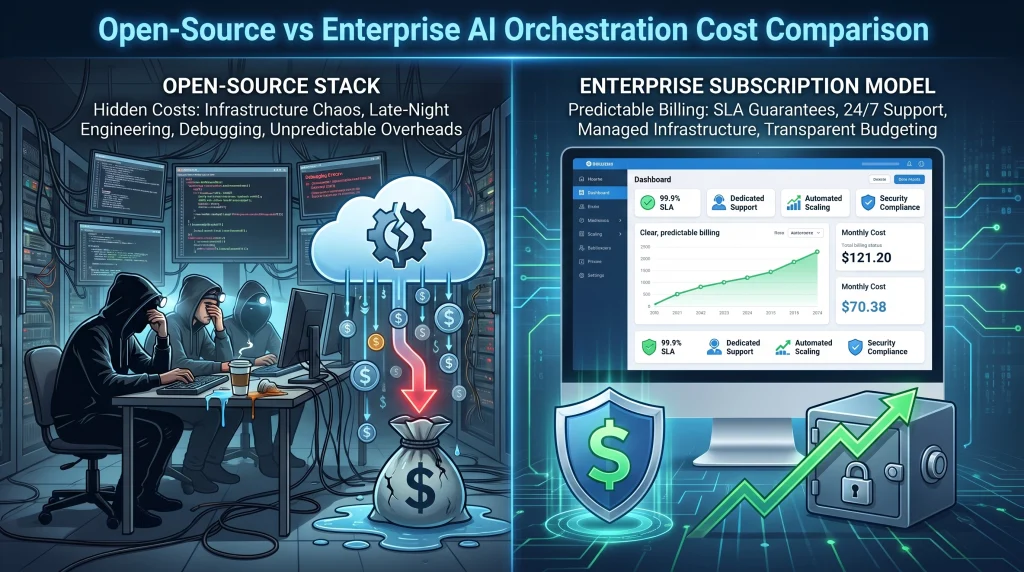
Open-Source vs Enterprise AI Orchestration Cost Comparison
This is where most teams get surprised because “Free” is just a starting price, not a total cost.
1) Open-Source Hidden Costs (Engineering Time, Infra, Maintenance)
Open-source tools have no licensing fees for use, that part is really accurate. But the real costs pile up quickly:
Engineering hours for setup, debugging, and customization (often 2–4 weeks just to reach a stable baseline)
Infrastructure spends: you are running your own servers, queues, and databases
Maintenance overhead: framework updates break integrations; someone has to fix them
Debugging at scale: tracing failures across multi-agent graphs without built-in observability tools is genuinely painful
In production systems, teams often spend more on open-source orchestration maintenance than they would have spent on an enterprise license, especially after year one.
Key Insight: Open-source orchestration shifts cost from licensing to engineering time and ongoing maintenance.
2) Enterprise Pricing (Licenses, Subscriptions, Support Tiers)
Enterprise platforms charge for what they abstract. Pricing models vary:
Consumption-based (per API call, per agent run)
Subscription tiers (team vs business vs enterprise with SLA included)
Support contracts (standard vs premium with dedicated engineering support)
For many mid-size companies, the math works out: a $3,000/month enterprise plan is cheaper than hiring a half-time engineer to maintain open-source infra.
3) ROI Perspective: Short-Term vs Long-Term Cost
Short-term, open-source wins on price. Long-term, the picture completely shifts.
The ROI question is not “how much does the tool cost?”, but it is “how much does this decision cost us over 18 months?”
If your open-source setup requires one engineer’s partial attention permanently, that is $50,000–$100,000 per year in loaded labour. Enterprise licenses rarely approach that number.
The right framing:
Open-source has a low entry cost and high ongoing cost.
Enterprise has a higher entry cost and more predictable ongoing costs.
## Scalability and Reliability in Production Systems
This section matters most for teams planning to run real workloads, not just demos.
SLAs with uptime guarantees (99.9% or higher for paid tiers)
Automatic retry and failover logic
In practice, the platform absorbs the operational complexity that would otherwise fall on your engineering team.
Key Insight: Enterprise platforms reduce operational risk by handling scaling and failures before they impact users.
3) In Production Systems, What Breaks First and Why
Here is a real failure pattern worth understanding.
A team builds a multi-agent research pipeline on LangGraph. It works well in staging. They launch to users. Within three weeks, they hit a combination of LLM API rate limits, inconsistent tool call returns, and a memory bottleneck in their vector store integration. The agents start producing partial outputs or looping indefinitely. None of these failure modes was visible in testing.
The root cause is not bad code; it is that open-source orchestration does not surface operational failures clearly. You often find out something is broken from user complaints, not from your monitoring.
## Security, Compliance, and Governance Differences
For many teams, especially in finance, healthcare, or legal, this section is not optional.
Open-source orchestration puts security entirely on your organization. This includes:
Securing API keys and credentials passed between agents
Ensuring data does not leak across agent boundaries
Managing audit logs manually
Handling compliance requirements (HIPAA, SOC 2, GDPR) through your own tooling
The risk is not that open-source tools are inherently insecure. The risk is that security is your problem, and mistakes at the orchestration layer can expose sensitive data at the LLM call level.
Role-based access control for agent configurations
Audit trails for every agent action (who ran what, when, with what inputs)
Data residency options for organizations with geographic compliance needs
Certifications (SOC 2 Type II, ISO 27001) that reduce your compliance audit burden
If you are handling sensitive customer data, enterprise platforms do not just help; they may be required.
3) If Handling Sensitive Data → Why This Decision Matters
A financial services firm that builds an AI orchestration pipeline on open-source tools and pushes customer data through it has taken on full compliance liability. If something goes wrong, a data leak, an audit failure, there is no vendor SLA to lean on. The firm owns the outcome entirely.
The enterprise option changes that dynamic. It does not eliminate risk, but it shares it with a vendor who has the compliance infrastructure already in place.
## Decision Framework: Which One Should YOU Choose?
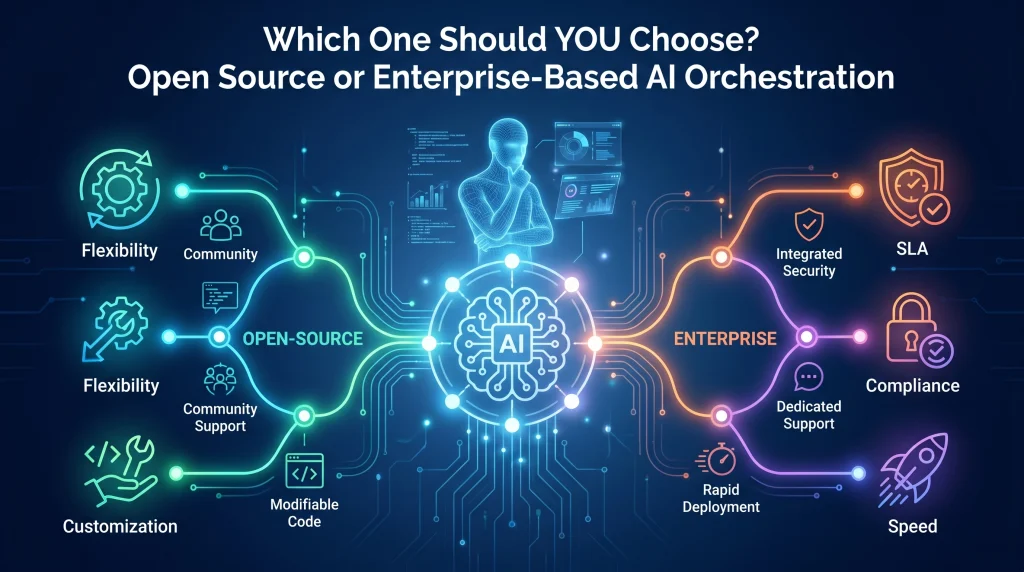
Which One Should YOU Choose Open-Source vs Enterprise AI Orchestration
Use this as a direct routing system. Find your scenario, follow the path.
1) If You Are a Startup → Decision Path
You have 1–5 engineers and need to move fast:
If you are pre-product or prototyping → open-source (LangChain, LangGraph)
If you are post-launch and scaling quickly → evaluate enterprise (Azure AI, AWS Bedrock)
If you have no dedicated ML/infra engineer → enterprise from the start saves pain
Most startups begin open-source and migrate to enterprise solutions once scaling becomes expensive to manage manually. Build with that migration in mind, keep your orchestration logic decoupled from the underlying framework.
2) If You Are an Enterprise → Decision Path
You have compliance, uptime, and vendor accountability requirements:
If you need SOC 2 / HIPAA compliance → enterprise only
If you need SLA guarantees → enterprise only
If you have a large existing cloud contract (AWS, Azure, GCP) → use that vendor’s agent platform (you’re likely already paying for it)
If you have a strong internal AI/ML team and need unusual customization → open-source with a dedicated infra layer
3) If X → Choose Y (Clear Rule-Based Logic)
Situation
Choose
Need rapid prototyping
Open-source
Need compliance and audit logging.
Enterprise
Have dedicated ML engineers
Open-source
Need uptime SLAs
Enterprise
Budget is the primary constraint.
Open-source (short-term)
Long-term maintenance cost matters
Enterprise
Need deep customization
Open-source
Need fast deployment without infra work.
Enterprise
## When NOT to Use Open-Source or Enterprise Solutions
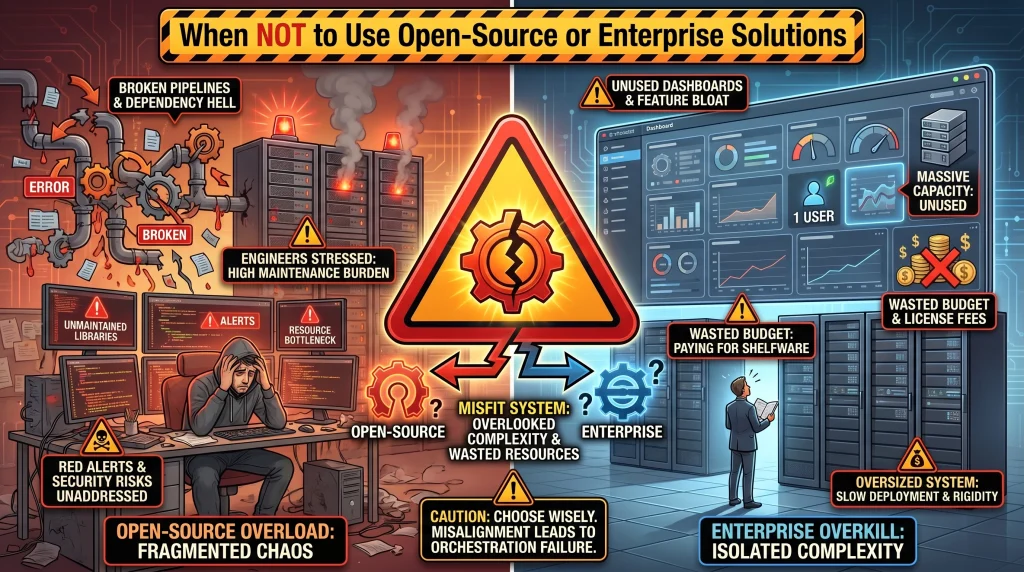
When NOT to Use Open-Source or Enterprise Solutions
Understanding where each option fails is as important as knowing where it succeeds.
1) When Open-Source Becomes a Bottleneck
Open-source orchestration becomes a bottleneck when:
Your team spends more time maintaining the system than building features
You are adding engineers specifically to manage orchestration infrastructure
Debugging agent failures takes longer than resolving the underlying business problem
You need vendor accountability for compliance audits and cannot provide it
At that point, the “free” tool is costing you more than an enterprise license would.
2) When Enterprise Becomes Overkill
Enterprise solutions are overkill when:
You are running internal tools with low traffic and no compliance requirements
Your use case requires orchestration patterns that the platform does not support
Your team has the engineering depth to build and maintain custom systems more cheaply
You are still validating whether the use case is viable at all
Paying for enterprise reliability before you know what you are building is a common early-stage mistake.
3) Contrarian Insight: Why “Free” Can Slow Innovation
Here is something competitors rarely say: open-source orchestration can slow product teams down.
When your engineers are debugging LangGraph state management instead of building new agent capabilities, innovation stalls. The freedom to customize everything becomes the obligation to fix everything. For product-focused teams, that trade-off is often not worth it.
Enterprise tools constrain what you can build, but they free your engineers to actually build it.
## Common Mistakes Teams Make (And How to Avoid Them)
1) Choosing Based Only on Cost
Price is the most visible factor, not the most important one. Teams that choose open-source purely to save money often spend more on engineering time within the first year. Teams that choose enterprise without assessing whether they need the capabilities often pay for features they never use.
The right question is not “what does it cost?”, it is “what does each option cost us, total, over 18 months?”
2) Ignoring Long-Term Scalability Needs
Open-source orchestration that works at 500 agent calls per day may not work at 50,000. Teams that do not plan for this often face a painful migration under time pressure, rebuilding orchestration infrastructure while simultaneously serving production traffic.
Build your decision around where you expect to be in 12–18 months, not where you are today.
3) A Common Failure Pattern Is Underestimating Maintenance
The most consistent mistake in this space: teams build open-source orchestration systems, then treat them as “done.” They are not done. Frameworks like LangChain and LangGraph release frequent updates. LLM API behaviors change. Tool integrations break.
Open-source orchestration requires ongoing maintenance. If your team does not have the capacity to maintain it, the system degrades over time, slowly, then suddenly.
## FAQ of Open-Source vs Enterprise AI Orchestration
1. Is open-source AI orchestration really free?
Open-source tools have no licensing cost, but they are not free to run.
Long-term maintenance often exceeds enterprise licensing costs
Engineering time for setup and maintenance is a real cost
Infrastructure spend increases with scale
2. When should a company choose enterprise AI orchestration?
Enterprise solutions are best when reliability, compliance, and scale are priorities.
Want faster deployment without building and managing infrastructure
Need strong security, audit trails, and compliance certifications
Require SLAs and vendor support
3. Can startups use enterprise AI orchestration tools?
Yes, it depends on the startup’s priorities.
Many startups begin with open-source and migrate to enterprise as they scale
Useful when speed to market matters more than upfront cost
May be expensive at pre-revenue stages
4. What is the biggest risk of open-source AI orchestration?
The biggest risk is operational complexity that grows with scale.
A common failure pattern is agent pipelines breaking under production load in ways not visible during testing
Requires ongoing engineering attention and maintenance
Harder to scale reliably without dedicated infra investment
5. Do enterprise AI orchestration tools limit flexibility?
Yes, and often intentionally.
Trade flexibility for deployment speed, reliability, and built-in compliance
Operate within platform-defined boundaries and abstractions
Reduce the customization space compared to open-source alternatives
## Practical Experience Note
In real-world AI deployments, teams often underestimate how quickly orchestration complexity grows once systems move from testing to production. Common patterns include agent failures under concurrency, increased debugging time, and unexpected infrastructure overhead. These patterns are based on observed behaviour across multi-agent systems rather than theoretical assumptions.
## Conclusion
The open-source vs enterprise decision is not about “free vs paid.” It’s about control vs reliability, and which trade-off your team can actually sustain.
In practice, most teams underestimate how much it costs to run open-source orchestration at production scale, in engineering time, infrastructure, and debugging overhead. And most enterprise evaluations focus too much on features rather than asking: Does my team need what this platform provides, right now?
The best decision starts with an honest assessment of three things: your engineering capacity, your compliance requirements, and where your system will be in 18 months — not today.