Table of Contents
Introduction:
In the growing age of data and technology advancement the more and more application workloads are going to move to various cloud platforms. This moment is based on a public, private, or hybrid cloud (where, in the latter, it appears to be a mixture of public and private).
The sub-branches of data science, like Big Data and Analytics application workloads, are also on the move. But now it is an important point or stage that the data science or engineering community has a good knowledge and understanding of these clouds at a deeper level, so as to make the best and most suitable use of them for doing their analytics work more effectively and efficiently.
What Is Virtualization in the cloud?
Virtualization is the basic technology that powers Cloud Computing. You can say that it is at the core of all modern cloud environments. It is the fundamental cloud infrastructure which enables flexibility, scalability, and efficient resource utilization.
The unit of your technology provides the flexibility, elasticity, ease of management, and scaling in any cloud, which is the virtual machine (VM), that acts as a single entity through the hardware independence and portability that virtual machines offer.
In simple terms:
The Virtualization in the cloud environment means a system which allows multiple virtual systems to run on a single physical machine, which enables efficient resource usage, scalability, and utilization.
Virtualization & the Cloud Infrastructure
Although non-virtualized systems (servers) may be supported in some clouds, which is very rare in practice that a cloud deployment would use this native hardware system approach, and it can become inefficient and unscalable.
No cloud service provider wants to be responsible for buying and setting up new hardware servers when you want to expand your analytics processing cluster or other distributed applications. Doing this kind of setup can take a lot of time.
Only the Virtualization concept is the answer here, because it provides the solution through quickly setting up of virtual machines, as long as the hardware capacity allows for it.
Multi-tenancy on the cloud system is also achieved through the virtualization process. This means two tenant workloads may share the common servers but are separated through their encapsulation by using virtual machines methodologies.
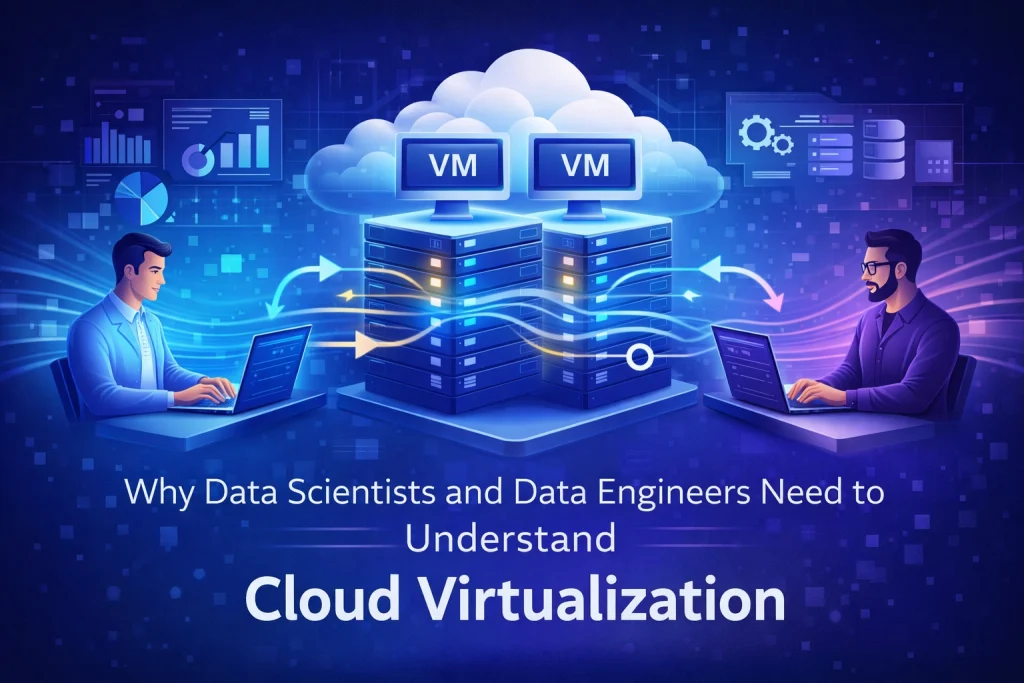
Why Traditional Infrastructure Is No Longer Enough
Data scientists and data engineers are familiar with running their data processing and analysis work on non-virtualized or physical environments.
But now, in the recent time the unexpected growth in cloud infrastructure, so these professionals must now understand about the virtualized environments, as they directly control workloads.
Key limitation of traditional systems:
- Fixed capacity
- Slow provisioning
- Inefficient scaling
- High hardware dependency
Industry Trend Toward Cloud-Based Data Platforms
Many data science and engineering workloads which are based on Hadoop and Spark platforms in today’s time, with Python, Scala, R, Java, or others as programming environments which operate on them.
Here, we see there is strong growth in deploying these platforms to cloud environments.
Examples include:
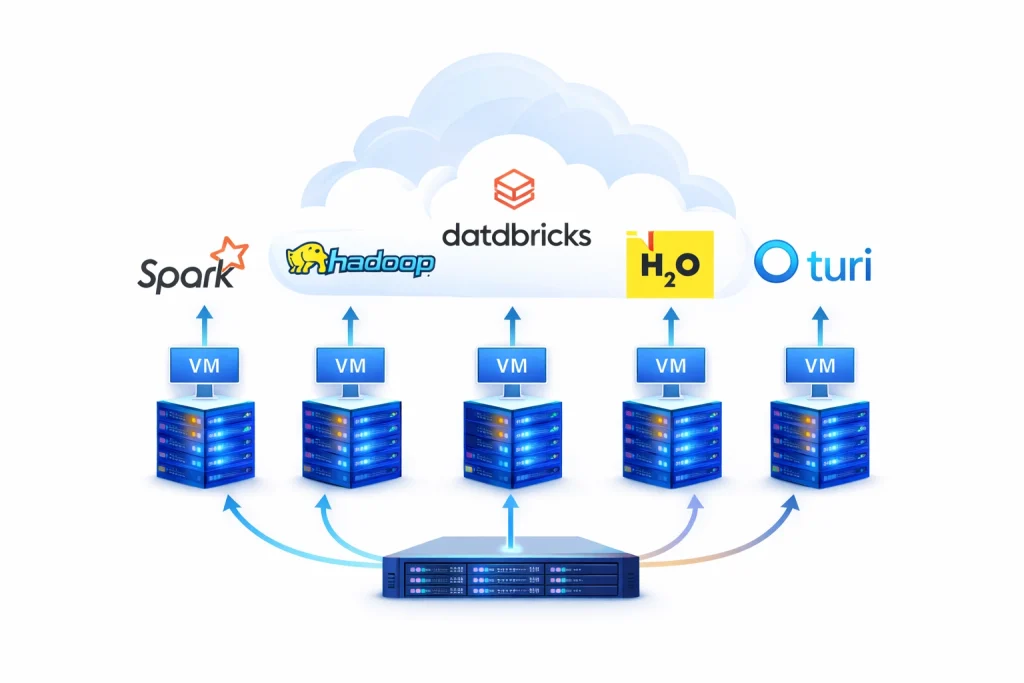
- Databricks is deploying Spark primarily on the public cloud but also suitable for the private cloud too.
- Hadoop distributors like Cloudera, Hortonworks, and MapR are offering cloud deployment tools for the deployment process on both public and clouds.
- Machine learning platforms like H2O and Turi are delivering as SaaS-based analytics
We see many smaller software-based companies now deploy their big data products directly to the cloud rather than traditional infrastructure.
Performance Myths vs Reality
There was an early misconception about Virtualization that virtualization would slow big data workloads in this way.
However:
- Performance is comparable to bare metal
- Properly configured virtualized systems which can be equally efficient
- Scalability often improves overall performance
This has accelerated completely cloud adoption significantly.
Speaking the Language of Cloud Infrastructure
Business managers ask from their data science teams to answer critical business questions.
Data scientists depend on data engineers for:
- Data integration
- Cleansing
- Indexing
- Management of data so that it is suitably organized for their queries.
Queries include: These queries include questions in different formats about fraud detection, customer pattern analysis, product feature use, sentiment analysis, product quality or many other business areas.
Data science teams are made up of different types of people with a variety of skills, including analytics and statistical processing, data cleansing, data integration, and SQL/programming ability, which are essential skills for data engineers. Data scientists and data engineers are often not involved in choosing or managing the infrastructure supporting their applications, but they naturally want to get the highest level of flexibility and the best performance from their applications. However, infrastructure decisions are often handled separately.
It is highly advantageous when data scientists can communicate with the infrastructure teams about:
- Virtual CPU allocation
- Memory optimization
- Cluster architecture
This alignment leads to better system performance and cost efficiency.

Iteration and Dynamic Workloads in Data Science
Data scientists often need to loop multiple times on analytical problems.
They:
- Refine queries
- Adjust datasets
- Scale compute resources
This creates unpredictable infrastructure demand. That’s why Virtualization supports this by enabling:
- Rapid scaling up or down
- Flexible resource allocation
- On-demand compute environments
System Services and Flexibility Needs
The tools used by data scientists vary widely:
- Dashboards
- Notebooks
- SQL engines
- Python and Scala applications
This diversity requires a flexible infrastructure.
Data scientists need:
- Scalable compute
- High-performance storage
- On-demand availability
Virtualization provides this adaptability.
Resource Management and Team Efficiency
Managing multiple data science teams can be complex. Leaders like the Chief Data Officer (CDO) must balance:
- Compute usage
- Team priorities
- Infrastructure costs
Virtualization helps by:
- Pooling resources
- Allocating dynamically
- Avoiding idle infrastructure
Multiple Changing Factors in Big Data
In big data, one infrastructure does not fit all needs.
At the Hadoop level:
- Some workloads are batch-oriented
- Others require real-time processing (e.g., Spark)
Organizations often run:
- Multiple versions
- Multiple distributions
- Different configurations simultaneously
Virtualization allows all of these to coexist efficiently.
Key variables include:
- Changing business questions
- Rapidly evolving tools
- Multiple software versions
- Shared data across teams
- Different performance requirements
The Cloud Virtualization Efficiency Framework
To understand how virtualization delivers value, consider this framework:
- Resource Abstraction Layer
- Separates hardware from workloads, enabling flexibility
- Elastic Compute Layer
- Allows dynamic scaling of processing power
- Workload Isolation Layer
- Ensures performance and security between teams
- Optimization Layer
- Improves cost efficiency and performance tuning
This framework helps organizations align infrastructure with analytics demands.
Comparison: Virtualized vs Non-Virtualized Infrastructure
| Feature | Virtualized Cloud | Bare Metal |
| Scalability | High | Low |
| Provisioning Speed | Instant | Slow |
| Cost Efficiency | Optimized | Expensive |
| Flexibility | Dynamic | Fixed |
| Multi-tenancy | Supported | Limited |
Summary in simple terms about Virtualization:
- Virtualization is the foundation of modern cloud computing
- It enables scalability, flexibility, and efficiency
- Data scientists must understand infrastructure to optimize performance
- Cloud platforms are now the default for big data workloads
- Virtualization eliminates many limitations of traditional systems
Virtualization FAQs
1) What does virtualization mean in cloud computing?
Virtualization refers to the process of creating virtual versions of physical resources like servers, which allows multiple virtual machines to run on a single system, improving efficiency and scalability.
2) Why virtualization is important for data scientists?
Virtualization is important for data scientists because it exactly provide the ability to data professional and enables scalable computing, faster experimentation, and practical and efficient handling of large datasets, which are essential for modern data science workflows in the fast growing advanced and modern age.
3) Does virtualization reduce performance?
Virtualization does not reduce performance, but new virtualization provides performance instead of a bare metal mean (non-virtualized system), especially when properly configured for big data workflow.
4) What is the main difference between virtual machines and containers?
The main difference between virtual machines and containers is that Virtual machines follow the entire systems, while the containers share the host OS and are also it have slower performance. Both are used in cloud environments for different use cases based on their needs.
5) How does virtualization support big data platforms?
Virtualization supports big data platforms by the following method “it allowing the distributed systems like Hadoop and Spark to scale dynamically and run multiple configurations at the same time without have any problem.”
6) Should data engineers learn cloud infrastructure?
Yes, data engineers learn about cloud infrastructure, because understanding about cloud infrastructure will help them to optimize data pipelines correctly, improve the performance, and reduce costs as much as possible.
7) What is multi-tenancy in cloud computing?
Multi-tenancy in cloud computing means multiple users or organizations sharing the same infrastructure while remaining isolated through virtualization.
8) Is cloud virtualization expensive?
It is generally more cost-effective than traditional infrastructure because it optimizes resource usage and reduces hardware needs.
Conclusion
Virtualization in the cloud environment is no longer just an optional and infrastructure concept for data scientists and data engineers, but it is a foundational skill which directly impacts how data science and data engineering teams operate. As data workloads grow it become more complex and dynamic, that’s why the understanding about how virtualized infrastructure operates becomes critical for performance, scalability, and cost optimization.
Teams which are bridge the gap between data science and infrastructure gain a significant and competitive advantage. The ability to scale resources, isolate workloads, and optimize performance in real time directly impacts the success of analytics initiatives very efficiently.
The next step is clear: move beyond using the cloud as a tool and start understanding it as a system.
Quiz: test what you learned